





The Perfect Health Diet
Here’s our Perfect Health Diet food plate:
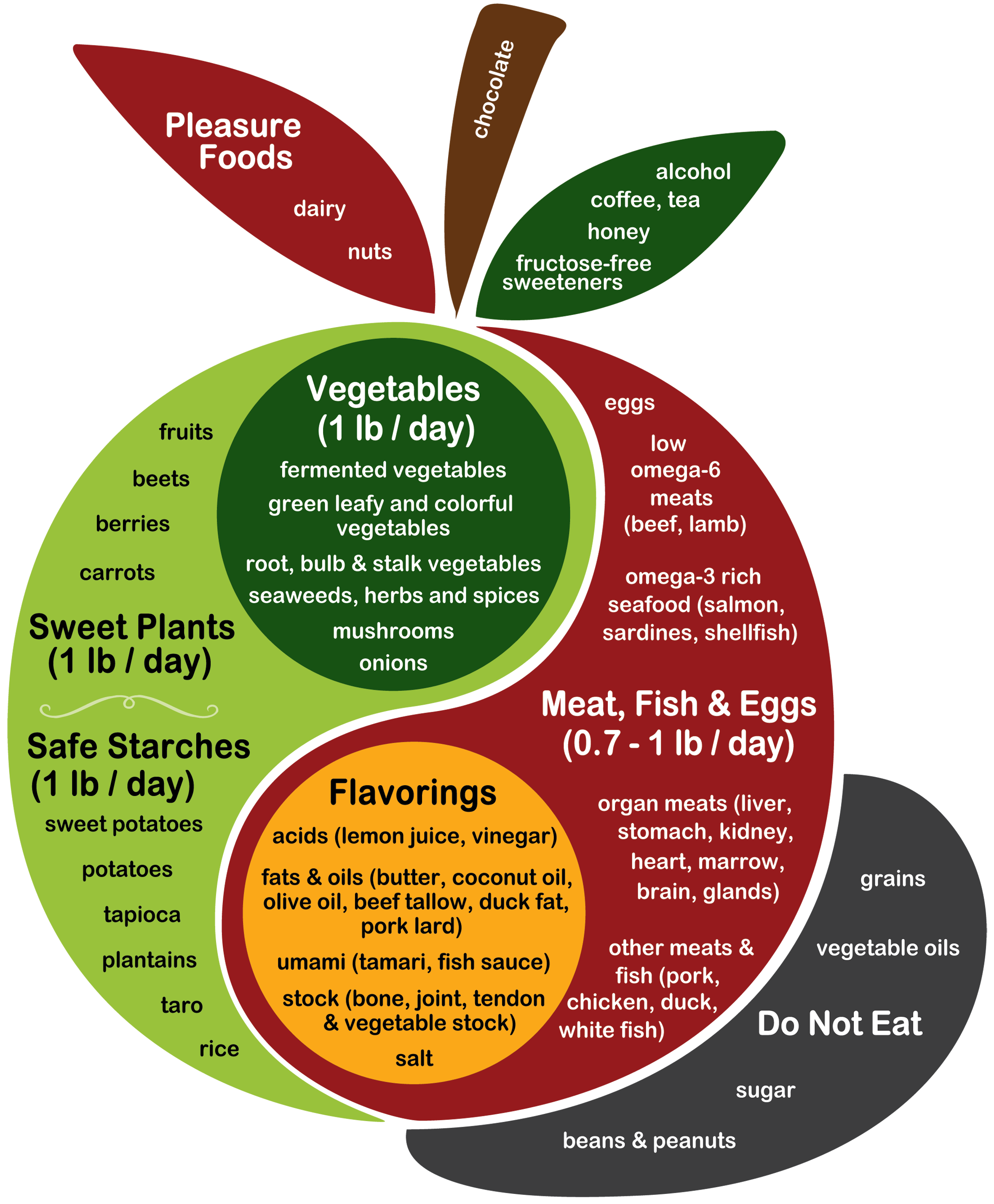
NOTE: This is our new food plate, updated 2015. Foreign translations of the original food plate may be found here.
We recommend:
- About 3 pounds [1.4 kg] of plant foods per day, including:
- About 1 pound [0.45 kg] of safe starches, such as white rice, potatoes, sweet potatoes, and taro;
- About 1 pound [0.45 kg] of sugary in-ground vegetables (such as beets or carrots), fruits, and berries;
- Low-calorie vegetables to taste, including fermented vegetables and green leafy vegetables.
- One-half to one pound [0.25 to 0.5 kg] per day of meat or fish, which should include organ meats, and should be drawn primarily from:
- ruminants (beef, lamb, goat);
- birds (especially duck and wild or naturally raised birds);
- Shellfish and freshwater and marine fish.
- Low omega-6 fats and oils from animal or tropical plant sources, to taste. Good sources include:
- butter, sour cream, beef tallow, duck fat;
- coconut milk or oil
- palm oil, palm kernel oil, olive oil, avocado oil, macadamia nut butter, almond butter, cashew butter
- Acids to taste, especially citric acid (lemon juice, lime juice, orange juice, grapefruit juice), lactic acid from fermented or pickled vegetables, vinegars, tannic acids from wine, and tomatoes.
- Broths or stocks made from animal bones and joints.
- Snacks or desserts from our pleasure foods: fruits and berries, nuts, alcohol, chocolate, cream, and fructose-free sweeteners like dextrose or rice syrup.
By weight, the diet works out to about 3/4 plant foods, 1/4 animal foods. By calories, it works out to about 600 carb calories, primarily from starches; around 300 protein calories; and fats supply a majority (50-60%) of daily calories.
In the shadow of the apple are foods forbidden because of their high toxin content. Notably:
- Do not eat cereal grains — wheat, barley, oats, corn — or foods made from them — bread, pasta, breakfast cereals, oatmeal. The exception is white rice, which we count among our “safe starches.” Rice noodles, rice crackers, and the like are fine, as are gluten-free foods made from a mix of rice flour, potato starch, and tapioca starch.
- Do not eat calorie-rich legumes. Peas and green beans are fine. Soy and peanuts should be absolutely excluded. Beans might be acceptable with suitable preparation, but we recommend avoiding them.
- Do not eat foods with added sugar or high-fructose corn syrup. Do not drink anything that contains sugar: healthy drinks are water, tea, and coffee.
- Polyunsaturated fats should be a small fraction of the diet (~4% of total calories). To achieve this, do not eat seed oils such as soybean oil, corn oil, safflower oil, sunflower oil, canola oil, or the like.
We highly recommend certain foods for their micronutrients. These include liver, kidney, egg yolks, seaweeds, shellfish, fermented vegetables, and bone broths.
We also recommend augmenting the diet with certain supplements. See our Supplement Recommendations page. These nutrients are deficient in modern diets due to removal of minerals from drinking water by treatment, depletion of minerals from soil by agriculture, or modern lifestyles that deprive us of vitamin D by indoor living.
We recommend tweaking the diet for certain diseases. Neurological disorders often benefit from a diet that is ketogenic; other conditions may benefit from lower carb diets. These variations are discussed in the book:
See the “Buy the Book” page for other purchase options.



 via this link:

Hello Paul,
I’m convinced that your PHD is the best diet out there. However, I choose to be vegetarian for moral and religious/spiritual reasons. What would a vegetarian version of PHD look like? And would such a diet mean a large sacrifice in terms of health, compared to the normal diet?
Thanks in advance,
Eric
I eat a lacto-vegetarian diet myself, I’m not fully convinced about macro ratios but a lacto-vegetarian diet can supply every macro and micronutrient quite easily. I recall Paul saying he’s not really pro or anti dairy, but funnily enough the macros of the PHD are very similar to whole milk and Paul even commented on this before.
I don’t think he ever said it was similar to whole milk. He said it was similar to breast milk. From a Weston Price review of the book.
“ The Jaminets believe that our Paleolithic ancestors ate a range of 5-35 percent carb, 50-70 percent fat, and 15-25 percent protein.
These ratios are similar to those obtained from human breast milk, after adjusting for the excess of carbohydrate provided for the infant’s growing brain, and are similar to the composition of the human body.”
Cheers,
Peter
That must be the quote, although the PHD macros actually seem closer to whole cow’s milk compared to human breast milk, which is very low in protein and higher in carbs. I’m still not really convinced on any macro ratios personally, we seem to be able to survive on a vast range, what is optimal I don’t know.
Hi Paul,
I’ve been following your diet for nearly six years, and it’s made a real difference in my life-thank you for that.
I wanted to get your thoughts on a concerning trend: the rising rates of colorectal cancer among people under 40. There seems to be limited research on the causes, but diet often comes up- particularly low fibre intake and high-protein diets- alongside other environmental factors. Do you have any insights on this trend?
Hi Munty,
It’s most likely due to the Covid vaccines.
Best, Paul
I have the exact same question!
I can only give you my personal experience as I follow the PHD for a year now as a vegetarian (also ethical – I’m buddhist).
I eat more cheese – focus on raw milk, grass-feeded.
Include eggs since half a year – as an ethical decision – today there dies no male chicken for it anymore.
My health tremendously improved.
I take all of the recommended supps, too.
Last issue which is recovering at the moment is pain in the aches which is getting very better right now.
Other changes I made:
– take algae omega 3 oil (look for good quality, means low totox-values)
– add glycin regulary
Best,
Johannes
Buddha EXPLICITLY forbade his followers to be vegetarians.
No, as far as I know it‘s the other way round. I think he said eating flesh would be similar to eating your brother. As we all are sentient beings.
But I think its a personal/intimate decision which shouldn‘t be discussed. I will not engage in any religious argument.
Best,
Johannes
I completely agree that PHD is the best eating plan. (for Perfect Health!) As a 68 yr old woman, I have a few extra pounds that I struggle to lose. I would love to see an Apple graphic that shows recommendations for weight loss. Almost every day I find myself staring at the graphic to determine where & how much I should decrease to reduce intake and still maintain the correct nutrient panel. Paul, can you help? Or anyone who has suggestions with actual food items & amounts for weight loss? Thanks so much.
Hey Paul,
I have a question about which vegetables to eat every day and the variety of plant-based foods you mentioned.
My primary vegetable sources are cauliflower, broccoli, cucumbers, carrots, kale, peppers, onions and mushrooms.
Do you think that because of the toxicity and toxins it contains, it is better to consume 450g of a single vegetable (e.g. only 450g of broccoli and the following day only 450g of cucumbers) per day (so that there are more days in between until I eat a certain vegetable again) or of each vegetable daily to consume only a small amount (e.g. 100g carrots and 100g broccoli and 100g cucumbers…) but to eat the same vegetables in small quantities every day. So my question is whether by variety of vegetables you mean that you should eat a different type of vegetable every day or many different types of vegetables in small quantities every day. And is it harmful if I simmer the vegetables in a little butter and cream, since cream should actually be consumed as a luxury food?
And if I alternate between white rice and white potatoes every day, is that enough variety for my safe starches or should I introduce sweet potatoes and other safe starches?
And is it harmful if I eat 500ml of bone broth every day and add tomatoes and spinach to it? So could the toxins found in tomatoes and spinach cause problems if I consumed small amounts of them every day?
Thanks in advance.
Best regards
Marvin
Hi Marvin,
I guess I would prioritize:
– Mushrooms
– Onions and garlic
– Tomatoes
– Carrots
– Green leafy vegetables
– Cruciferous vegetables
– Sweet peppers, small amounts of spicy peppers
As far as how vegetables are distributed, I don’t think it matters. Some should be raw (eg sweet peppers) and some are better cooked. It is good to make stews and soups and put plenty of vegetables in there.
Yes, I think it’s fine to alternate between rice and what potatoes and let those be staple starches.
No, there’s no problem to eating tomatoes and spinach daily in modest quantities.
Best, Paul
Hello Paul,
many thanks for your response. I really appreciate your answers, your book and your blog posts and I am spreading your book to everyone I know. I can’t thank you enough for everything. I wish you and your family continued God’s blessings and good luck in your cancer research. I follow the posts on your website Angiex with great pleasure and hope that this can help many people in the future. I hope people recognize the service you have provided and will continue to provide for them through your work.
Best Regards
Marvin
Dear Paul,
does it make a difference whether you buy frozen vegetables or fresh vegetables?
Can nutrients be lost through freezing?
I find frozen vegetables very practical.
Best Regards
Marvin
my go to list
In the book you recommend strength training once a week. Do you belive it is possible to gain strength and or also build muscle training once a weekol or really it’s about maintenance. Thanks in advanced
Hi Paul,
You replied in a one-off comment somewhere years ago (I can’t find it now): “Bad to worse: Oats<beans<corn<sugar<wheat<vegetable oil." Does this still hold true today? . . . Maybe beans would be least bad with suitable preparation? Oats (which I do like from time-to-time) you gave a grade of "D" in the book. Sugar is interesting as you still recommend we eat a bit for blood sugar control (at most 25g fructose/day). And you recommend eggs (which have tons of nutrition) despite having a fairly high PUFA content.
Thank you,
Pat
Hi Pat,
Great question. Yes, I think beans are fine with good preparation (soups/stews, hours at simmer). Oats are fine as an occasional food, I would not have them as a daily staple. Sugar is OK in moderation, eg a teaspoon of honey or added sugar per day on top of 3 servings of fruits and berries. Wheat I think most people can treat similar to oats but there are more questions about it and more potential for food sensitivity/allergy or autoimmunity, so everyone should try removing it periodically and see if they feel better. I eat wheat when traveling but generally confine myself to rice and potatoes at home, plus occasionally well cooked beans. Vegetable oil, I think this is best avoided. Yes, eggs are a nutritional powerhouse and should definitely be eaten. They do have significant PUFA, and 3-4 eggs per day will meet all your needs for omega-6, so you should generally avoid any omega-6 containing oil. Even olive oil I would consider inferior in this regard, I try to eat olives for their beneficial polyphenols and use butter/sour cream for fats.
Best, Paul
Hi Paul,
I wasn’t expecting your somewhat leniency towards wheat. Just trying to drill down what will dramatically hasten an early demise as I realize no diet will make me live forever. Avoiding seed oils, peanuts, and soy completely along with your subtle nuances concerning the foods above should be preventative. Any other foods you consider verboten? I appreciate your work because I always learn something new reading this blog.
Pat
Hi Pat,
It’s hard to have a firm scientific basis for absolutely excluding commonly eaten foods. If they were obviously or acutely toxic, they wouldn’t have become common foods in traditional diets. I think we can reasonably forbid anything that wasn’t available as a food 200 years ago, eg processed foods (this is the Paleo concept). Then we can be aware of the toxins in traditional foods, but then “the dose makes the poison” and the question becomes what level of intake is safe vs harmful. The exception to “the dose makes the poison” is allergy or autoimmunity, in which case even small doses can be quite harmful. But not everyone will react the same way. Wheat I would put in the class of, avoid entirely if you have reason to believe it excites immune activity, or keep the dose low if you don’t.
I strongly recommend circadian rhythm entrainment, which has a huge impact on longevity and is especially important to tend to as we age. Also some close attention to commonly deficient nutrients like magnesium, iodine, zinc, copper, calcium. But even something commonly abundant like salt can become deficient on individual diets, so it is good to have an awareness of nutritional needs and compare your intake to optimal intake.
I think the field of anti-aging nutrients and practices is a fertile opportunity for health improvement, but the research basis for many interventions is still young.
Thanks for the compliments. I hope to begin blogging again soon, mostly about our cancer company which is now in the clinic with our lead drug, but there should be opportunity to blog on natural health topics too.
Best, Paul
Might one with prostate cancer benefit from your drug?
Is it too early for the general public ?
Or not applicable to prostate cancer?
Hi Edward,
Yes, the drug may be of value in all solid cancers including prostate cancer. It is in Phase 1 clinical trials, so to be eligible patients have to have late stage advanced metastatic cancer and have failed or refused all approved therapies.
Best, Paul
Hi Paul, I honestly believe this diet has saved my health and hopefully added years to my life. I am though, probably like most, keen to understand if there are any revisions to the diet or any other information in the book as it has been some years since there has been a significant update.
Thanks for your hard work and for sharing this wonderful resource with the world.
Long time reader of PHD. I have followed the recommendations in a broader sense for years. Finally to a place where I can try using these guidelines to lose weight. I am over hundred pounds overweight. Trying to get the proportions right but I need some help. I’ve been told I must eat enough protein for my current weight. In order to do that I would throw off the recommended ratios. Do I just go with the average person ratios? Am I likely to lose muscle as I lose weight? So appreciate any help from Paul or anyone who knows the answer. Thanks
Hi Leigh,
For protein, and macronutrients generally, I would follow appetite: eat what looks good to you, don’t eat what repels you.
Keys for weight loss are (1) keep omega-6 fats down, (2) balanced nourishing natural whole foods diet, (3) circadian rhythm entrainment (light and exercise in the day, rest in a 12-hour night), (4) time-restricted feeding with food intake in the morning or mid-day as much as possible.
Best, Paul
Hello Paul,
I have noticed that I react negatively to fermented milk products such as sour cream, yogurt and cheese. Also on sauerkraut. But I really enjoy eating cheese and sour cream. I get itchy and sore spots on my hands, and then I’m completely dizzy and drugged. I also get very tired and have strange thoughts and anxiety. Do you have an idea what that could be? Is my intestine perhaps damaged and am I therefore reacting negatively to the added bacteria? I also develop eczema around my eyes and around my nose. I don’t want to give up dairy products. I don’t have such severe reactions to cream and fresh milk, except for itching and facial redness.
Best regards
Marvin
It sounds like it might be histamine intolerance. I get an overlapping set of symptoms from histamine intolerance myself. There are different causes of it but it does usually come down to an issue with intestinal biota.
Can I use beef and lamb as my main source of protein every day or will they give me an excess of iron? I do weight training and therefore pay attention to a slightly increased protein intake and ate 500g of roast beef every day for a while. Or should I use lean chicken meat because of the high iron content and replace the missing fat in the lean meat with butter? I don’t want to use fish as my main daily source of protein because of the omega-3 fatty acids.
Paul thanks for everything over the years. I would love to hear your thoughts on the topic of micro plastics, and any information on it’s affects on our health. Happy holidays!
Paul,
I have a question regarding the food reward system and organ meats.
I regularly eat liver and other organ meats from grass fed and wild animals. While I enjoy them and appreciate their nourishing effects, I don’t get the same satisfying feeling and mood boost that I get from say a ribeye. And despite enjoying them, I don’t look forward to the next ‘liver day’.
I am not alone. It seems most people do not enjoy liver, or find it palatable.
Which leads me back to my question:
If organ meats like liver are so healthy, why does the food reward system not encourage us to eat more of them?
Is the liver a detox organ that processes and stores toxins? If so, maybe that’s why we don’t like the taste of it. Maybe a detox organ is bad for us because it’s full of toxins. Liver to me is more like a garbage disposal. We have to learn to trust our body.
Hi Anna,
The liver doesn’t store toxins, it excretes them in feces.
Best, Paul
“we don’t like the taste of it”
who is we? so many people love liver somehow, delicacy in many places, while some are extremely disgusted by it. strange phenomenon.
The taste depends very strongly on how it is prepared. Most people don’t like the blood and other contaminants that are on it if you just cook and eat straight out of the store (or animal).
I measured my blood pressure today. I have been following the PHD for almost a year now. I am very muscular and have a very low body fat percentage. My systolic values are generally elevated and differ greatly between both upper arms. I read that deviations of more than 10 indicate arterial occlusive disease. What can I do to lower my blood pressure? I am very worried. Best wishes
Hi Marius,
What is your blood pressure? We generally had very good results with blood pressure at our retreats, and mine is between 100/60 and 110/70.
High brachial pulse pressure can be an indication of diabetes. Do you have diabetes or metabolic syndrome? Are you low carb?
Some things that are usually helpful are a balanced diet, circadian rhythm entrainment, and supplemental magnesium.
Best, Paul
Dear Paul, yesterday I measured five different values in five consecutive measurements on my right upper arm:
1. 140 systolic, 80 diastolic, 84 pulse
2. 150 systolic, 68 diastolic, 95 pulse
3. 146 systolic, 73 diastolic, 79 pulse
4. 175 systolic, 65 diastolic, 83 pulse
5. 151 systolic, 65 diastolic, 82 pulse
I took two measurements on my left upper arm:
1. 123 systolic, 74 diastolic, 81 pulse
2. 124 systolic, 74 diastolic, 84 pulse
I used a brand new measuring device. And tried to measure as accurately as possible.
My fasting blood sugar is between 100 and 110. After meals, it sometimes even rises above 140. But not always. I don’t have diagnosed diabetes. And I don’t have diagnosed metabolic syndrome either. I’m very muscular and athletic. I have a lot of stamina and do very intensive bodyweight exercise. Mainly push-ups, squats and pull-ups.
At the beginning, I had a very low-carb and particularly high-fat diet. But since I do a lot of exercise and they recommended increasing the carbohydrates in that case, I consumed more safe starches. I would say that I’m currently eating more carbohydrates again. And I’ve now reduced my fat consumption. Can I continue to eat saturated fat or is that dangerous in my case? I’m worried that my arteries are clogged. I’m turning 38. Best wishes
I have read so much contradictory information. In your book you have explained in detail why saturated fat is safe and good for your health. I am enthusiastic about your work and I believe you. Yet you read everywhere that saturated fat increases blood pressure, clogs arteries and causes heart disease. And it is precisely when you notice irregularities in yourself that you are particularly unsettled and run the risk of going down the wrong track. I trust you as a scientist but, what is even more important to me, I trust you as a human being. You believe in God and act out of charity. But I am not a scientist, I cannot evaluate and analyze studies and distinguish between truth and untruth. I have prayed to God to help me find the truth. And I do not believe that it is a coincidence that I came across you and your work after a long search. But my blood pressure is unsettling me. I do not want to have a stroke or a heart attack. I am simply very worried.
Hi Marius, not a physician and haven’t been on this website since around 2014 or so! My advice: see a physician. Don’t mess around too long looking for advice on the internet. Find a good doctor and shop around if you have to. Have you had a complete lipid panel and bloodwork done? If you have familial hypercholesterolemia for instance you need to get that under control ASAP. Your blood pressure elevation might be a measurement artifact, or something simple to treat, or a sign of something more serious that needs professional attention. Don’t spend a lot of time overthinking this on the internet/ go to a good primary doc or cardiologist and get this figured out.
Best wishes,
Chris
Hey Paul, which protein source would you prefer when doing weight training? Fish, beef or chicken? In an old comment of yours I read that more than half a pound of red meat a day could lead to an iron surplus. So would it be possible to eat 225g of red meat a day and also eat some salmon every day to increase the protein a little? And which fish should I use? Firstly because of the contamination of the fish and secondly so that I don’t have a problem with too much Omega 3? You actually only recommended salmon once a week? Best wishes
I’ve been reading “How not to Die” and receiving Facebook posts from nutritionfacts.org. Their views are almost diametrically opposed to PHD and whatever Dr. Greger says, he backs up with studies from medical journals/PubMed. I’m quite confused as you both make good points and back them up with research. How can you both be right?
Hi Paul, would you ever consider a role like this in government?
https://www.mahanow.org/nominees-for-the-people
Not at the moment, but at the right time and if I trusted the people in power, yes.
I’m happy to hear this, Paul. Even though your and Shou-Ching’s voices aren’t loud, their impact over the years has been far-reaching and profound. Something tells me the best is yet to come.
Hi Paul.
I was just wondering where tiger nuts would be on the food palate? Sweet plants or safe starches? I am intending consuming around 50g per day and just wondered if I should count them as part of my starches or sugary in ground plants? Thank you for any advice, it is much appreciated.
Best wishes,
Mark.
Hey, I’ve gotten a little closer to the cause of my problems in the last few months. I can say with absolute certainty that I react negatively to almost all foods I eat. Sometimes very severely, sometimes less severely. But I don’t have bloody diarrhea or diarrhea several times a day, so I hope I don’t already have a chronic inflammatory bowel disease like Crohn’s disease or ulcerative colitis. When I eat dairy products, I get swollen nipples (hormonal disorders) and I’m so foggy and stoned that I can’t interact with anyone. When I eat cheese, it’s particularly bad. But I also react to cream or butter or ghee. When I eat boiled egg yolk, my face turns red and I get dry, cracked patches on the back of my hands and forearms, as well as pressure in my head. When I eat chicken breast, I react with diarrhea and stomach pain. The reactions sometimes occur several hours after I’ve eaten something or the next day. The only thing I seem to be able to tolerate is beef and potatoes. I am absolutely certain that I have a problem with my gut. I have systematically documented everything over the last few months and because I react to almost everything, it was so difficult for me to identify a specific culprit. Because there was none. When I eat bone broth, my face flushes and my ears turn bright red and hot and I am completely foggy again. I am wondering what I can do in my situation. I react to foods that are actually healthy because something is wrong with my gut. Should I still consume them and hope that my gut slowly heals? Even though I then suffer from severe symptoms? On the other hand, I don’t know what I can eat anymore. I have done food allergy tests, all of which have been negative. Since I am still young and don’t want to develop an autoimmune disease due to my leaky gut, I urgently ask anyone who has a suggestion on how I could heal my gut to help me. I have asked a lot of questions in the last few months because I am desperate and have considered everything and I would like to apologize again for that. Best regards, Marvin
Marvin,
I would suggest you stick with beef and potatoes for a few weeks to a month, start there. Let your system calm down for a bit. I suggest you trial a few supplements if you can, and research them too: I suggest butyrate, a probiotic powder from the brand youtheory, and a multivitamin to start with. These should jumpstart you a bit. I also suggest trying the liquid from saurkraut if you can’t stomach the cabbage itself. If not that, perhaps a coconut yogurt but you have to get the probiotics in somehow.
Best,
Jas
Marvin I had some of these same problems. Firstly look in to meat broth instead of bone broth. Home broth is high histamines and causes me tons of problems. Secondly have you considered a parasite cleanse? I reacted horrible to most foods and did a cellcore cleanse (it is al herbs and binders) and 80% of my issues left. Consider it. You need a dr or Chiro or functional med Dr to order for you . I have a physician in my family so I’m happy to have him order for you if need be. Are you doing anything for gut health to replace the healthy flora? Most probiotics are dead (google how to test with milk) that you buy in store. Klaire labs probiotics are the best I’ve found. Butyrate from “body bio” is my go to. Also for inflammation perhaps look in to fermented skate oil from green pastures website. . It helps me a lot. I ALSO take shark liver oil for over all immunity.
I’m so sorry you are having so many issues. I hope this helps a bit. I will add that I’m investigating Dr makis research on parasites study of being destroyed by ivermectin and fenbendozole. Google that.
Sorry that should say BONE broth has high histamines not none broth
Hi Paul,
I have a question about dairy. For some reason whenever I eat any form of dairy it trickers my migraines, although the allergy tests I’ve taken say that I tolarate it.
I would love to be able to eat dairy, but as soon as I have some I get a migraine aura, followed by a migraine headache. I’ve also taken histamine tests, and show no sign of intolerance. I have celiac disease, though.
Is there anyway I could eat dairy? Any way to arrange my diet so that I could include it?
Anything I need to cut out that perhaps make them worse? I’m thinking eating low-sugar might help.
I would be immesly thankful for your input. I can’t seem to find anyone that can explain this, not even my doctor.
Hi Alisa, The immune system is very complex, and we don’t have lab tests for all the ways it can become sensitive to something. Generally if your immune system reacts to something you have to avoid it. However, fermentation will often remove the problem (so yogurt or sour cream or cheese may be possible), and sometimes people are sensitive to dairy from certain cows but not others, you can read about that here: https://www.healthline.com/nutrition/a1-vs-a2-milk. Also dairy with the proteins removed, as in ghee, can be tolerated when others are not.
Best, Paul
Thank you so much for the reply!
I’ll experiment with these different things and see if it makes a difference.
… I also have Menieres disease and eating dairy seem to make that worse too… I don’t understand how though, since I’m not allergic.
Hello
I am new to the PHD and getting started slowly as I just finished your book.
I am a little confused by the B50 complex weekly supplementation. This complex contains folic acid and earlier in the book there is a link to folic acid and prostate cancer.
Should I take this complex knowing the risk?
Thank you
Derek
Hi Derek,
It’s not necessary to take it, particularly if you eat eggs, seafood, liver once a week, and diverse vegetables. I no longer take it myself.
Best, Paul
Hi Paul,
We would be in your (further) debt, if you could please update the supplements page very soon!
Thanks and Happy 2025,
Jill
Hi Paul. I just have a quick question in regards to vitamin e. I’m struggling to find food sources which provide decent amounts, as it looks like vegetable oils, nuts and seeds are best sources (and I eat none of those) It seems to me to be a puzzling vitamin and I don’t know where our early ancestors would have got the rda from if I’m honest. I thought with it being a fat soluble vitamin it would be high in animal fats, but apparently not! I therefore just wanted to ask your thoughts on cold pressed wheat germ oil as a source? Not a natural source, I know, but it’s very high in this elusive vitamin. Thanks for your thoughts,
Best, Mark.
Red palm oil.
Just wondering why onions are not in the sweet plants section of the revised apple, when they are listed as an example of such on page 101 in the book under ‘healthful sugary plants’? Also, even after reading about ignoring vegetables when counting carb calories (because of the 40 calories used in digestion etc.) I’m still not sure whether or not I count the sugary vegetables listed, or ignore all veg?
Thank you for any clarification and apologies for not entirely understanding 🫤
Best,
Mark.
Hi Paul, I’ve been reading about the Adventist Health Studies (AHS 1 & 2) conducted by Loma Linda University, and wanted to bring them up for discussion here as the findings seem quite interesting when considered alongside PHD principles.
Quick Background on AHS:
These are large, long-term observational studies following tens of thousands of Seventh-day Adventists. This group is unique because they generally share healthy lifestyle habits (low smoking/alcohol) but have diverse dietary patterns ranging from vegan and lacto-ovo vegetarian to pesco-vegetarian and non-vegetarian. This allows researchers to isolate diet effects more easily than in the general population.
Key Findings often Highlighted:
The AHS studies consistently report significant health advantages for vegetarians within their cohorts compared to non-vegetarians:
– Lower All-Cause Mortality: Vegetarians tend to live longer. Pesco-vegetarians sometimes showed the lowest risk in some analyses.
– Reduced Risk of Chronic Diseases: Vegetarians (especially vegans) generally had lower rates of type 2 diabetes, hypertension, high cholesterol, and obesity (lower BMI).
– Cardiovascular Benefits: Lower rates of heart disease were observed in vegetarian groups.
– Cancer: Some findings suggest lower overall cancer risk for vegetarians compared to non-vegetarians in the cohort, with specific benefits noted (e.g., colorectal for pesco-vegetarians).
The Question for Discussion:
On the surface, these findings appear to strongly favor purely vegetarian (vegan, lacto-ovo, pesco) diets for longevity and preventing major chronic diseases, seemingly more so than the omnivorous patterns studied within the Adventist cohorts (which would be the closest comparison group available in AHS to a diet including meat).
This raises interesting questions in the context of the Perfect Health Diet, which emphasizes a nutrient-dense, plant-rich omnivorous approach, including specific animal foods while often cautioning against certain plant components like excess grains or legumes (which might feature more heavily in some vegetarian AHS diets).
I’m really curious to hear your thoughts on interpreting these influential studies.
Erik
Hi Erik,
It’s certainly a good topic. My thoughts ten years ago on reviewing these studies were (1) the pesco-vegetarians did better than the vegetarians so some animal foods must be good, (2) vegetarian diets tend to be more natural whole foods and less ultraprocessed, which is very favorable, (3) some lifestyle aspects (such as living in sunny Loma Linda) are favorable in these studies relative to other populations, (4) other studies have found that people who reported being vegetarian tend to eat meat regularly, so it is not clear that true vegetarianism is well supported by these studies, and (5) avoidance of meat may bias toward eggs and dairy (yogurt/cheese = fermented) which are highly beneficial.
What we need are head-to-head studies of PHD vs these diets. I was walking toward that with our health retreats.
Best, Paul
Hi paul,
Thank you for your response. I was wondering if, based on the AHS studies (and since we still don’t have head-to-head studies of PHD vs these diets), it would be most prudent to avoid meat.
To address your points:
(1) Your point that the pesco-vegetarians did better than the vegetarians is valid, but it’s important to note that (1) they don’t eat meat, and (2) vegans also show excellent health outcomes, particularly for BMI, risk of type 2 diabetes, and certain cancers. This indicates that animal foods are not necessary for excellent health, provided the plant-based diet is well-planned, and it also indicates that leaving meat out entirely might be the most prudent choice.
(2) This point is valid.
(3) The most powerful conclusions from AHS come from comparing different dietary patterns within the Adventist population itself. For example, comparing vegan Adventists to non-vegetarian Adventists. Also, Adventist Health Study 2 enrolled participants from all 50 US states and Canada, mitigating the “sunny Loma Linda” specific criticism to a large extent. While California still had a large representation, the findings have been shown to be consistent across different regions.
(4) A not so valid point, for the following reasons:
1. if some individuals classified as “vegetarian” in AHS do occasionally consume meat, it would mean the “vegetarian” group is slightly “contaminated.” Paradoxically, this type of misclassification would likely underestimate the true health benefits of a stricter vegetarian diet. If the “vegetarian” group (which includes some occasional meat-eaters) still shows significant benefits compared to the non-vegetarian group, then a group of truly strict vegetarians might show even greater benefits.
2. Consistency of Findings: The dose-response relationship often seen in AHS (e.g., vegans having lower BMI than lacto-ovo, who have lower BMI than non-vegetarians) suggests that the classifications, while not perfect, are capturing real underlying differences in dietary patterns and their health effects. If misclassification were rampant and random, it would tend to obscure these associations (bias towards the null).
3. AHS, particularly AHS-2, uses comprehensive Food Frequency Questionnaires (FFQs). These don’t just ask “Are you vegetarian?”. They ask about the consumption frequency of a wide range of specific food items, including different types of meat, poultry, and fish. The participants are then classified by the researchers.
4. Stronger Commitment: For many Adventists, dietary choices, including vegetarianism, are often tied to religious beliefs and a long-standing cultural emphasis on health. This can lead to a more consistent and well-defined adherence to their chosen dietary pattern compared to individuals adopting vegetarianism for other reasons in the general population.
(5) Valid point, but this still indicates that exchanging meat with eggs and diary is beneficial, and thus constitutes an argument against meat.
Hi Erik,
Yes, good points. There is an association of red meat with autoimmunity, due to the Neu5Gc sialic acids that can be immunogenic. Persistent low-level inflammation from that could be life-shortening. This would arise from any mammalian meat, but not from fish or shellfish or birds.
To me, the benefits of natural whole foods over ultraprocessed foods trumps every other known food health factor, and the likelihood that vegetarians were eating more natural health foods is sufficient to explain any benefits, without needing to invoke harm from meat. The superiority of pesco-vegetarianism could be due to (1) a superiority of fish and shellfish specifically, or (2) a superiority of a plant-animal food mix over plant foods only, with the pesco-dietary plan just being the one where they adhered to a natural whole foods approach.
So I’d infer from the AHS studies, in the light of other information, that (1) natural whole foods are supported, (2) fish and shellfish are supported, (3) every other inference needs more research.
Best, Paul
Hi Paul,
I appreciate your response. It makes sense to me.
Based on all of the above (the AHS findings, the Neu5Gc effect, the fact that we need more research), would it not be the most prudent approach to stick to a pesco-vegetarian version of PHD (maybe including birds), until we have more research regarding the safety of red meat consumption?
Or do you see an important sacrifice (in terms of healthfulness) in following that version compared to full/standard PHD?
Best, Erik
Hi Erik,
I think a pesco-vegetarian version of PHD is a perfectly fine approach, and it might be optimal. For my part, I enjoy red meat, and I think in the absence of indications of an autoimmune response to red meats (such as Hashimoto’s thyroiditis) the negative health effects of red meat are likely to be small (not persuaded that dietary heme iron itself as intrinsically problematic), and so I’ll stick with including red meat and dairy.
Best, Paul
“Your point that the pesco-vegetarians did better than the vegetarians is valid, but it’s important to note that (1) they don’t eat meat …”
‘Pesco’ indicates fish, which is a type of meat, so someone who eats that way is not any kind of vegetarian. The correct term for people whose only source of meat is fish is ‘pescatarian’.
TL;DR: too many uncertainties, very likely a bunch of nutritional issues in all of them. Especially copper and collagen deficiencies likely. Iron-copper-zinc balance might explain better result pescatarians.
My questions/remarks would be:
– What meat? If they ate primarily pork and/or chicken they’d have a high Omega 6 intake. Same with pathogens.
– What were the macros like? It’s likely vegetarians etc. had lower protein intake overal, but I’m just guessing.
– What other nutritional deficiencies might they have had? If your intake of salt is too low you’ll have low/non-existent stomach acid. I consider poorly digested meat more likely to be harmful than poorly digested plant matter when reaching the colon, but that’s a guess.
– Likely possibility: vegetarians might be getting more potassium than meat eaters; as I consider it unlikely for anyone to get enough unless they’re aware of the daily requirement, but vegetarians more likely than meat eaters.
– Maybe most likely: meat yields iron and zinc; both are almost guaranteed deficient on vegetarian diets. If the overall balance between iron-zinc-copper was ok, but deficient, it might result in lower mortality/health issues than if iron-zinc were sufficient but copper low. In other words; copper deficiency likelihood if no liver was eaten by meat eaters. Might also explain the better result of fish: it is lower in iron but avoids the toxins of plant-protein.
– Also very likely: if meat was eaten, but low/no collagen; it’s going to lead to a glycin deficiency/imbalance, which again is probably more harmful than being deficient in both, at least “short term”.
Paul even warns about this in the book: all meat tends to be thrown onto one pile in studies, but there are a lot of different types and nutritional differences even with the same type. Example: grass fed beef versus grain fed. And then the difference between eating muscle only or whole-animal eating, especially collagen and liver.
If only we could get total nutritional intake of all these people and then correct deficiencies/excess and see the results.
Hi Paul,
Please help settle a friendly debate. Which is worse it terms of overall health: a single donut per day, or 7 donuts in a single day once a week? Obviously, this is purely hypothetical. 😛 I’m sure a PHD-compliant donut could be created.
Enjoy the summer,
Ian
Hi Ian, I think they are pretty much the same. Probably the 7 donuts once per week is slightly worse, but not enough to notice.
Best, Paul
Hi Paul,
Thank you for the clarification. I think your delicious recipes are enough to keep me on the straight and narrow. Cheers, Ian
Hey Paul-
The doctors office I go to has an unfortunate history of high turn over and as a result I am on my 5th doctor in 15 year.
And ever time I have a new doctor and I do blood work followed by a letter from my new doctor saying my cholesterol looks elevated. And then something similar to this:
“We would recommend increasing exercise and a heart healthy diet. A heart-healthy diet emphasizes fruits, vegetables, whole grains, poultry, fish, nuts and nontropical vegetable oils, while limiting red and processed meats, sodium and sugar-sweetened foods and beverages.”
I used to think, well they do not know PHD and they are wrong.
But as i get older, and they so consistently have the same response, I wanted to check in with you on this and see if the science has evolved, if we have learned anything new?
For reference, here are my numbers:
HDL: 79 (35 – 100 mg/dL)
CHOLESTEROL: 215 (H) (<200 mg/dL)
TRIGLYCERIDES: 44 (40 – 150 mg/dL)
LDL: 127 (50 – 129 mg/dL)
CARDIAC RISK RATIO: 2.7 (0.0 – 5.0)
NON-HDL CHOLESTEROL: 136 mg/dL
Should i feel good about these numbers?
And if the number you discuss in the book still hold true, why is it taking the medical community so long to see it?
Hi Bob,
Your lipids are perfectly normal and entirely healthy. I would ignore the doctors. Yes, you should feel good about your numbers.
Medical community – https://rowansimpson.com/quotes/salary/.
Best, Paul
Hi Paul,
I was wondering if you still eat dark chocolate?
Thank you.
Hi Sara, yes I do, 50-100 g of dark chocolate daily. I also eat rosemary and turmeric daily, and egg yolks, as my major “supplemental foods”.
Best, Paul
Hi Paul,
what‘s the deal about microplastic?
I‘m interested in your opinion.
Are they a problem and what to do about, if they were?
I didn’t know where to place my question so I did it here.
Best,
Johannes
They are a problem, how big a problem is unclear, and what to do about it is unclear (Mercola recently had an article claiming that glass bottles shed more microplastics than plastic bottles).
Best, Paul
https://www.sciencenewstoday.org/glass-bottles-shed-more-microplastics-than-plastic-ones-surprising-french-study-finds
Hi Paul,
Would you still recommend against eating peanut butter, or do you see it as not such a big deal? The reason I’m asking is that it serves a really useful and satisfying snack. Thanks
Erik
Hi Erik,
As with so many things, there is not enough data to support a firm answer, but I still favor nut butters (cashew, almond, etc) over peanut butter.
Best, Paul
Hi Paul-
Do you know Avi Loeb and what do you make of his fascination with 3I/ATLAS?
Hi TR,
I wasn’t familiar with it, but I’ve just googled and read https://lweb.cfa.harvard.edu/~loeb/HCL25.pdf. I don’t understand why “larger than an asteroid” is evidence for it being technological, and why the aliens would contrive to achieve perihelion on the opposite side of the Sun from earth. Also, supposing it is aliens, I don’t know why they’d infer the aliens as hostile.
My plan is to wait until the alien invasion is a little more advanced to start prepping.
Best, Paul
….love it….thanks Paul
Hi Paul,
Is it O.K. to be in a slight caloric deficit daily as long as I maintain a healthy weight? I’m a normal weight now, and I find undereating calories is actually pretty easy to do on PHD. I eat normal protein and carbs.
Appreciate this awesome resource,
Nate
Hi Nate,
How do you know you are on a caloric deficit? If you are maintaining a healthy weight and not hungry, then you are eating the right amount of calories for you. Your body knows its needs better than anyone else does.
Best, Paul
Hi Paul,
Thanks for replying. Er, good question. I guess I would say because there is still a bit of a hunger which might be good for longevity. But I’ll take the sound advice of “listen to your body” as a guide.
Cheers,
Nate
Hi Paul, This is Marvin with a quick update. I’ve asked many questions about my health problems over the past few months, and I want to thank you and all the readers sincerely for your concern, messages, and words of encouragement. I’ve systematically documented everything over the last two years and worked by process of elimination. I’m sure I was on the verge of finding the final solution. And it seems that diet wasn’t the cause of my symptoms. The Perfect Health Diet is, without a doubt, the best diet in the world, in my experience. I thank God for bringing me to your book and blog. Please pray for me that I’m on the right track and will solve this mystery. As soon as I’m 100% certain, I’ll share my thoughts and results here with you, hoping to help someone else with the same issues. I’m also praying for your cancer medication. May God guide you on the right path. Best regards, Marvin.
Are chickpeas , and derived foodstuffs such as hummus and pulses such as mung beans, pigeon peas also to be avoided ?
They don’t need to be avoided, but I would avoid making them dietary staples. Diversity in legumes/pulses/seeds/grains helps avoid problems that can arise from an excess. But chickpeas and lentils are among the safest and best.
Paul, do you have any thoughts on the new dietary guidelines
Yes, they are a huge improvement.
I agree,
too. Also I have
to say something about recent politics
– Mr. Kennedy said about German Health
Minister Warken. I‘m not in detail with his
corona argument, but
on a metasphere I am
personally concerned. I think
medicine and obligation have to
be splitted as I was put by force in a mental health hospital a
few years ago – which put me on bad drugs and
even worse nutrition. This is really crazy. Now I protect
myself against this unwanted aggressive behavior by law
and other means. I
doubt Ms Warken has
the competence for
her job.
That’s horrible; the food in hospitals/retirement homes etc. tends to be atrocious. Almost as if they want people sick or stay sick…
Good on you for getting out and understanding the problem/solution!
I have a question regarding nutrition of my
parents and brother. They think they eat healthy
and this is true concerning diversity in plants,
healthy meat. But, they eat grains on a
regular basis
and drink a lot of juices. They
say, they
are healthy. But:
Mom and Dad were fainted recently and they have
obesity problems.
My brother is
addicted to cigarettes and has
some
exzessive behavior
(had
some dangerous
car
accidents) and has
pain in chest
etc.
They
refuse to think
about not eating grains for a few
months to test
health status.
Any ideas- could
excluding grains and juice help? How to reach
them? I do not annoy
them neither
help them if they
dont want to
be helped. Best, Johannes
Hi Johannes,
While it’s possible that grains could be a problem for them, especially in cases like celiac disease, it’s likely there are other more serious issues that should be tended to first. Obesity is usually a mix of excessive omega-6 fats in the diet and circadian rhythm disruption. I would look first to the oils they eat, and try to move them away from soybean oil toward dairy fats. Then look to lifestyle and good light exposure, exercise, and meal timing. Giving up smoking would also help, but I’m sure your brother has heard that.
Best, Paul
Paul, what does a typical day of eating meal composition and timing wise looking like for you these days?
I usually have breakfast of yogurt with tomato paste, turmeric, and rosemary, eggs, and fruit/berries. Lunch is a balanced PHD meal and my largest of the day, usually in early afternoon. At dinner I just have a few bites with the family, most food I save for lunch the next day.
Thank you,
Paul! Well, I am sure they have never eaten soybean oil in their life. In general, it‘s olive oil and palmoil and butter aswell( should be phd
conform). Normally, they should have an eye on this. I‘m really not sure what could help. My mom has some allergies which can also be dangerous. I would have said,
concerning PHD they eat too much wheat (bread,
noodles wholegrain but regular) and tend to drink many juices (fructose). I think I would give it a try,
reducing both. But as I am not too sure… we‘ll see. Best, Johannes
Yeah, fructose sounds like a big issue, especially juices. I think eliminating those will yield the biggest initial improvement. Make sure potassium intake remains sufficient if juices are eliminated.
Wheat elimination good idea too.
Meat wise; right type and also make sure sufficient collagen intake; glycin-methionine balance.
Then the usual PHD stuff: sufficient copper high priority.
Good luck!
The macronutrient breakdown here — particularly the reasoning behind keeping carbohydrates in the “safe starch” range rather than eliminating them entirely — resonates with something I’ve wrestled with for years, because the all-or-nothing approach to carbs always felt more ideological than physiological to me. What strikes me most is the emphasis on food quality over rigid calorie counting, which aligns with research like the 2018 DIETFITS trial out of Stanford showing that neither low-fat nor low-carb was universally superior — individual food quality mattered far more than the macro split itself.
Hi Paul,
Calories aside, say a person wanted to be on a high-carb diet. What’s the lowest fat intake per day you could go as an adult that you would still consider healthy? This is assuming salmon/eggs/liver/oysters, etc. were still being eaten weekly.
Thanks,
Nate
Hey Paul, I just wanted to ask you something out of curiosity. Do you still drink coffee, considering that it’s made from coffee beans, or have you stopped drinking it by now?
Kind regards,
Marvin
What is wrong with coffee beans?
Well, my thought was based on what Paul discusses in the book about being cautious with seeds and the defensive compounds they can contain, which may interfere with a mammal’s digestion or potentially cause other problems.
Botanically speaking, a coffee bean is actually a seed. Since I’ve become quite critical of grains for similar reasons, it made me wonder about coffee as well. Coffee also naturally has a very bitter taste that most people have to get used to, so I started wondering whether coffee beans, being seeds themselves, might also contain compounds that could potentially have negative effects on health.
I’m not saying that coffee is necessarily unhealthy, that’s exactly why I was interested in hearing Paul’s view on it. I have a similar question about cacao beans, since they are seeds as well.
That’s basically where my question came from, and I’d be very interested to hear Paul’s thoughts on both coffee and cacao.
Coffee beans are seeds of the coffee cherry and are fermented and roasted before they are prepared by extracting hot water through their grounds. Most studies have found that coffee is healthy in many different ways.
Modern, light-roasted coffee isn’t bitter but actually is sweet, because it’s roasted in such a way as to reveal the terroir of the fruit.
I recommend finding a specialty coffee shop in your area and exploring if you are interested.
Hi Marvin,
Yes, I drink coffee daily. There is a significant body of evidence associating coffee consumption with health benefits. I also eat chocolate daily.
Best, Paul
Hi Paul,
Thank you very much for taking the time to answer my question. I really appreciate it! That definitely clears things up for me. I was particularly curious whether you viewed coffee and cacao differently from other seeds, so it’s very helpful to know that you still enjoy both coffee and chocolate daily.
Thanks again for sharing your thoughts and experience. I always really appreciate your perspective.
Best regards,
Marvin
Thank you, Peter! That’s really interesting and helpful. I hadn’t really considered how much fermentation and roasting might change things, and your point about modern light-roasted specialty coffee not necessarily being bitter is interesting as well.
I’ll definitely keep your suggestion in mind and look into specialty coffee a bit more. Thanks for taking the time to explain it and for the recommendation!
Best,
Marvin
Hi Paul,
I hope you and your family are doing well. There is something a little more personal that I have wanted to ask you, and I would be very grateful for your thoughts.
My family and I have been following many of the recommendations from your book since around 2022, when I first bought it. In terms of dietary fat, our main sources are butter, cream, ghee, beef fat and of course egg yolks, with some olive oil occasionally on salads. We no longer use the oils we used to consume, such as canola or sunflower oil. So, overall, saturated fat has been our primary source of dietary fat for several years now.
I am still quite young, in my mid-twenties, my brother is around forty and my father is approaching seventy. I was really the driving force behind changing our diet because I found your work and the reasoning presented in your book very convincing, and my family came to share that view as well.
However, because my father is getting older, I sometimes find myself wondering whether I could somehow have gotten something wrong. If it were only about my own health, I probably wouldn’t worry as much, but I naturally feel a greater sense of responsibility when it comes to my family.
The reason this has been on my mind recently is that my father has apparently been experiencing pain in his legs for some time. Unfortunately, he doesn’t always tell us very much about health problems. The pain seems to affect his calves and thighs, as well as his feet. He doesn’t go for walks as much anymore and I’ve noticed that he sometimes seems to have discomfort even while lying in bed and will elevate his legs. I am encouraging him to have this properly evaluated by a doctor, as I realize that there could be many possible causes and that this cannot be diagnosed based on diet alone.
Still, it made me want to ask you something more general: has your view on saturated fat changed at all since writing the book? Do you still consider saturated fat an appropriate primary source of dietary fat, including for older people, based on the evidence available today?
One thing I should add is that my father is the only one of the three of us who has never completely given up grains. He used to own a bakery, so bread has always been a big part of his life. He still eats homemade 100% rye bread with butter every day. I was able to convince him to stop eating white bread and my brother and I no longer eat grains, but rye bread is the one thing my father simply doesn’t want to give up.
I hope you don’t mind me asking such a long question. I genuinely value your work and your perspective, which is why I wanted to ask you directly rather than make assumptions about what your current position might be.
Thank you very much for your time, kindness and all the help you provide. I truly appreciate it.
May God continue to bless you and your family.
Best regards,
Marvin
Hi Marvin,
While my views haven’t changed much, the book was written with an eye toward younger adults and as we age our metabolism and need for calories diminishes. In that time, the need for protein and for carbs stays about the same but fat is the variable that is reduced. If he follows his appetite toward what he needs he should be guided to the right proportions naturally. He still wants roughly equal proportions of meat/fish/eggs, starchy plants, sweet plants, and vegetables.
It is impossible to diagnose his leg pain from afar. Does it involve cramping? That is very common and indicates electrolyte deficiencies (potassium, magnesium, possibly salt). He should get a sufficiency of these. Is there edema (swelling)?
I don’t think the rye bread is much of a concern. Most people don’t seem to have any trouble from it.
Best, Paul
Hi Paul,
Thank you very much for getting back to me so quickly and for taking the time to give me such a thoughtful and detailed answer. I really appreciate it, especially because this concerns my father.
When it comes to his health, unfortunately, my dad often only tells me a small part of what he is actually experiencing, so I asked him again more specifically about the symptoms after reading your reply.
Regarding the pain and your question about cramping: he describes a sharp, stabbing pain in his thigh that sometimes seems to run along a particular line or “strand.” When he walks downstairs and puts weight on the leg, for example, he can feel the pain pulling along that area of his thigh.
In his calves, he also experiences a sharp pain that can spread through the entire calf. It does not seem to come exclusively from his heels. He describes it as a stabbing type of pain that can then persist for some time. When he starts walking, even just a little, the pain will often begin quite quickly.
He also has persistent numbness in part of the sole of his foot, particularly in the area underneath the toes and extending along one side of the sole. A doctor previously mentioned that he may have a heel spur, although I am not sure whether that could explain the other symptoms.
When the pain becomes particularly strong, he describes the muscle as feeling as though it “closes up” or contracts and becomes very painful, sometimes to the point where he feels unable to put weight on the leg.
As for edema, there is no obvious or persistent swelling. His legs are actually quite slim and have very little fat on them. There was an occasion when his ankle was slightly swollen, but generally there is no noticeable swelling or edema.
Thank you also for mentioning electrolytes. I will definitely pay more attention to making sure he gets sufficient potassium and magnesium through his diet. Salt is probably less likely to be lacking, as I would say he tends to consume plenty of it rather than too little.
For some additional context, every morning he usually eats his homemade rye bread with butter and cheese and drinks coffee with it. His other meals are generally the same meals that my brother and I eat and are based quite closely on the recommendations in your book. Since changing our diet, the meat we eat at home is primarily organic beef. For our main starch, we generally alternate between white rice and potatoes, together with sweet plants and vegetables. I have studied your book very carefully over the years, as well as the valuable information you have made available on your blog, and I have tried to implement the principles as consistently and sensibly as possible.
Something else that may be relevant is that my father used to be overweight and had high blood pressure for many years. Since we changed our diet, however, he has lost the excess weight and, from my perspective, is now at a very healthy weight. I also don’t believe that he still has high blood pressure, although I realize that this is something that should actually be measured rather than assumed.
Given the symptoms I described, would you recommend that I encourage him to see a doctor or go to a hospital with me and have the circulation in his legs, veins, arteries and perhaps other possible causes properly evaluated? I sometimes tend to be cautious about medical investigations because I worry about unnecessary alarm or diagnoses, but at the same time I certainly don’t want that concern to cause us to overlook something important, particularly given his age and his previous history of high blood pressure and excess weight.
I would also really appreciate your thoughts on walking in this situation. I remember how strongly you emphasized the importance of walking in the book, including in many health conditions. Would you still encourage him to walk regularly despite this kind of pain, or would you have the cause of the pain evaluated first before encouraging him to walk through it?
And thank you for clarifying the point about dietary fat and aging. I think I understand your position much better now. I will continue to base our meals on the general principles from the book, while keeping in mind that my father’s total calorie requirement is lower with age and that fat is therefore the macronutrient that should naturally decrease rather than deliberately adding large amounts of it. In practical terms, I will simply use butter, ghee, beef fat, cream, egg yolks and occasionally olive oil as our main fat sources, but in moderate amounts according to appetite rather than trying to increase his fat intake for its own sake.
It is also reassuring to hear that you don’t consider his rye bread much of a concern. He will probably be particularly happy to hear that!
Thank you again, Paul. I genuinely appreciate the time you take to answer my questions and share your knowledge. Your work has had a significant influence on the way my family and I think about nutrition, and I am very grateful for all the information you have made available over the years.
Best regards,
Marvin
Hi Marvin,
I do think he should consult a doctor. It could be something like sciatica or sacroiliac joint dysfunction. Getting a clear diagnosis would be helpful.
Does he have a partner who can help him with things like massage or gua sha therapy? Does he do stretching or mobility exercises? Does the strand where he gets pain match with a fascia location?
Best, Paul
PS – in regard to your other questions: if the pain prevents him from walking then it is a very serious issue that needs to be addressed. He should definitely seek a medical diagnosis. He can evaluate their recommended therapies after he knows the diagnosis. I think it is more likely to be neurological and/or musculoskeletal than vascular in origin but the doctors will consider the various possibilities. Pressure on a nerve in the lower back can cause transferred pain to be experienced in the downstream leg, for example. There are specialists in these kind of issues who will know how to evaluate him.
Hi Paul,
Thank you so much for taking the time to think about this in such detail and for giving me so many helpful ideas and possibilities to consider. I really appreciate it more than I can say.
Unfortunately, my father doesn’t have a partner who could regularly help him with things like massage or gua sha therapy. He also doesn’t currently do any stretching or mobility exercises. Regarding your question about the fascia and whether the painful “strand” corresponds to a particular fascial location, I honestly don’t know. That is something we would probably need to have properly assessed as well.
I will definitely take your advice seriously and go with him to see a doctor so that we can hopefully get a clear diagnosis and understand what is actually causing the pain. Once we know what we are dealing with, we can then look at the appropriate treatment options rather than trying to guess the cause ourselves.
Your explanation about a possible neurological or musculoskeletal origin, including the possibility of referred pain from pressure on a nerve in the lower back, is also very helpful and gives me a better idea of what might need to be investigated.
Thank you again, Paul, for all the information, suggestions and for taking my concerns seriously. It means a great deal to me, especially because this is about my father. I really cannot thank you enough for taking the time to help.
I wish you and your family all the very best and may God bless you.
Best regards,
Marvin
Hi Paul,
I wanted to give you an update regarding my father, as he went to see his doctor this morning. First of all, thank you again for encouraging me to have this properly investigated. I am very glad that we took your advice seriously.
His doctor examined the arteries in his groin, around his knees, legs, and feet using a device to assess the blood flow. According to the doctor, the arteries appear to be significantly narrowed. He told my father that he may need a stent. He has now been advised to make an appointment with a vascular specialist so that they can perform a more thorough examination and determine exactly how severe the narrowing is and what treatment is actually necessary.
Another concerning finding was his blood pressure. It was around 180 systolic this morning, which is obviously far too high. My father had high blood pressure in the past, so apparently this is something we also need to take much more seriously again.
The doctor also advised him to increase his intake of omega-3 fats and recommended that he reduce or avoid red meat.
Naturally, this has made me think a lot about our diet over the past few years, and I would really value your thoughts. As I mentioned before, for several years our main added dietary fats have been butter, cream, ghee, beef fat, and egg yolks, with only occasional olive oil. We stopped using things such as sunflower and canola oil. We have also eaten quite a lot of beef.
Do you think it is plausible that our high intake of saturated animal fats over these years could have contributed to the arterial narrowing, or would you consider that unlikely based on your understanding of the evidence? I am asking this very openly because, since I was the person who originally encouraged my family to make these dietary changes, I naturally want to reconsider what we are doing if there is any possibility that I misunderstood or applied something incorrectly.
What would you personally change in his diet at this point? Would you still use butter, cream, ghee and beef fat as his main fat sources, just in smaller amounts as you explained previously, or would these new findings change your recommendation? And what do you think about the doctor’s advice to increase omega-3 intake and reduce red meat?
I would also be very interested in your thoughts regarding the possible stent. Of course, I understand that you cannot determine from a distance whether he actually needs one and that we need to wait for the vascular specialist’s examination. But in general, if significant arterial narrowing is confirmed, do you consider stenting an appropriate and reasonably safe treatment when specialists recommend it? Are there particular risks or alternatives that you think we should make sure to discuss with the specialist before making a decision?
For now, I will make sure that he attends the vascular specialist appointment and that his blood pressure is properly followed up as well. I don’t want to dismiss conventional medical treatment or delay anything important, especially now that there seems to be an objective finding that could explain his symptoms.
Thank you again, Paul. Your earlier advice to seek a proper diagnosis was clearly the right thing to do, and I am very grateful that you encouraged me to take his symptoms seriously. I really appreciate your time and your willingness to share your thoughts with me.
Best regards,
Marvin
Hi Marvin,
Thank you for the update. I’m glad you were able to get this diagnosed so quickly.
I don’t think fat itself is a problem, but excess fat intake is — especially in the context of intestinal conditions like small intestinal bacterial overgrowth. The reason is that immunogenic and toxic compounds from microbial cell walls, like lipopolysaccharide, are carried into the body by fat, and if you eat an excess of fat and take in too much of those microbial toxins, then you can cause vascular problems.
In general, if you proportion foods to appetite, eating starch, meats, fruit, vegetables, and flavoring to test, you should be eating the optimal amount of fat. If you force yourself to eat more than is appetizing then you are likely to eat too much.
So I would tell him to keep approximately equal proportions of meat/fish/eggs, starchy plants, sweet plants, and vegetables, and then flavor to test with dairy fats (butter or sour cream), acids (lemon juice or vinegar), fermented foods and flavorings, and stock, proportioning the flavorings to taste.
Best, Paul
PS – I prefer not to give medical advice, and an AI can summarize the pros and cons of treatment with a stent better than I could.
Hi Paul,
Thank you very much for your quick reply and for taking the time to explain your thoughts on fat intake in more detail. I really appreciate it, especially with everything that is going on with my father at the moment.
To be completely honest, I feel a little overwhelmed by all of this right now. I am finding it difficult to know what is right and wrong and which decisions are the best ones for my father.
Regarding your suggestion to use AI to look at the pros and cons of stenting, I have always been somewhat cautious about relying on AI for important questions. I had generally thought of these systems primarily as text-generation programs rather than something whose answers should be treated as independent expert judgment.
Nevertheless, I did ask AI to explain the potential benefits and risks of stents. The range of possible risks and considerations has honestly left me somewhat unsure what to make of it all, particularly because I understand that placing a stent may address a significant narrowing but does not by itself eliminate the underlying process that caused the arterial disease.
I completely respect that you prefer not to give medical advice and I certainly don’t want to put you in that position. We live in Germany and of course we will have the findings properly evaluated by the appropriate specialists here and discuss the benefits, risks and alternatives with them before making any decisions.
If you would rather not answer the following question at all, I completely understand. However, if you are comfortable sharing your purely personal perspective, I would still be very interested to know how you would approach such a situation yourself.
If you personally were diagnosed with significant arterial narrowing and high blood pressure and a vascular specialist recommended a stent, would you generally be comfortable proceeding with it, or would you first want to explore whether the condition could be managed conservatively?
I am not asking you to tell us what my father should do and I would not treat your answer as medical advice. I am simply interested in how you personally would think through such a decision.
My biggest concern is obviously that I don’t want my father to suffer a heart attack, stroke, or another serious complication. I have great respect for medicine and science, but at the same time I also have considerable respect for medical interventions and prefer to understand their necessity, benefits, risks and alternatives before making decisions.
That has generally been our approach to medical decisions. For example, during the COVID pandemic we ultimately decided against vaccination, not because we are opposed to vaccines in principle, but because at the time we were cautious about the newer vaccines and wanted to be conservative about interventions we felt uncertain about.
There is also one nutritional point from your answer that I would really appreciate clarifying, because I want to make absolutely sure that I understand your current position correctly.
My father’s doctor told him today that unsaturated fats are healthier, specifically recommended increasing his omega-3 intake and advised him to reduce red meat. From your answer, am I understanding you correctly that you would still favor dairy and other saturated fats such as butter and sour cream as the main added fats, but simply in moderate amounts according to appetite rather than deliberately trying to consume a high-fat diet?
And would you still favor obtaining omega-3s naturally from foods such as fish while keeping the intake of other polyunsaturated fats relatively low?
I am asking because the doctor’s advice understandably made me reconsider what we have been doing. I don’t want to stubbornly hold on to an idea simply because I have believed it for several years, but I also don’t want to abandon an approach without understanding the evidence and reasoning behind the different recommendations.
I am not trying to question your book or your work, quite the opposite. My family and I have followed your work for years because we have found your reasoning very convincing. I simply want to make sure that I have understood your current position correctly, particularly now that we know about my father’s arterial problems.
I also realize that whatever has happened to his arteries most likely developed over many years and that it would be far too simplistic to attribute it to one particular food or to the dietary changes we made in recent years.
For now, I am trying not to jump to conclusions about the cause and instead focus on getting a proper diagnosis and making sensible decisions from this point forward.
Please forgive me for asking so many questions. I genuinely appreciate your patience, your honesty about the limits of what you can advise on and all the time you have already taken to help me think through this. It means a great deal to me.
Thank you again, Paul. I wish you and your family all the very best and may God continue to bless you and your family.
Best regards,
Marvin
Hi Marvin,
The best way to heal the vasculature is with natural methods – circadian rhythm entrainment, time-restricted feeding, and supporting gut health and natural immunity. But if he can’t walk due to the pain, he won’t be able to adequately implement the natural methods. If the stent improves circulation and relieves pain to enable him to exercise, then it will be well worth doing.
You have to judge the ability of the medical treatment to increase his capability and joy in living and moving, and also its ability to reduce acute risks such as a thromboembolism or the passage of clots past the lungs into the heart or brain to cause a stroke. Those will be the benefits. You can weigh those against risks.
I am in favor of eating salmon (or equivalent fatty cold-water fish) once or twice per week to obtain omega-3s.
Vitamin A and D are important for gut immunity, so try to ensure he gets adequate sunshine on bare skin and try to get him to eat 1/4 pound liver per week. Also if he can make some soups and stews with joint material, that will assist healing. I would include mushrooms, rosemary, turmeric, onions, and carrots in his weekly meals.
Best, Paul
Hi Paul,
Thank you once again for taking so much time to give me such a detailed and thoughtful response. I really cannot tell you how much I appreciate your willingness to share your thoughts with me, especially while I am trying to figure out the best way forward for my father.
I also hope that my previous message did not make you feel that I was trying to push you into giving medical advice after you had already said that you prefer not to do so. That was absolutely not my intention. I completely respect that boundary and am very grateful for the general principles and personal perspective you have shared with me.
Unfortunately, the pain really is preventing my father from walking at the moment. His activity has declined considerably and he now spends most of his time inside the house. That makes your point about restoring his ability to move particularly relevant to me. I can understand the reasoning that, if an intervention were able to restore sufficient circulation, reduce his pain and allow him to walk and exercise again, that improvement in his capability and quality of life could itself be a very important benefit.
We are currently waiting for an appointment with the appropriate vascular specialist here in Germany. They will examine his arteries much more thoroughly and determine where the narrowing is, how severe it actually is, and what treatment they recommend. So far, his general practitioner has only examined the arteries supplying his legs. I don’t want to assume that arteries elsewhere in his body are similarly affected without proper testing, although naturally I am concerned about his overall cardiovascular health now that this problem has been discovered.
Once we have the specialist’s findings, I will discuss everything with my father and we can weigh the expected benefits and risks of the available treatments together with his doctors. Above all, I don’t want us to delay necessary treatment and inadvertently expose him to an avoidable risk of a serious cardiovascular event.
I will also try to encourage him to spend more time outdoors, both for movement to the extent that his condition safely allows and for sunlight. There is one question regarding vitamin D that I would particularly appreciate your thoughts on.
We live in Germany and autumn is now beginning, so our opportunities for meaningful sun exposure will become increasingly limited over the coming months. Given his current situation, would you consider something like 2,000 IU of vitamin D3 per day from a supplement during periods of inadequate sunlight, or would you still prefer to rely on sunlight and food unless a blood test demonstrates that supplementation is needed?
One reason I am cautious about this is his arterial disease. He eats quite a lot of cheese and therefore presumably gets a considerable amount of calcium. I have wondered whether supplementing vitamin D in that context could potentially increase calcium absorption too much or create any concern about hypercalcemia or vascular calcification. I remember your view that sunlight is the safest way of obtaining vitamin D, so I don’t want to start supplementing him unnecessarily. Would you have his vitamin D status measured first before deciding?
Regarding omega-3s, we will definitely continue eating salmon. Following the recommendations in your book, we have generally eaten salmon twice per week, around 250 g per serving, so approximately 500 g per person per week. We usually cook it gently in ghee.
My brother recently suggested buying canned mackerel and sardines as additional sources of omega-3s. I wondered whether frozen salmon might be preferable from the standpoint of lipid oxidation compared with fish that has been processed and stored in cans for a long period. I would be interested to know whether you see any meaningful difference there or whether you consider sardines and mackerel good alternatives as well.
I have also already ordered beef liver from our local butcher and collect it every two weeks. We can therefore continue eating approximately 1/4 pound of liver per person each week as you suggested.
We are also already doing something very similar to your recommendation regarding joint material and stock. I regularly buy oxtail from our butcher. About every two days we prepare roughly 2 kg of oxtail as a long-cooked broth and eat some of it daily. We cook it gently for up to around seven hours. By the second day the broth becomes very firm and jelly-like when cold, so I assume that we are extracting a considerable amount of gelatin from the connective tissue. I will also make sure to incorporate your suggestions of mushrooms, rosemary, turmeric, onions, and carrots into our meals regularly.
For our main starches, we will continue alternating between white rice and potatoes and combining those with vegetables and sweet plants.
My brother recently suggested that, because of my father’s vascular findings, we should switch from beef to chicken breast. I was hesitant about doing that because I have always understood your recommendations to favor ruminant meat over poultry partly because of the fatty-acid composition and the higher omega-6 PUFA content that poultry can have. I therefore thought it might make more sense to continue eating beef rather than replacing it with large amounts of chicken. I would be interested to know whether I am interpreting your position correctly, particularly in my father’s situation.
My father previously didn’t eat eggs regularly either. I have now been trying to incorporate egg yolks into his diet, and my thought was around three yolks per day. Our added fat sources would otherwise remain mainly butter, ghee, sour cream, cream, beef fat, egg yolks, and occasionally olive oil.
However, your previous messages have made me realize that I may have placed too much emphasis on saturated fat being a major source of calories rather than simply using these fats according to appetite. Going forward, I intend to reduce the amount of added fat and use it primarily in moderate amounts for flavor, rather than deliberately trying to make meals high in fat. I think that is an important distinction that I may not have fully appreciated before.
There is also some important background regarding my father’s cardiovascular risk that I should probably have mentioned earlier. He smoked for decades, although thankfully he stopped completely about 16 years ago. He was also overweight for many years and at one point weighed around 110 kg.
Since we changed our diet around late 2022/early 2023 and began following the principles in your book more closely, including replacing the vegetable oils we previously used with predominantly saturated animal fats, he has lost a considerable amount of weight and now weighs approximately 89 kg. So in that respect the change has been very positive for him.
Unfortunately, it now appears that his high blood pressure has persisted. Interestingly, my brother also has elevated blood pressure despite being very lean, physically active, and well trained, so I sometimes wonder whether there may be a significant familial component to hypertension in our family.
Something that concerns me considerably in retrospect is that my father had previously been prescribed blood-pressure medication but stopped taking it on his own several years ago because he experienced significant side effects. Given that his systolic pressure was around 180 at the doctor’s visit, I am going to strongly encourage him to discuss this with his doctor again rather than simply continuing without treatment. If the medication he previously used caused intolerable side effects, I hope his doctor can determine whether another medication or approach would be more suitable for him.
I have also been reading that if he ultimately undergoes stent placement, antiplatelet medication may be required for a period afterward, depending on the procedure and his individual situation. That is another issue we will make sure to discuss properly with the vascular specialist rather than making assumptions ourselves.
Of course, part of me would love to be able to get everything under control through nutrition, circadian rhythm, gut health, exercise, and other natural measures alone. But I am beginning to understand that, given the severity of his current symptoms and his blood pressure, it may not be sensible to view natural methods and medical treatment as mutually exclusive. If medical treatment can reduce an immediate risk or restore his ability to walk, while we simultaneously work on the underlying lifestyle factors over the long term, perhaps that is the more sensible way for me to think about it.
Thank you again, Paul, for all the time, patience, and thought you have given to my questions. Your advice to have my father’s symptoms properly investigated was extremely important, and I am very grateful that you encouraged me to take this seriously.
I truly appreciate your kindness and your willingness to share your knowledge with me and my family. May God continue to bless you and your family.
Best regards,
Marvin
Hi Marvin,
Mackerel and sardines are fine fish. You have to judge the quality of preservation in the tins. Smell and taste may be adequate indicators.
I do think it’s appropriate to take a 2000 IU D3 supplement in the winter if you live in Germany and don’t get sun. He should still strive to get sunshine as well.
I would stick with beef over chicken, unless you think he may have the alpha-gal syndrome reactivity to mammalian meats, in which case bird meat may be beneficial.
Best, Paul
Hi Paul,
Thank you very much again for your quick reply and for answering my questions about vitamin D, fish, and beef. I really appreciate your time and your continued willingness to help me understand these things.
Unfortunately, I have to contact you again so soon because we received some new and rather concerning information about my father this morning.
When he visited his general practitioner, they also took a fasting blood sample in the morning. The blood was analyzed on September 25, 2026, and he received the results today.
His results were as follows:
Fasting glucose: 313 mg/dL
HbA1c: 11.2%
HbA1c (IFCC): 99 mmol/mol
Total cholesterol: 265 mg/dL
Non-HDL cholesterol: 223.1 mg/dL
LDL-C: 209 mg/dL
HDL-C: 41.9 mg/dL
Triglycerides: 175 mg/dL
HBs antigen: negative
Anti-HCV: negative
His doctor told him that he has diabetes and that, given these results, he needs another appointment to discuss starting insulin treatment. He is also going to receive a referral to a diabetologist for further evaluation and treatment.
The doctor explained that the very high HbA1c indicates that this has probably been present for quite some time rather than being a recent development. He told my father that he now needs to enter a diabetes treatment program and that he should stop eating sweets.
I know that you prefer not to give medical advice, and I completely respect that. We will follow through with the medical evaluation and the appointment with the diabetologist, particularly given how high these values are. Nevertheless, I have to admit that I am very worried about these results, especially in combination with the arterial problems, high blood pressure, and leg pain we have already discussed.
If you are comfortable sharing your general perspective, I would be very interested to know what you think about these numbers and, particularly, how you would approach diet in this situation within the framework of the Perfect Health Diet.
Would you generally continue with approximately equal proportions of meat/fish/eggs, safe starches, sweet plants, and vegetables as you previously recommended, or would glucose and HbA1c values this high change the proportions substantially?
For example, would you reduce the amount of safe starches such as white rice and potatoes for the time being, or would you approach the carbohydrate intake differently? More generally, if you personally found yourself with glucose and HbA1c values like these, what would you prioritize eating while the condition was being medically evaluated and brought under control?
I don’t want to make the mistake of drastically changing his diet based solely on my own assumptions, particularly now that the situation has become more serious. At the same time, I obviously want to avoid giving him foods or quantities that could make his blood glucose situation worse.
Until now, I had hoped that many of his health problems could be improved primarily through nutrition, circadian rhythm, exercise, gut health, and the other natural measures we have discussed. With a fasting glucose of 313 mg/dL and an HbA1c of 11.2%, however, I am beginning to think that this may have progressed to a point where medical treatment is necessary in addition to lifestyle measures. We will therefore take the doctor’s recommendation seriously and arrange the diabetologist appointment as soon as possible.
I would still be extremely grateful for your thoughts on how you would adapt the Perfect Health Diet to a situation like this, particularly regarding safe starches, fruit and sweet plants, protein, and added fats.
Please forgive me for contacting you again with so many questions. A lot of concerning information about my father’s health has come to us in a very short period of time, and I am trying to understand it and make sensible decisions without panicking or jumping to conclusions.
Thank you very much for all the time, patience, and kindness you have shown me and my family. I genuinely appreciate it more than I can express.
May God continue to bless you and your family.
Best regards,
Marvin
Hi Marvin,
Such a severe diabetes has probably been present for a long time, it’s a shame it wasn’t caught earlier.
At our retreats we had great results in diabetes, in a week there would often be normalization of blood glucose and people would have to reduce their meds (or their insulin if they were on it). So I trust PHD as a diet for diabetes. But it is key to minimize calorie intake (not to the point of hunger, but through optimal nourishment). The other main key is circadian rhythm entrainment.
Time-restricted feeding can be very helpful. He should try to get all or almost all his calories in a 6-8 hour window early in the day – say, 8 am to 2 pm. That will help sterilize the small intestine and drive bacteria down to the colon where they belong.
A question to consider is whether the origin may be autoimmune. Since he lost weight it doesn’t seem that he is getting a major excess of calories. Yet the high LDL, high triglycerides, and beta cell loss suggest an infection in the upper digestive tract and possible autoimmunity.
It is challenging to give you advice from afar. I would tend to circadian rhythms, and try to keep the small intestine as clear of microbes as possible. Does he have acid reflux? Gingivitis or cavities?
Best, Paul