



Jan
25
2012
A few “Peat-atarians” – followers of the iconoclastic health writer Ray Peat – have accused us of being too skeptical of fructose. They think we should promote sugar consumption.
Here’s Travis Culp:
I think fructose is only conditionally problematic and that the consumption of it alongside glucose at a time of low liver glycogen is highly advantageous. In fact, I would go so far as to say that (somewhat slowly) drinking a can of soda upon waking (as disgusting as that is) would not result in any real glycation, insulin resistance, elevated TGs etc…. I think it’s beneficial to eat something really sugary upon waking …
Here’s Danny Roddy:
Peat has stated that … fructose … “powerfully” refills glycogen …
I would consider the ability to refill glycogen (minimizing adrenaline & cortisol release) to be an important factor in health …
It’s true that the ability to refill glycogen is essential for health; some genetic glycogen storage disorders are fatal in early childhood. But everyone who lacks a glycogen storage disorder has the ability to refill glycogen from multiple sources. In addition to fructose, glucose sugars and starches refill glycogen, as does milk sugar (a compound of glucose and galactose).
So the question is which combination of dietary sugars (a) is best at refilling glycogen and (b) makes the healthiest diet, all things considered?
Sugar Composition of the Diets
Both Danny and Travis framed their arguments as criticisms of our diet. They are really arguing that a Peat-style sugary diet is healthier than a PHD-style moderate-starch diet.
So before going further, let’s look at the sugar content of the diets we’re comparing.
First, note that PHD is not a zero-fructose diet. As an examination of the PHD Food Plate shows, PHD includes many fructose-containing plant foods – fruits, berries, and vegetables such as beets, onions, carrots, and squashes – plus “pleasure foods” like chocolate.
Also, PHD is not a zero-dairy diet, so for many practitioners it will include some milk sugars which are half galactose and half glucose.
In my diet personally, probably about 55% of carb calories come from starches, 30% from fruits, berries, and sugary vegetables, and 15% from dairy products such as yogurt. In terms of simple sugars, this translates to about 77% glucose, 15% fructose, and 8% galactose.
Not every Perfect Health Dieter will have the same sugar proportions; there is no obligation to consume dairy, and the relative proportions of starchy and sugary plants will vary according to taste. But let’s take mine as characteristic PHD proportions.
In a Peat-style diet, in contrast, the breakdown of sugars is near 50% glucose and 50% fructose.
So we aren’t comparing fructose against glucose, but a 77% glucose 15% fructose diet against a 50% glucose 50% fructose diet.
Why the Focus on Refilling Glycogen?
Why do the defenders of sugar focus on its ability to refill glycogen?
The reason is that fructose is treated by the body as a poison. Dietary fructose is shunted to the liver for disposal by conversion to glycogen, fat, lactate, or pyruvate.
Fructose is treated like a poison because it is dangerous. High doses of fructose have observable harmful effects even in short-term studies. Fructose does no good to the liver while it’s there, in fact fructose combined with polyunsaturated fats very effectively creates liver disease. Fructose in any other organ does harm; for instance, fructose promotes cancer growth.
Given fructose’s rapid disposal, any benefits from fructose have to be attributable to the glycogen or other products it is turned into. If fat, lactate, or pyruvate (a glucose product) provided benefits, dietary fats or starches would do the same, without the risk of fructose toxicity or fats getting stuck in the liver due to choline and methionine deficiency. So if fructose is to have benefits, it has to be via glycogen.
Here, then, is the challenge Peat-atarians face. Fructose has many proven harms. It has only one possible benefit: its ability to help re-fill liver glycogen. Peat-atarians have to show two things:
- That a diet with Peat-like sugar proportions – roughly 50% fructose, 50% glucose –is better than a diet with PHD-like sugar proportions – 15% fructose, 8% galactose, 77% glucose – at refilling liver glycogen.
- That better re-filling of liver glycogen improves the healthfulness of the diet.
How Do Sugars Perform at Refilling Glycogen?
Danny provides no citations for his claim that fructose “powerfully” refills glycogen. But Danny’s commenters help him out.
Daz, drawing upon a New York Times report, offers two studies [1] [2]. Cliff offers several more [3] [4]. Let’s see what these tell us.
The first study, “Fructose and galactose enhance postexercise human liver glycogen synthesis” [1], looks at athletes depleted of liver glycogen by intense cycling, and assessed the effectiveness of three sugar drinks at replenishing liver glycogen. The three drinks were:
- 2/3 maltodextrin, 1/3 fructose;
- 2/3 maltodextrin, 1/3 glucose;
- 2/3 maltodextrin, 1/3 galactose.
Maltodextrin digests to glucose, so all three drinks are majority glucose. The athletes drink 275 calories of these drinks per hour for 6.5 hours after exercise. Galactose is non-toxic, but like fructose tends to be taken up by the liver.
Liver glycogen was measured every two hours with carbon-13 magnetic resonance imaging. Here were the results:
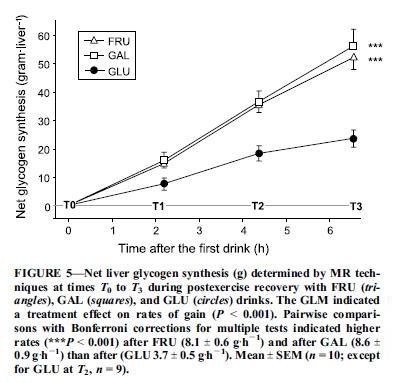
So 67% glucose / 33% galactose did the best, 67% glucose 33% fructose was close behind, and 100% glucose lagged.
Why does the 100% glucose drink underperform? One reason is that fructose and galactose, but not glucose, are preferentially targeted to the liver:
A factor of potentially larger magnitude in enhancing liver glycogen synthesis is the differential postabsorptive fates of fructose and glucose. Glucose is a relatively poor direct substrate for liver glycogen synthesis (24,27). Much of it is released from the liver into the systemic circulation to be stored as muscle glycogen (3,7). In contrast, fructose is primarily taken up by the liver … [1]
The second paper, “Superior endurance performance with ingestion of multiple transportable carbohydrates” [2], did not measure liver glycogen replenishment; instead, it gave its cyclists sugary drinks every 15 minutes throughout an intense 2-hr cycling test, and compared performance. Three different drinks were used: a 67% glucose 33% fructose drink, a 100% glucose drink, and a water-only control group. Performance was best with the 67% glucose 33% fructose drink, intermediate with the glucose drink, and worst with the water drink. The results suggest that the 67% glucose 33% fructose drink was better for liver glycogen replenishment, and that liver glycogen replenishment aided the cyclists’ performance.
The third paper, “Effect of different post-exercise sugar diets on the rate of muscle glycogen synthesis” [3], isn’t available to me electronically, so we’ll have to work from the abstract. It looked at muscle glycogen, measured using biopsies (ouch!), rather than liver glycogen.
It first assessed the effect of different amounts of glucose. It found that 0.7 g/kg body weight of glucose given every 2 hours would maximize the rate of muscle glycogen synthesis. For an 80 kg man, that works out to 56 g or 224 calories of glucose per two-hour period, or 112 calories per hour. Above this amount, the rate of muscle glycogen synthesis is unchanged.
It then compared three formulations at this same 0.7 g/kg body weight dose: 100% glucose, 100% sucrose (50% glucose, 50% fructose), and 100% fructose. Muscle glycogen synthesis rates were:
- 5.8 mmol/kg/hr with 100% glucose
- 6.2 mmol/kg/hr with 50% glucose, 50% fructose
- 3.2 mmol/kg/hr with 100% fructose
If we fit a quadratic curve to these points, it predicts a peak rate of glycogen synthesis with 70% glucose, 30% fructose:
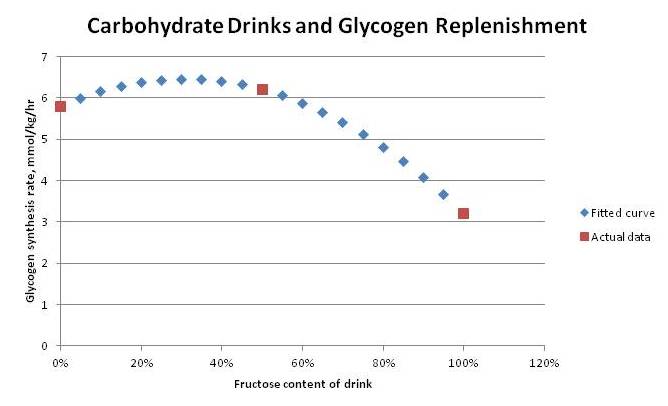
Athletes Agree: More Glucose Than Fructose
Of course, endurance athletes know that it’s beneficial to replenish glycogen during endurance events like marathons and triathlons.
Some authorities, including Tim Noakes, an exercise physiologist who has run over 70 marathons, believe that liver glycogen rather than muscle glycogen is the gating factor in marathon performance. From “The Science of Carbohydrate Loading” by David Peterson:
Remember also that muscle glycogen is committed to be used by muscle and cannot assist in maintaining blood sugar levels. Therefore should no additional carbohydrate be ingested during prolonged exercise, the task of maintaining blood glucose levels rests firmly on the liver’s glycogen stores and gluconeogenesis (the manufacturing of glucose from plasma amino acids). Oxidation of blood glucose at 70-80% VO2 max is about 1.0 g/min or about 60 g/hour. Therefore it can be predicted that even with full glycogen stores, a less conditioned athlete’s liver will be depleted of its carbohydrate within an hour and three quarters of continuous moderate intensity exercise. (Interestingly, the daily carbohydrate requirements of the brain and nervous system alone are enough to deplete the liver glycogen stores within 24 hours.) Once liver glycogen levels begin to drop and exercise continues the body becomes increasingly hypoglycemic (low blood sugar) mainly because blood glucose is depleted faster than it is replaced by gluconeogenesis. Professor Tim Noakes considers liver glycogen depletion and subsequent hypoglycemia to be the primary factors affecting fatigue and performance during extended duration races and especially in instances where muscle glycogen levels are low as well.
So marathoners and other endurance athletes will want to replenish liver glycogen as rapidly as possible during a race. What mix of sugars do they use?
The popular product is carbohydrate gels that can be swallowed at the same time water is taken. Here are the top carbohydrate gels sold on Amazon:
- Carb BOOM! Energy Gels – 24-Pack
consist of “a special blend of 22-25g of complex carbohydrates and just 2-4g of simple sugars to maximize energy delivery to working muscles.” The complex carbs are probably derived from starch and are 100% glucose, while the sugars probably contain some fructose. If the ratio is 2 g fructose in 25 g gel, then the composition will be 8% fructose 92% glucose.
- PowerBar Energy Gel, Double Caffeine, Tangerine, 1.44-Ounce Packets (Pack of 24)
consists of a 2:1 glucose to fructose blend, or 67% glucose 33% fructose.
- Clif Bar Shot gel, razz – 1.1oz (24/box)
list their primary ingredient as organic brown rice syrup, which is nearly 100% glucose.
So the sugar mix ranges from 67% glucose to 100% glucose. No product uses 50% fructose.
Presumably, athletes have done a great deal of personal experimentation and know that these ratios do, indeed, optimize the speed of glycogen replenishment.
When athletes have no need for speed, as when they are carb loading before a marathon, then they eat starches like pasta and bread, not sugar. So to maximize total glycogen status, regardless of speed of filling, a carb mix close to 100% glucose works just fine.
Glycemic Control
The fourth paper, “Acute fructose administration decreases the glycemic response to an oral glucose tolerance test in normal adults” [4], is about how a bit of fructose affects the glycemic response to an oral glucose tolerance test.
It showed that a 9% fructose 91% glucose test (7.5 g fructose, 75 g glucose) produced a lower glucose area under the curve and higher insulin response than a 100% glucose test. Here’s the glucose response:
In general higher insulin and lower glucose is healthier than the reverse, so this is considered an improvement.
Summary of the Data
What these papers show is:
- Glycogen replenishment proceeds the fastest with a mix of sugars consisting of about 70% glucose and 30% fructose or galactose.
- Although this wasn’t tested, we can guess that a mix of fructose and galactose would be more effective than fructose alone, since it seems that utilizing multiple carbohydrate pathways is what drives the speedier glycogen replenishment. So the fastest glycogen replenishment might occur with something like 70% glucose 15% fructose 15% galactose.
- Muscle glycogen replenishment is maximized with a carbohydrate intake of 100 calories per hour.
- Athletes agree with the research, using carb gel packs that contain typically 30-40 g carbs with a composition of 67% to 100% glucose, 0% to 33% fructose.
- Glycemic response to a large dose of carbohydrate may be improved by eating a 9% fructose 91% glucose mix.
From these data, I infer that for glycogen replenishment in liver or muscle, a PHD-style carb mix of 77% glucose, 15% fructose, 8% galactose is probably equal or superior to a Peat-style carb mix of 50% glucose, 50% fructose.
Conclusion
For athletes in the midst of a race, or in need of rapid recovery for a second race on the same day, speedy glycogen replenishment may be the endpoint to optimize. If so, they should eat a sugar drink composed of roughly 70% glucose and 30% fructose and galactose.
This is closer to PHD diet ratios than to Danny Roddy’s recommendation of orange juice or Travis Culp’s recommendation of soda!
But for others, speed of glycogen replenishment is hardly likely to be the parameter to optimize. There are unlikely to be significant benefits for non-athletes from replenishing glycogen 6.5% faster, as was found in the muscle glycogen study [3].
Speedier glycogen replenishment is almost the only known benefit to fructose consumption. It’s possible that low fructose doses, about 9% of carb calories (perhaps 2-3% of total calories), may improve glycemic control. This is a lower fructose fraction than is found in PHD, and far below the fructose fraction recommended by Danny and Travis.
Given the known risks of fructose consumption, especially with chronic intake at high doses or in conjunction with polyunsaturated fats, it seems prudent to err on the low side. It seems to me that the Peat-atarians have failed to provide any evidence at all in favor of a higher fructose intake than is provided by the fruits, berries, and sugary vegetables recommended by the Perfect Health Diet, save for athletes in the midst of a race or post-race recovery.
References
[1] Décombaz J et al. Fructose and galactose enhance postexercise human liver glycogen synthesis. Med Sci Sports Exerc. 2011 Oct;43(10):1964-71. http://pmid.us/21407126.
[2] Currell K, Jeukendrup AE. Superior endurance performance with ingestion of multiple transportable carbohydrates. Med Sci Sports Exerc. 2008 Feb;40(2):275-81. http://pmid.us/18202575.
[3] Blom PC et al. Effect of different post-exercise sugar diets on the rate of muscle glycogen synthesis. Med Sci Sports Exerc. 1987 Oct;19(5):491-6. http://pmid.us/3316904.
[4] Moore MC et al. Acute fructose administration decreases the glycemic response to an oral glucose tolerance test in normal adults. J Clin Endocrinol Metab. 2000 Dec;85(12):4515-9. http://pmid.us/11134101.

Tagged as: Carbohydrates, Perfect Health Diet, Ray Peat Diet • Comments (118)


Good post, I learned a lot from it. But just how relevant is what athletes happen to do to what is actually best to do? Unless these sports products were made based on available evidence then they don’t do much to make a point. I don’t trust athletes any more than I trust doctors, I don’t trust anyone. People are highly fallible, and health science is the worst I have ever seen.
But the central point seems to be valid. Although some fructose is clearly desirable for an endurance athlete, that doesn’t warrant the recommendation for the bulk of carb calories to be sucrose.
Cheers!
Hi Paul,
I’ve read that you’re recommending rice syrup or dextrose for people with bowel dissorders as a substitue for safe starches. If I were to use only rice syrup for a while, how much would you recommend that I consume? My fear is that it’s going to spike my blood sugar too much if I use 100 grams of it a day, which is what’s needed to achieve 400 carb calories. I’m guessing guessing mixing it with protein and fat will help, but still it seems like alot.
just a comment/query/thought on “Fructose and galactose enhance postexercise human liver glycogen synthesis”;
Is their anything else that could have had an impact on the volume change of the liver in this study.
Can we be certain than the change in liver volume is 100% due to the change to liver glycogen? or are there other things in the liver that may also be a factor in the change in volume.
(ie. is water a factor….does the liver/liver cells contain water)
Hi Stabby,
I was moved to look up what athletes actually do by the fact that the journal articles rather sparsely sampled the various possible carb ratios.
Sometimes athletes are more advanced than the exercise scientists.
Since the two agree, I would consider them supporting evidence for each other.
Hi Eirik,
Bowel disorders are tough because you have to make compromises, both in what types of carbs you eat and how much you eat.
200 calories carbs + 400 calories protein I regard as the minimum intake consistent with health, so I would start by trying to get at least 200 carb calories. If rice syrup is the best tolerated, then that can be a major source. Add it to other foods like ice cream, drinks, etc so you can get it in small doses. If you can, raise carbs past 200 toward 400 and diversify food sources.
Hi Darrin,
The volume growth was not very consistent, but it did correlate with glycogen levels, and shrinkage with the exercise that depletes glycogen.
There is about 2.6 g water associated with each additional 1 g of glycogen.
Yeah but Ray Peat is kind of cool, so I’m not entirely convinced he could be wrong about something.
On a different topic, I thought you might be interested in this vid that I just saw posted on Facebook – about a guy whose alzheimers is improving through use of coconut oil.
http://www.cbn.com/media/player/index.aspx?s=/mp4/LJO190v1_WS
An excellent summary of the data, Paul. I’ve always found that particular Peatism to be bizarre — and I’m extremely physically active by modern standards.
Given the following:
* Most people don’t exercise very much
* Exercise burns less calories than most people think
The problem for the overwhelming majority is “how do I dispose of excess sugars, simple or complex,” not “how do I replenish depleted liver glycogen?”
As you point out, glycogen replenishment during intense endurance exercise is about the only time when fructose is beneficial. In all other situations, fructose is more like “well, perhaps it’s not actively harmful if consumed in moderation.”
JS
Hi Todd,
Heh, yes Ray is very interesting, I kind of root for him to be right. But as JS says, his stand on fructose is rather hard to support.
Thanks for the Mary Newport video. It’s nice to see he’s still doing well.
Hi JS,
I agree. Thanks.
I think much of this needs to be put in greater context. The data listed above is only loosely associated with the reasons Peat recommends fruits to begin with. He recommends sucrose as a supplement when fresh fruits are unavailabl as well. Add to that fruits are great sources of salicylates and inisitol, two favorable nutrients for inflammation and insulin sensitivity. Peat on the whole suggests that if there were an “ideal” macronutrient ratio it would be 33% from each source, but would vary based on the individual’s response.
Some of the reasons Peat recommends sugar from fruit is because it leaves less for gut bacteria to feed on, it replenishes glycogen best, which in Peat’s view increases the liver’s capacity to detoxify the body of PUFA and excess estrogen, suppresses adrenalin and cortisol (stress response; of course paired with adequate protein and salt in the diet), it also stimulates the production of cholesterol, which if one thinks the cholesterol-heart hypothesis is bologna, would stand to bring up the protective effects of lipoproteins and their ability to bind endotoxin. I’m not a Peat expert but the above are just a few reasons he advocates fruit. My advice, start reading his articles because I feel his ideas regarding thyroid, stress, and hormonal status marry well with your ideas.
Don’t want to defend peat to much as people can make there own conclusions and read his work for themselves but this post isn’t really a fair critique of peat. The reason(one reason) why he thinks fructose is superior to glucose is its ability to promote liver glycogen storage, in a stressed state the body has a decreased ability to store liver glycogen and has to waste energy to create it. I suggest checking out his article on Glycemia, starch, and sugar in context, a critique of that would me much better. Also Ray Peat’s approach is based on a lot of things and has many factors, focusing on one part without looking at the whole won’t get you anywhere when it comes to his work.
Some random articles-
Fructose and dietary thermogenesis.-
“Fructose ingestion induces a greater thermogenesis than does glucose. This can be explained by the hydrolysis of 3.5-4.5 mol ATP/mol fructose stored as glycogen, vs 2.5 mol ATP/mol glucose stored. Therefore the large thermogenesis of fructose corresponds essentially to an increase in obligatory thermogenesis”
http://www.ajcn.org/content/58/5/766S.short
Sucrose ingestion normalizes ADX rats-
Adrenalectomy (ADX) changes CRF and NE activity in brain, increases ACTH secretion and sympathetic outflow and reduces food intake and weight gain; all of these effects are corrected by administration of adrenal steroids. Unexpectedly, we recently found that ADX rats drinking sucrose, but not saccharin, also have normal caloric intake, metabolism, and ACTH. Here, we show that ADX (but not sham-ADX) rats prefer to consume significantly more sucrose than saccharin. Voluntary ingestion of sucrose restores CRF and dopamine-beta-hydroxylase messenger RNA expression in brain, food intake, and caloric efficiency and fat deposition, circulating triglyceride, leptin, and insulin to normal. Our results suggest that the brains of ADX rats, cued by sucrose energy (but not by nonnutritive saccharin) maintain normal activity in systems that regulate neuroendocrine (hypothalamic-pituitary-adrenal), behavioral (feeding), and metabolic functions (fat deposition).
http://www.ncbi.nlm.nih.gov/pubmed/11415998
Dietary supplementation with n-3 fatty acids may impair glucose homeostasis in patients with non-insulin-dependent diabetes mellitus.-
“The blood glucose concentration tended to increase during MaxEPA treatment, and to decrease during the placebo period, the changes under the two regimes being significantly different (P less than 0.01). In addition, the rate constant for glucose disappearance (k value) for the intravenous insulin-tolerance test, which reflected the peripheral insulin sensitivity, tended to decrease during MaxEPA treatment and increase during administration of the placebo, there being a significant difference (P less than 0.03) between the changes during the two treatments.”
http://www.ncbi.nlm.nih.gov/pubmed/2394967
O3 deteoriates glycemic response-
“Average blood glucose concentrations during the third week were significantly higher fasting (+ 15%, p < 0.01), and during the day at 1100 h (+18%, p < 0.001) and 1500 h (+ 17%, p=0.002) on PUFA than on the saturated fat diet."
http://onlinelibrary.wiley.com/doi/10.1111/j.1464-5491.1992.tb01748.x/abstract
Gabriel brings up some good points. Peat only recommends sucrose as a supplement in the context of a nutrient rich diet. Its a fruit based diet and as far as I have seen fruits have been associated with pretty much nothing but benefits in the health literature.
A couple quarts of milk and OJ with a egg yolk or 2 will provide you with just about every nutrient, add some liver or shellfish and it becomes extremely nutrient dense.
That was interesting!
Looks like chocolate milk is again the winner for liver-glycogen replenishment.
Gabriel,
from where did you get the 33% macro thing? I actually figured that myself (didn’t found anything concrete in Peat’s writings) and always wondered why Danny emphasizes sugary carbs (55% of cals) so much.
And Peat is still kinda cool!
The 33% recommendation is probably old. Ray’s current line of thinking as far as I understand is that you should eat primarily carbohydrates to minimize PUFA but certain sources(butter, coco oil. ruminant fats) are fine in moderate amounts. He usually recommends around 80-120g of protein and the rest of your cals coming from carbs with fat added for taste(some people may need more fat depending on health circumstances). Its not a fat free diet though, probably 20-30% for the average person.
>High doses of fructose have observable harmful effects even in short-term studies.
Free fructose has been demonstrated harmful, but has sucrose?
Free fructose, including high fructose-ratio foods like soda, is commonly malabsorbed, and the malabsorbtion feeds pathogens. Fructose-liver harm can be “markedly reduced” by antibiotics, and antibiotics generally will prevent fatty liver, which suggest to me that fructose may only be indirectly related to fatty liver via malabsorption + microbes, rather than some effect of fructose on the liver.
Plus, the dies lab rates eat are deficient, and it seems likely the liver needs adequate supply of certain nutrients (like choline) to properly process sucrose. What about in those contexts, i.e. fructose delivered via sucrose + a nutritious diet?
Here are two reports where mice ate 40% to 67% of their diet as sucrose, and showed no harm, when they were fed nutritious diets:
http://jn.nutrition.org/content/3/1/61.full.pdf+html
http://www.ncbi.nlm.nih.gov/pmc/articles/PMC1275514/pdf/biochemj00921-0130.pdf
http://flare8.net/health/doku.php/when_fructose_is_bad
http://flare8.net/health/doku.php/diseases#microbes3
The benefits of fructose over glucose are beyond just refiling liver glycogen:
http://flare8.net/health/doku.php/fructose#benefits
Cliff’s probably right and the upper range of 20-30% gets you close enough. Let me add that having a Peat discussion on a this blog is epic! Central to Peat’s arguments regarding physical degeneration and longevity are PUFAs and their destructive synergism with estrogen via the stress response and diet. One way to avoid any excess PUFA would be to consume more starch and sugars from fruit, potato, and rice (all recommended in certain amounts by Peat with an emphasis on fresh fruit). If you lowered fat intake and increased carbohydrate intake your body would produce some fats from the carbohydrates in the form of saturated fats. This would be protective as it would lower exposure to PUFA.
“Sugar” is just one small part of Peat’s ideas and in my opinion should be addressed properly, which I feel wasn’t done here. Of course Paul was mainly responding to Danny’s post. I feel if Paul and Ray got together for an extended discussion of their respective research it would culminate in a more unified view. They each have different strengths.
I’m with JS on this one. Given the amount of glycogen flux that an athlete’s liver experiences, I don’t think it is particularly helpful for anyone to be referencing athlete studies as a model for what might occur in your average skinny-fatty wandering around.
Just on the superiority of glycogen reloading by adding fructose in the mix. Get it right, and there might be a slight advantage. Get it wrong, and the gastrointestinal distress caused by too fructose will soon outweigh any advantage fructose gives you at the liver. Particularly with fructose – ingestion is not the same thing as absorption.
[...] Perfect Health Diet » Is It Good to Eat Sugar?. Share this:TwitterRedditFacebookMorePrintEmailStumbleUponTumblrDiggLinkedInLike this:LikeBe the first to like this post. [...]
Hi Paul,
I know white rice is generally preferred over brown rice as it doesn’t have the bran which may contain toxins, however in my search for rice syrup I was unable to find a decent white rice one on Amazon. Instead, I found an organic brown rice syrup that I’ve been using. Do you think this is an ok/PHD-safe product (maybe the way it’s processed removes the toxins?) or would white rice syrup still be preferred? If so, can you recommend one (preferably on Amazon). Here’s the one I’ve been using if you could share your thoughts: http://www.lundberg.com/products/syrup/Organic_Sweet_Dreams%C2%AE_Brown_Rice_Syrup.aspx
Thanks!
I still don’t know how one would get the fat under 30% (by Calories), while drinking plenty of milk, eating cheese, eggs and beef for 120g+ of protein.
And eating real ice cream too!
The only lean portein sources are shrimps/shellfish and bone broth/gelatin.
My carb intake is about 80g (320 kcals) a day, and that is very easy just to get from a moderate amount of fruits and sugary veg like beets, carrots, zucchini, etc. In fact, i do just that – i.e get nearly all my carbs from these sources, except a small amount from dairy sugars. Is this a problem?
Like others have said, i have never seen any studies anywhere that show moderate or even high intake of fruits or high carb containing veg is detrimental to health, and some studies actually have shown the higher the proportion of carbs coming from whole fruit, the greater the weight loss. E.g. this study http://www.ncbi.nlm.nih.gov/pubmed/21621801, which Lyle discusses here http://www.bodyrecomposition.com/research-review/the-effect-of-two-energy-restricted-diets-a-low-fructose-diet-vs-a-moderate-natural-fructose-diet-research-review.html.
Of course, its important to re-iterate that fruit carbs are not pure fructose, and even the most fructose containing fruits have only 2/3rds fructose and 1/3 glucose, and most only have a 1:1 ratio of fructose :glucose. So even if you got all your carbs from fruit and sugary veg, you wont be getting huge amounts of pure fructose.
This leads me to think that fructose as part of a package in whole food like fruit and veg is not detrimental to health and adequate for non-athletes
Sorry, i forgot to add that in the study i posted, the high fruit consumption group also significantly improved some key health markers like blood sugar and blood pressure, vs the low fruit group
Franco,
The 33% macro comes from an interview with Peat (EastWestHealing I think?). Peat appears not to care about macros much; he also said in the same interview that one could go high in any macro provided they are of good quality (I.e. low PUFA, not too much muscle meat etc). He prefers carbohydrate metabolism (more CO2 produced) as Cliff states but the body burns saturated fat at rest and most people need fat to balance blood sugar and feel satisfied so 30% should be enough for that.
Peat drinks 1% milk because fullfat can be fattening when it’s considered a protein source too (simply due to calories).
As Danny posted, a Peat-a-tarian diet isn’t a gigantic sucrose snorting fest. Sugar can help in restoring oxidative metabolism but fruit is better…
Peat isn’t against starches as such; he just thinks fruit is better for a number of reasons.
I eat Peat (although Peat and PHD are very similar) but I still consider myself influenced by PHD and recommend PHD as a go to read for nutrition for anyone who asks.
All the best Paul!
James
Hi James,
thanks for clearing that up for me. Danny somehow made it sound different (milk/eggs/cheese) in his quick-start guide and I couldn’t fit his sample meal plan to his macro-ratios (20% fat only) from the very same document, except by really eating lots of sugar.
Well, I eat PHD but I still consider myself influenced by Peat.
Mostly for the higher protein but I even have a tbsp. of sugar in my coffee regularly!
Oh, I forget to say that Peat also has said the ”optimal” amount of fructose to glucose ”appears to be a 1 to 3 ratio”. But also thinks you can get all your carbohydrate from fruit nicely.
Franco, looks like even Sisson is using sucrose in coffee now! ha We better not go over 150g for fear of insidious weight gain though.
I personally view sucrose as similar to coconut oil. Fuel but no vitamins or minerals; both are ok in the context of a nutrient rich diet.
I don’t like labels much but I read every post here; which is only the case for a small number of blogs!
*1/3 to 2/3 ratio.
/need more coffee
@jamie-
“The synthesis of liver and muscle glycogen was studied in healthy volunteers given glucose and fructose infusions. In the course of 4 hours 21 to 26 mmol sugar per kg body-weight was given. Before and after the infusion the glycogen content was determined in needle biopsy material from liver and muscle tissue. The mean increases of liver glycogen after fructose and glucose infusions were 274.6 ± 25.87 and 76.2 ± 9.92 mmol glucosyl units per kg wet weight liver tissue, respectively. In muscle tissue the increase of glycogen was of the same magnitude for both sugars, corresponding to 23.0 and 24.4 mmol glucosyl units per kg after fructose and glucose, respectively.”
http://informahealthcare.com/doi/abs/10.3109/00365517409114190
Who gets gastrointestinal stress from eating too much sucrose(50/50 gluc/fruct) based sugars? No one unless they have severe dysbiosis.
While searching google scholar I came across this gem-
http://www.ncbi.nlm.nih.gov/pmc/articles/PMC425376/
“Evidence has mounted that under physiological conditions glucose utilization by the liver is rather limited and that it is in fact a poor precursor for glycogen and fatty acids(much inferior to gluconeogenic substrate such as fructose, lactate or glycerol)”
http://en.wikipedia.org/wiki/Glucose_paradox
“The paradox is that the large amount of glycogen (10%) in the liver cannot be explained by its relatively minimal glucose absorption.”
Making glycogen from lactate or glycerol is anti-thyroid in peats opinion.
Paul,
Great article – I’ve got a few related questions concerning athletic performance and recovery:
* In your opinion, does nutrient timing come into play for high intensity and resistance workouts as far as DOMS, recovery, and overall fitness (the canonical example being “save the starchy carbs for post-workout”)?
* Is there any advise you can offer for pre-workout nutrition? Again, assuming we’re talking about high intensity and resistance.
* Do you agree with the nutrient timing advice given in Part I of the book “The Paleo Diet for Athletes” (if you’ve read it)?
Thanks!
-Marc
Paul, I always enjoy reading you blogs, they are very eye opening. You should receive Dr. Peat’s newsletter,it also is very eye opening, and is all based on past sceince(with ref.). I would really like to read your responses to what he writes about in his newsletters.
Hi Paul,
Thanks for the blog post.
I’ve interpreted PHD fructose/fruit consumption to be optional, even though it is generally included. More of a eat fruit/fructose for variety/pleasure to a certain limit to minimize its harmful effects and none is needed to have a healthy diet … optional source of potassium/fiber to supplement veggies … supplement C, and antioxidants may not have purported benefits.
Thanks,
Mark
Despite the sugar content, sugar types and the ratios, Orange Juice (OJ) has shown very significant benefits just by ingesting a few glasses per day.
Orange juice decreases oxidative stress, diabetes and cardiovascular risks
http://conference.ifas.ufl.edu/citrus/presentations/Wednesday/PM/0335%20Cesar.pdf
Extracted from there:
Orange Juice helps to prevent pre-disease conditions:
• Insulin Resistance and Metabolic Syndrome
• Type 2 diabetes and coronary heart disease
* Orange juice improved insulin sensitivity in all individuals
studied, regardless of their sex and BMI, observed as
decreased insulin secretion and reduction of the HOMA index
* Even though OJ add calories in diet, there were no alterations
in body weight, BMI, body fat or abdominal circumference
* OJ decrease inflammation and increased antioxidant activity
1)No effect on weight, BMI, body fat or waist circumf.
2)Less Cholesterol, LDL-C in normal and overweight individuals
3)Less Insulin (no glucose) = improvement insulin sensitivity
4)Less – CRP 13% in normal and 26% in overweight
5)More – 2.5 times antioxidant capacity in both groups
6)Less – 4% Systolic BP in normal weight individuals
7)Less – 4% Diastolic BP in overweight individuals
Plus more (see the pdf)…
Also, “Sugary Drinks, Not Fruit Juice, May Be Linked To Insulin Resistance”
http://www.sciencedaily.com/releases/2007/09/070905095319.htm
My own belief is that JS and Jamie are correct, most people’s levels of exercise render any slight advantage for fructose refueling a moot point. A much more common issue for folks eating a low fat wheat centric diet, is having to constantly stop and snack because they lack energy and get light headed. That used to be me.
One of my favorite forms of exercise these days is a fast round of golf on a hilly course carrying my clubs. I am lucky to have a couple friends who share this eccentricity, and most would agree we are all in pretty good shape for 50something year old women. However, I notice that this winter, I beat them to every elevated tee and green. They are huffing, I am not. They are waiting for me to tee off even if I don’t have the honors, because they need to catch their breath. They are wearing more clothes on a 38 degree day than I. And they absolutely cannot make it through the round without their apple and orange slices, their bananas, their vitamin water and what have you. When I politely refuse their generous offers to share, they can’t believe I don’t need to eat anything. When I describe my breakfast of a couple eggs, several tablespoons of saturated fat, and a serving a safe starch, I might as well have said I am a green blooded martian. The Peatatarians can have their OJ, I’ll take my PHD rocket fuel.
2 months ago I was explaining the PHD to them and they replied to fructose being low that low fructose was odd considering we evolved from monkeys that eat so much fruit. I had no reply and this left me puzzled about fructose in context of evolution.
If we evolved from monkeys, then we started out at least eating much higher amounts of fruit and fructose, right? Do monkeys handle fructose any better than us? Does the monkey diet concept of them eating lots of bananas a myth? Or has humans just evolved for so long away from jungles that we changed to handling safe starches/glucose more and less fructose? Yet, Paul has mentioned we really started in earliest evolution with processing glucose first, so???
Hi Paul,
What I think is oft neglected when considering Peat is the hormonal reaction to foods. Though taking in ice cream and orange may not be optimal (not terrible either), I think the hormonal reduction of estrogen, glucocorticoids, and promotion of pregnenolone,etc. plays an important role in correcting a persons health. I think that people with metabolic syndrome and such have a hormonal disruption that is neglected. Maybe the optimal course for correcting health in some people is to take in foods that provide a positive hormonal reaction, while continuing to take in other highly nutritious foods to correct other disruptions–attacking the problem from multiple facets. In this manner highly nutritious foods are the major consituents of a long term correctional protocol, while sugary foods(and such) are part “supplementary” foods that provide an acute spark of supportive hormones (so that as the person becomes healthier they can probably be reduced more and more).
Just as a side note, I think it’s interesting that overeating, or eating of sugary foods,etc., are not necessarily damaging to a healthy person– i.e. when healthy people overeat or under eat they return to normal weight under subsequent ad libitum conditions. It’s probably also interesting that though a person with metabolic disorders will feel terrible most of the time, with periods of relief brought on after consumption of these sugary foods, or just overconsumption in general–signaling the possibility of beneficial hormonal (or some other) effects. In this paradigm the biggest problem seems to come from the chronic intake of toxins that separates the healthy person from the unhealthy.
Hi Paul,
How much can we extrapolate from the idea the fructose+glucose is [likely] better than glucose at repleting glycogen? First, this says little about overall health. Second, as you mention, this says little about the advantages of a 30% fructose diet vs a 10% one. Third, carbohydrate source and amount is not the only factor that affects glycogen storage/repletion.
Studies that involve rodents use diets that contain so many refined ingredients, and results are all over the place. It’s difficult to come to any confident conclusion when you’re looking at cornstarch vs sucrose, or, in the case of flare’s links above, multiple variable changes.
Peat and followers also use the idea that fructose+glucose stimulates glucose oxidation moreso than starch (and fat obviously). But, I’ve never seen direct evidence that this is a positive (in fact Lucas Tarfur makes a strong case for fatty acids and ketones being superior) besides the fact that glucose oxidation produces more CO2, which is another questionable extrapolation to overall health. Anyway, high carb/sucrose diets don’t necessarily increase CO2: there are studies that show respiration is less efficient with high carb, so that the expected increase in CO2 doesn’t happen, because there is more lactate produced.
I really enjoy Peat’s writing and ideas, but I don’t see the need to put him up on a pedestal and act like everything he says is gospel, which many of his followers do.
Oh, and although it’s not a “scientifically valid” conclusion, I think it is telling that cultures like the Kitavans favor starches over fruits, despite both being widely available (I’m not 100% sure that’s true though).
lenny,
The problem is that Peat’s recommended dietary changes don’t necessarily lead to beneficial changes in those hormones, or at least there is a lack of evidence.
Rat metabolism of fructose is a very poor model for examining human metabolism of fructose. Previous studies have shown that rats suffer much more damage from high (artificial) fructose feedings than human subjects. Alan Aragon did a whole analysis about this in a previous issue of AARR
Paul, what do you make of this rodent study comparing starch/sucrose/fat based diets?
http://jn.nutrition.org/content/136/3/582.full
How is it that LIFE-LONG feeding of a 56% refined sucrose diet did not cause these mice any ill effects compared to starch-fed mice, no obesity, no fatty liver, no elevated blood lipids, no insulin resistance, if fructose is a poison? They also had lower micronutrient intake than the starch-fed mice. I have to say studies like the above made me very skeptical that sucrose poses any particular threat at all.
The PHD is evidence-based; everything is truly backed and few things (if any) are left as simple opinions or beliefs. That is in part why it gives it way more credibility than other diets, including the standard Paleo Diet, IMHO. To that, add the many positive testimonials from PHD adopters and you have an excellent reference diet for health.
It’s unfortunate, but many Peat followers do blindly follow him, without questioning almost anything he mentions. But it is also true that those who critizice the work of Dr. Peat seem that they have never taken the time to actually read his essays, where he does provide justifications and references.
People has to understand that what he recommends is something optimal based on his knowledge, views and experimentation for optimal health and doesn’t consider evolution as far as I know, only pure biology and biochemistry. As I undertand it, dismissing his recommendations as a “High Sugar” diet is unfair and demonstrates ignorance on his work.
Peat has on his side that he’s a Ph.D in Biology, with decades of experience and knowledge so to me it is interesting to lissten to what he has to say. He’s not looking to create a movement as I see it, the people who follow his work probably are.
The plot thickens. Many very interesting comments in this thread.
Enrique, I don’t think many of us want to start a movement, but just get better. Interesting post Paul, good to see you replying so promptly to Danny’s post.
this comment thread is gonna get awesomely insane!
i’m going to tell my story here because i experiment with a mixture of ideas – given that everyone is unhealthy in their own way, self-experimentation is key.
due to my leaky gut and dysbiosis, safe starches screw with me, fatigue, constipation, bloating. even some fruit does this: bananas i’m talkin’ to you!
it has been a struggle to gain a surplus of energy without resorting to caffeine. upon experimenting with brown rice syrup, i improved a bit, but not enough for my tastes.
exploring peat-eating, i increased simple sugars. i find that i can tolerate well fruits, fructose and sugar, sucrose TO A POINT. after that point i can feel my liver become swollen and then i am overfull with fructose.
i can ingest lots of dextrose and it suits me better than brown rice syrup, so a mixture of more dextrose and less fruits is a good combo for me, but i have to monitor the liver swollen-ness thing. it’s easy to overeat sweets, even fruits.
as for blood sugar and crashing, i ingest my sugar right before a high protein meal. i do not “crash” any more or less than i did before on a lower-carb diet, presumably because now i am eating a high protein diet and 16:8 Intermittent fasting each day.
here’s where other things diverge as well. i eat very high protein, somewhere along the lines of 2-2.5g protein per kg of bodyweight. this helps with satiety, and i do not want my protein being used as blood sugar so i try to get at least 200g or more of carbs a day. i feel better on more carbs. this is key. but i also eat limited PUFA and since increasing the carbs and protein i eat LESS healthy fat in general.
the rest of my calories come from fat. i eat big in that 8 hour window and have some yerba mate to help digest.
i do also take lots of supplements to heal my leaky gut, as well as many of phd recommended supplements. as you can see, this is a mixture of phd, lalonde-paleo, kresser-paleo, harris-paleo, and peat. i am intolerant to casein, so no dairy except for grass fed ghee, and i eat very little vegetables. even peat’s recommendation of raw carrots for gut health causes my small intestine to rumble uncomfortably.
i think there may be something specific about me, perhaps my past and genetics does not allow my liver to function optimally, therefore having some fructose malabsorbtion issues, whereas other people process fructose well. there may be many other factors at play – perhaps having a super liver that is challenged everyday by that amount of fructose has some other knock-on health benefits. perhaps the dairy inclusion is helping, or perhaps other positive hormonal thresholds must be met which help the entire system offset any possible damage done by the bolus of fructose.
someone please correct me but … for dieters, liver glycogen is much more important. I’ve read a bunch of times how liver glycogen is one of the things that determines how hungry one is.
Why is anyone arguing for better muscle glycogen replenishment, when most non-athletes do very little exercise that’s in the intensity ranges that require muscle glycogen.
> as for blood sugar and crashing, i ingest my
> sugar right before a high protein meal.
> i do not “crash” any more
That’s interesting … I remember reading a paper where sugar plus cottage cheese caused twice the insulin spike as just sugar.
So for you anyway, it may not be (insulin ->force -> low blood glucose) that causes your “sugar crashes”
sam, since i don’t have any sugar crashes i don’t know what causes them… i’m just sayin’.
OK, thanks … read that part of your post too quickly.
@sam-maybe you should read the comments, specifically mine.
hi Cliff – I did read your posts, my question was why the overall discussion regularly veers off to emphasise athletes and muscle glycogen, while downplaying the area that’s probably much more important to regular dieters.
@sam- You have to ask paul about that. The studies were posted on dannys blog in response to another commenter wondering about fructose’s ability to refill muscle glycogen. If you read dannys original blog post and peats work they are much more interested in liver glycogen as it supports thyroid function, hence the emphasis on fructose. Danny’s original post(which this blog post is a reply too) doesn’t mention muscle glycogen one time, when he says refills glycogen he is referring to liver glycogen.
Thanks for the well-reasoned update on sugar. You already had me convinced a year ago when I read your book, but, as you noticed, the fructose cheerleaders have been vocal recently.
I have cut way back on my fruit consumption during the past half year, ever since I noticed that my ear canals would start itching after eating an apple or a half cup of berries. Wish I knew what that was about.
Danny Roddy made a typo…
Peat has stated that … fructose … “powerfully” refills glycogen …
SHOULD BE
Peat has stated that … fructose … “powerfully” refills LIVER glycogen …
WHICH would create a whole new argument for PJ to discuss
@KIRKC- Apples are very starchy and raw starch creates inflammation by feeding bacteria. Berries have lots of little seeds that create inflammation by feeding bacteria and the little seeds can get stuck in your colon and create diverticulitus. Ray Peat recommends Orange Juice and other tropical fruits with low serotinin and low starch content.
ALL ORGANISMS CAN USE SUGAR AS FUEL NOT THE SAME FOR STARCH
Hi Gabriel,
Thanks for summarizing Peat’s ideas, which I am not intimately familiar with. It still sounds like an excessive amount of fructose to me.
But I very much agree with his deprecation of PUFA, so we do have a lot of common ground.
Hi cliff,
I was directly addressing the role of fructose in replenishing liver glycogen. Whether there are benefits to more effective replenishment of glycogen is another topic; it seems to me difficult to make this case.
More thermogenesis from fructose is what you would expect from ingesting a toxin. The body tries to dispose of it as quickly as possible, even if that means generating waste heat.
That paper on ADX rats doesn’t even compare sucrose to other macronutrients.
Since we share Peat’s distaste for polyunsaturated fats, I’m not sure why you include your last two references.
Hi Franco,
Chocolate milk does seem like a good choice for liver glycogen!
Hi flare,
I agree that micronutrition can make a big difference. Doesn’t that make recommendations to drink low-nutrient-density sugary beverages suspect?
Some of the “benefits” of fructose you cite I see as defects.
Hi Tea,
Tapioca syrup is available at Amazon. But that brand of brown rice syrup is OK. It’s sold at our local Whole Foods.
Hi Rob,
We support natural foods. It’s the added sugar, eg orange juice or soda or other sucrose sources, that I object to.
Hi JRAC,
If the fructose to glucose ratio is 1:3, or 25% fructose, then it’s not that far apart from my 15% fructose. Hardly worth arguing over.
But Danny thought there was a difference worth critiquing. Perhaps his emphasis should have been on quantity of carbs, rather than sugar/fructose?
Hi Marc,
Yes, I think nutrient timing matters, but it depends on the type of exercise you are doing and I am not expert in this literature. For most people doing casual exercise I would recommend exercising fasted and then eating sufficient carbs post-workout.
For resistance exercise, a bit of protein pre-workout is probably helpful, but not too much – less than 10 g. The workout should be at least 3 hours since the previous meal.
I haven’t read The Paleo Diet for Athletes.
Hi Kevin,
I agree, I should subscribe to his newsletter. But I have so much that I lack time to read already!
Hi MarkES,
Lots of foods are optional individually, but since food variety is a desirable trait of a diet (one of the “Eat Paleo not Toxic” recommendations), it’s good to incorporate optional items, just not in huge doses. And pleasure is a positive goal also.
Hi Enrique,
Oranges would have worked as well as orange juice. And not a large number of oranges, either.
Epidemiological evidence is of course going to blame soda, which has increased, not fruit juice, which has decreased, for rising incidence of metabolic syndrome. That doesn’t mean fruit juice is benign.
Hi Kate,
Great story! Maybe if your scores improve too, they’ll try your diet.
Hi Jaybird,
First, the ape-monkey divergence was 24 to 29 million years ago (http://news.discovery.com/human/monkey-ape-fossil.html), so there’s been a long evolutionary time since. And bipedal grassland dwelling apes are known to have lived 20 mn and 7 mn years ago. There’s reason to believe that the common human-chimp ancestor was a grassland dwelling bipedal starch eater, not a forest-dwelling fruit eater. It may be that chimps and gorillas evolved for fruit eating, not humans for other foods.
But even if our distant ancestors ate fruit in quantity, this doesn’t make it optimal. It’s best to eat nutrients our body can incorporate in tissue. Fructose isn’t one of them.
Hi Lenny,
This seems to me a pharmaceutical approach to food: People have some pathology, characterized by faulty hormone levels, and ice cream and orange juice can treat it. I don’t believe this model. At least, it should begin by telling us exactly what the pathology is, and who has it, and show us evidence that ice cream and orange juice effectively treat it. (If the pathology is metabolic syndrome, I don’t believe they do.) If everyone has the pathology, then why did evolution give us an obligate requirement for orange juice and ice cream?
Hi John,
I agree. Stimulation of oxidation / metabolism is in most cases a negative, not a positive. Also, short term effects and long term effects may be opposite.
Hi Collden,
Rodents have trouble with high-fat diets. Sucrose is mainly a problem in combination with PUFA, but this study gave milkfats, very low in PUFA. The starchy diet had a better glycemic response to the OGTT than the sucrose diet. Overall, I don’t see anything to recommend sucrose in the study. Mice tolerate it as long as there are very low PUFA in the diet.
Hi Enrique,
Peat is certainly very interesting. His website doesn’t always link cites to statements closely, and it is hard to tell in what contexts his ideas are valid. I think there’s insight there but it is hard to chase down exactly when his insights are useful.
Hi Darius,
Thanks for sharing. Dextrose should indeed by the most tolerable carb in cases of gut dysbiosis.
Hi Kirk,
I’m afraid I don’t know what that’s about either, but congratulations to you for figuring out the cause!
Best, Paul
Ray Peat also recommends low fiber so strained Orange Juice because the fiber feeds bacteria which creates inflammation.
ALL ORGANISMS CAN USE SUGAR AS FUEL
NOT ALL ORGANISMS CAN USE STARCH AS FUEL
What about the Glucose Paradox PJ?
http://www.ncbi.nlm.nih.gov/pmc/articles/PMC425376/
“Evidence has mounted that under physiological conditions glucose utilization by the liver is rather limited and that it is in fact a poor precursor for glycogen and fatty acids(much inferior to gluconeogenic substrate such as fructose, lactate or glycerol)”
http://en.wikipedia.org/wiki/Glucose_paradox
“The paradox is that the large amount of glycogen (10%) in the liver cannot be explained by its relatively minimal glucose absorption.”
Making glycogen from lactate or glycerol is anti-thyroid in peats opinion.
Thyroid increases thermogenesis, is that a toxin too?
Hi cliff,
There’s agreement that liver glycogen gets synthesized after glucose ingestion. The paradox is over how. See this quote from the paper’s conclusion:
The claim that processes involving lactate or glycerol are anti-thyroid needs documentation. It’s hard to credit, especially if these are normal physiological substrates for liver glycogen synthesis.
Paul,
My idea was based upon the chronic deprivation of vital nutrients, as well as chronic exposure to plant toxins such as gluten, that brought about such a hormonal disruption that necessitated the supplementation of refined, but not toxic, foods (i.e. ice cream and orange juice) that can help attenuate the hormonal problem without adding excess stress to create another problem. Though I understand it may resemble a pharmaceutical approach, I like to view this as the approach taken by traditional tribes, specifically in the application of refined wisdom–similar to how Weston Price described cultures that had pristine dental health as a result of their accumulated wisdom, and subsequent application/refinement of it.
To be slightly clearer, I’m sure you’ve taken notice of metabolic flexibility graphs–those comparing the macronutrient partitioning abilities of obese individuals compared to metabolically healthy ones. It is shown there that obese people tend to burn an increased ratio of carbs to fat. This line of thought carries through to PHD carb recommendations, where the guidelines state an general recommendation of 400-600 carb calories. Now according to my logic, if you convinced a severely obese person to follow this mantra they would have to produce additional glucocorticoids compared to a leaner individual (adjusting for total weight/height,etc.) due to the disruption of their metabolic milieu (hormones and all). In their case orange juice “supplementation” would be more beneficial, and as their weight–and subsequent metabolic status–improved, we could taper down the “supplements”.
I would like to hear your opinion on a diet that is high carbohydrate and fruit based with very very very very low levels of PUFA. How toxic do you consider fructose in the near total absence of PUFA?
@Jaybird
They say human gut morphology is based on the fact that we evolved from frugivores, that is, frugivory adapts apes to soft calorie dense foods. When we discovered hunting and cooking, we took advantage of this pre-existing adaptation and further evolved in that direction thus increasing the size of the small intestine and shortening the length of the colon. From the standpoint of human geographic dispersal, moving to starch and fat based diets makes very good sense as these are much easier to consume in northern climates and/or store not to mention being much lower volume per calorie. Considering the importance of calcium:phosphorus ratios and the interesting coincidence that Peat’s anti-inflammatory amino acids are most abundant in eggs and shellfish; I’m starting to think that humans probably initially evolved in coastal forests with a fruit dominant diet supplemented by stealing eggs, shucking bivalves, and the odd insect or anthropod with fiber coming from leafy greens. Dairy, as such, provides a convenient way to replicate all these conditions which is why I believe Peat supports it. Without dairy, you’d need to eat clams, oysters, and probably 4lbs of leafy greens every day in addition to fruit and tubers.
Hi Paul –
I have listened to five of your podcasts this week – thank you!! On fructose and PUFA’s. I have been giving my children their fermented cod liver oil shots with apple juice and I poach their salmon in apple juice. Am I poisoning them??
All kidding aside, if it is causing a harmful oxidation effect, I will stop it and find another way.
Thanks for your help! Pam
On a semi-related note, babies don’t even have GLUT5 transporters, meaning colics are mostly caused by fructose.
http://onlinelibrary.wiley.com/doi/10.1111/j.0954-6820.1978.tb14836.x/abstract
http://pediatrics.aappublications.org/content/109/5/797.short
Normal people generally do not absorb fructose great:
http://www.ajcn.org/content/48/6/1424.short
Small-intestinal absorption of fructose was investigated in healthy human subjects by sequential breath-hydrogen measurements. Fifty-eight percent of 103 subjects produced greater than 20 microL H2/L after consuming 50 g pure fructose in water. About half of those who absorbed fructose incompletely (incomplete absorbers) had abdominal symptoms. Malabsorption of medium doses of pure fructose may therefore be common in man. When 25 g pure fructose was consumed, only 19% of 21 poor absorbers (of 50 g fructose) still produced excess breath H2. When glucose was taken with fructose, the frequency and amount of excessive breath H2 was substantially reduced.
This is typical soda scenario, its less ‘fruit scenario’ but could be easily done by anybody consuming fructose rich, glucose poor fruit.
Its known that glucose helps it by some hypothetical cotransport, but that brings old question – how good is this combo for the liver. But we know that, as Pual noted, at least in CM deficiency state its not good. Deficiency of choline is more or less regular thing and vegetarians are probably deficient in methionin too:
http://www.jlr.org/content/50/10/2072.full.pdf
Rats are probably not a good model because their diurnal change of GLUT5 expression shows how important fructose might be for them: Diurnal rhythm consists of an anticipatory fourfold induction of intestinal GLUT5 mRNA and protein expression occurring 3–4 h before the onset of peak feeding. This doesn’t happen in humans to that extent and when it does its not in advance like with rats, unless you are T2 diabetic in which case, for some reason, GLUT5 is over-expressed several fold in the gut.
As a small nitpick, from the review presented at
http://ajpendo.physiology.org/content/295/2/E227.full
we see there are other potential uses of fructose in the body – sperm motility.
My personal opinion: take apple a day literally .
Hi Lenny,
I think the obese burn more carbs than the non-obese because (a) both populations are eating excess carbs, ~50% of calories, and (b) the carb-to-fat conversion pathways are somewhat blocked in the obese.
I don’t think the proper response to this is to continue to eat an excess of carbs.
Hi Joe,
Toxicity depends on quantity. Low doses of fructose in the presence of PUFA are toxic to the liver; in the absence of PUFA, high doses of fructose are toxic to the body. Exactly where “high” is, I’m not sure, but I don’t see much benefit to fructose consumption, so it’s easy for me to recommend getting it only from whole foods.
Hi Pam,
I would recommend switching to another sweetener, like rice syrup. Even honey would be better.
Hi maj,
Thanks, interesting comments all.
@maj- 90% of fruit are a 50/50% ratio, apples are the exception not the rule. The children did fine on grape juice.
@cliff
That isn’t really important since the parole isn’t “an grape a day keeps doctor away”.
Further:
Apples were purchased by 80 percent of consumers in 2006, according to The Packer’s Fresh Trends.
with the most consumed fruit being banana.
Fruit is massively consumed all around because everybody think they are abnormally healthy. And they are, if you eat them occasionally and don’t drink fruit juices every day.
@majkinetor
Thanks for letting me know your opinion. I’ll stick with the facts.
conference.ifas.ufl.edu/citrus/presentations/Wednesday/PM/0335%20Cesar.pdf
Sucrose substitution in prevention and reversal of the fall in metabolic rate accompanying hypocaloric diets
Hypocaloric diets cause a fall in resting metabolic rate that interferes with weight loss. To evaluate the mechanisms underlying this phenomenon, resting metabolic rate was measured sequentially in six healthy obese women on a weight maintenance diet (more than 2,300 kilocalories), after 15 days of an 800 kilocalories carbohydrate-free diet, and after isocaloric sucrose replacement for an additional 15 days. The carbohydrate-free diet produced a 21 percent decline in resting metabolic rate (p <0.005) as well as a decrease in circulating triiodothyronine (41 percent, p <0.02) and insulin (38 percent, p p <0.1). However, when sucrose was substituted, resting metabolic rate rose toward baseline values even though total caloric intake was unchanged and weight loss continued. The sucrose-induced rise in resting metabolic rate was accompanied by a rise in serum triiodothyronine values, but not plasma insulin or norepinephrine concentrations. Throughout, changes in resting metabolic rate correlated with changes in serum triiodothyronine levels (r = 0.701, p <0.01). In four obese women, a hypocaloric sucrose diet was given at the outset for 15 days. The fall in both resting metabolic rate and triiodothyronine concentration was markedly reduced as compared with values during the carbohydrate-free diet. It is concluded that carbohydrate restriction plays an important role in mediating the fall in resting metabolic rate during hypocaloric feeding. This effect may, at least in part, be related to changes in circulating triiodothyronine levels. Incorporation of carbohydrate in diet regimens may, therefore, minimize the thermic adaptation to weight loss.
http://www.amjmed.com/article/0002-9343%2886%2990264-0/abstract
Hi cliff,
Thanks for the paper, it’s useful for my obesity thesis.
However, the fall in T3 and metabolic rate is due to carbohydrate deficiency and the need to conserve glucose. I’ve blogged repeatedly about that. Starch does just as well as sucrose at preventing it.
Paul,
Sorry to beat a dead horse, but according to Peat, metabolic disturbance–chronic hyperglycemia–is due to elevated cortisol. So while your suggestion is reduce overall carb levels and supplant the ones you do eat with starch, Peat suggests consuming sugar, which targets the liver more so than pure starch–as your article suggests. The latter suggestion reduces cortisol by saturating liver stores while reducing insulin (due to half fructose/half glucose), meanwhile pure starch would have to be dealt with solely by insulin, and there would be less of a tendency to saturate liver glycogen, subsequently leading increased glucocorticoids and a reduction in thyroid functioning.
According to Danny Roddy, Dr. Kharrazian also promotes a constant flow of glucose for his IR patients–http://www.dannyroddy.com/main/2011/3/21/the-root-of-all-evil-sugar-or-estrogen.html
I understand your line of reasoning throughout all this, but after being exposed to certain anecdotes, again from Danny Roddy’s recent post–Where a woman expresses improvement when she “started eating more carbs in the form of fruits and orange juice (was already eating a fair share of “safe starches”).”
I think the HPA axis and thyroid functioning needs to be assessed before any “perfect health” diet is prescribed–adding another possibility towards using diet to diagnose pathology, besides pro/eukaryotic infections that you suggest.
@ Lenny
That is a great synopsis that I was trying to refer to in my previous comments. Not all of us are so gifted, lol. This is why I feel a weekend spent together by phone or visitation between Paul and Ray would really be useful for both sides. They both approach some similar problems with different ideas that I feel marry well when taken all together. Because Peat’s work has a focus on stress and it’s effects on the organism and cellular energy production I tend to side with Peat on many things. I feel Paul’s approach marries well because toxins and infections are primary sources of environmental stressors. Stress is at the center of it all and the associated cascades can spiral out of control in different ways for each individual. I am currently attempting to synthesize the ideas of both and incorporating Robert Sapolsky’s ideas about stress into my own approach to “evolutionary” lifestyle practices. Lastly, both Paul and Ray stress the importance of thyroid function but both have different takes on the “optimization” of that pathway. I feel too much of the “paleosphere” tends to view the organism from the viewpoint of scarcity. Peat attempts to view the organism from the viewpoint of abundance. Both viewpoints yield similar approaches but with slightly different interpretations of the true state of the organism.
@ Paul
Why don’t you send a copy of your book to Ray and have him review it? Then ask if he would be interested in a guest post concerning some of his points of contention. I think the both of you can learn a lot from each other and without having to do so much research on subject matter for which you do not have time. I think your blog does a tremendous job of bringing many lines of research together but there is too much out there for just one man/couple. Also, it tends to irritate me that you still associate your nutritional approach to “Paleo” and feel an appropriate change to “Evolutionary” is much needed, mainly because there are too many “Paleo” die-hards who are too dogmatic and also because the current mainstream interpretation of “Paleo” seems to gravitate towards the dogmatic approaches.
Paul,
Based on your answer I find it hard to believe that you and Peat are really on opposite sides. The main difference is in what fuel source you believe to be optimal but besides that, there seems to be little true disagreement. Seeing as you support fructose consumption from whole foods and are against the combination of fructose with PUFA; well, this is the same as what Peat prescribes.
I’d like to suggest that Peat’s diet may be thought of as an evolutionarily earlier form of your diet. That is that the human diet may have consisted mostly of fruit and coastal animal protein at first and once migrating onto the plains and northern climates we changed our staples to fatty meat and root vegetables. In other words, there is the Northern/Plains diet (PHD), and the Southern/Coastal diet (Peat).
In any case, I understand your aversion to fructose in light of all the studies documenting its ill effects but considering some of the anecdotes seen from people on high fruit protocols, it does seem that there is more to this story than meets the eye.
Paul, this discussion gets to the crux of what I do not understand about the Perfect Health Diet. You are speaking as if refilling liver glycogen is a good thing, and it undoubtedly is, because mood is so much better when there is sufficient liver glycogen because then the brain is confident of its power supply. Also, you acknowledge that safe starch would eventually replenish liver glycogen after muscle glycogen is topped off. So why not eat enough starch to replenish liver glycogen? It is not so difficult to figure out how much that would be. Have some sugar, feel what replenished liver glycogen is like, then titrate safe starch gradually meal-by-meal to get the same effect. When I do it, and I am not an athlete, I get 260 grams of non-fiber carb per day, which is considerably more than you usually recommend. Have you tried this experiment and found the result unsatisfactory in some way?
Hi Jim,
It’s an excellent question. I’m not persuaded that it’s a desirable thing to keep liver glycogen filled at all times, but for some health conditions it may be good to tend that way, like hypothyroidism. There may also be a case to be made for intermittent / occasional high-carb feeding.
260 g is 40-50% of energy, which is close to how most people eat.
Can’t wait for the obesity thesis. I still don’t know how you can respond to every comment, I get tired just reading them.
Hi James,
I haven’t been able to keep up either. The Q&A thread has gotten away from me, and a few other threads.
Paul, the high-sucrose fed mice had lower fasting glucose and insulin, as well as being more insulin-sensitive (see ITT). But the point was that this is by far the longest-term animal study, and also one of the most high-quality IMHO, on the chronic effects of high-sucrose diets, and it doesn’t verify any of the supposedly negative metabolic effects of sugar found by shorter-term studies and studies using pure fructose, or using sucrose in combination with high PUFA diets. So this provides stronger evidence that in the context of life-long consumption, eating lots of sugar is not a problem, than the plethora of fructose-overfeeding experiments provides to the contrary.
For positive effects of fructose you have to actually read some of Peats writing, particularly his November 2011 newsletter on sugar. But just one more question, if fructose is a “poison”, why why would it be one of the substances we find most intuitively rewarding to ingest? Sugar, unlike foods that truly can be poisonous such as alchohol, raw vegetables, raw meats and legumes, is one of the few things you never have to learn to appreciate, everyone is just born with a strong taste for it. I can’t see this being the case with any other substance that is a poison for us.
Colldén
Raw beef tastes amazing (grass fed). And is very safe. You could check out the raw paleo forum, for more information and journals from long term raw meat eaters, if you don’t believe me. I would think twice before putting raw meat in the same category as alcohol.
Paul,
I am looking for a protein powder with maltodextrin in it. Do you know of any brand? I have been looling at the only one I have found so far is one with soy and I dont want that either. I may have to find one and just add dextrose? I am a bodybuilder.
Hi Jerry,
Yes, why not add dextrose yourself or eat rice syrup with it?
Thanks Paul.
Jerry, I switched to maltodextrin (I got it from truenutrition) to reduce food reward and for faster stomach emptying time. Malto’s lower osmolality (than dextrose) lets it move out of the stomach quicker. It’s probably a difference that makes no difference though …
One scarfs down protein shakes so quickly that it doesn’t make sense to flavor them much.
I can definitely see a case for dextrose though, if you savor your shake during a workout I would guess it would reinforce working out in the future.
As someone following the PHD with a good dash of Peat, I really enjoy this post and the comments. Thank you Paul.
Using athletes as evidence is clever, but keep in mind that Tim Nokes is the first to claim that the composition of sports nutrition is supply driven (by the Industry), not based on demand or the need of the athlete. Well, to be fair his point is made about drinks (and Getorade etc. is not primarily targeted at athletes, but those who want to identify as such), but as far as gels go, the story might be different – no sane truck driver or high school kid would ingest that stuff voluntarily. So since Paul is using gels as an example, it may actually be that the lab testing of athletes is not just for show. But as others have pointed out – if you run for two hours, high fructose might cause GI issues for people who would not have a problem with it while sedentary.
Okay, so I am the woman, the “anecdote”, in Danny Roddy´s recent post referred to by lenny above, so I will try to give some of my latest thinking as for why I did better on adding some “Peat” diet interventions to the PHD mix, and why I think I am not the only one. I am still learning, so I do not claim to have found any truths, and forgive me for a messy presentation, but here you go:
Paul says that “I’m not persuaded that it’s a desirable thing to keep liver glycogen filled at all times, but for some health conditions it may be good to tend that way, like hypothyroidism.” Well, according to Chris Kresser, 13 of the top 50 selling US drugs are either directly or indirectly related to hypothyroidism. If going by either the low body temperature/low pulse diagnostic, and/or some kind of pattern on the serum tests (Anti-TG, TPO, TSH, free T-3, free T4, total T3, total T4), we are talking a significant proportion of the population, especially women, being hypothyroid in some form.
There seems to be a correlation between hypothyroidism and estrogen (Peat certainly thinks so). Following a Peat like theory of the immune system (Polly Matziger, Jamie Cunliffe), high anti-bodies to the thyroid might actually be an attempt to clean up an estrogen mess in the tissue. There seems to be a sex difference in carbohydrate metabolism in general, both in muscle tissues and in the liver ” (….) lower hepatic glucose production for women compared with men” (http://www.ncbi.nlm.nih.gov/pubmed/11706287). Women tend to utilize free fatty acids more than men during moderate endurance exercise. The difference seems to be estrogen related, which influence fuel selection towards free fatty acids. Men given estrogen supplements, change their fuel source selection during rest and endurance exercise (http://www.ncbi.nlm.nih.gov/pubmed/15755861). But the estrogen induced pathway might not be the most favourable state, and for slim people, often problematic. Judging from anecdotes, I think Danny has mentioned this, and I certainly have, some people seem to experience lean mass increase on Peat´s diet and reduction in body fat, probably because one is able to break the more catabolic type of metabolism. Back to the estrogen – a history of oral contraceptives is probably a red flag. Further, a crash in T3 from very low carb, can cause progresterone production to plummet, which again leads to an estrogen excess. With an increased exposure to estrogen in the environment in general (plastic etc.) and maybe by a less fortunate response to very low carb, men are at risk too. In a state of estrogen excess, the liver is busy detoxifying, maybe a reason for why the glycogen in the liver is not used efficiently. Many with low T3 have a conversion problem from T4 in the liver (80% of T3 is converted from T4 in the liver and kidneys – only a small portion is coming from the thyroid gland).
Is it a good idea to NOT try to fill the liver glycogen in such a pattern? For those who have lived with the consequences of low T3 (adrenaline rush, waking up in the middle of the night, fatigue, tendency to orange-yellowish color i the face etc.), and had improvements on a more Peat like diet, I do not think so.
And lastly, I will not say the feminist argument, but rather the “where you stand depends on where you sit argument” – most of (or all?) the lowish carb Paleo gurus seems to be men. Peat, as someone with a more typical “female” hypothyroid (and high estrogen?) pattern seems to have a lot to offer many with a similar pattern, many being women.
Hi Paul!
What is your theory on how the Kitavans consume mostly carbohydrate(glucose/fructose) but don’t seem to exhibit any toxic effect from constantly keeping glycogen stores high or over-full? Are they continuously depleting stored glycogen through their lifestyle and then possess the ability to refill at will? Does extra glucose in the body only become toxic through a sedentary lifestyle?
All of their carbs are “safe starches” and thus contain a high water content. I wonder if they are even consuming as much glucose as some suspect from just looking at the macro-nutrient ratio. (Just hypothesizing from listening to you talk about the glucose availability from cooked white rice was very low compared to the amount.)
Thanks for your time.
IS anyone really going to believe that when a person ingests over 1 POUND DRY! of pure sugar over 6 hours that they only achieve a 20-60% refilling of liver glycogen? ANd that is directly AFTER emptying the liver of glycogen through strenuous exercise? (When lactic acid levels are THROUGH THE ROOF and therefore glycogen creation by the liver is ultra-elevated)?
Does anyone else find this as preposterous as I do?
@Jerry,
SAN has some starch product (SAN ELEMENT) similar to waxy maize, but made from potato starch what you could add to your protein.
Absolutely pure and tasteless, if it is that what you want and suppossedly faster acting then dextrose/malto.
But honestly, I never saw a difference and are doing as well with just whey hydrolysate+bcaa taken ~20-30 min. before the workout.
“That is, View the MathML source mice gained more weight on high-fat diets without consuming more calories than View the MathML source mice. The increase in FE was related to adipocyte hyperplasia in View the MathML source mice on high-fat diets. Fat-induced obesity in View the MathML source mice was unrelated to adrenal cortical activity. In the absence of fat, sucrose produced a decreased in FE in both strains. Animals fed a low-fat, high-sucrose (LH) diet were actually leaner than animals fed a high—complex-carbohydrate diet. Fat was also found to be the critical stimulus for hyperglycemia and hyperinsulinemia in View the MathML source mice. In the absence of fat, sucrose had no effect on plasma glucose or insulin. These data clearly show that across these two strains of mice, genetic differences in the metabolic response to fat are more important in the development of obesity and diabetes than the increased caloric content of a high-fat diet.”
http://www.sciencedirect.com/science/article/pii/002604959590123X
Pretty interesting that the sucrose rats were leaner than the complex carbohydrate controls.
ET, you bring up an important issue – the impact of unbalanced sex hormones on health, especially women’s, and what dietary strategy is best for correction. It’s a subject that gets too little attention by the diet bloggers, who, as you note, are almost all men. That’s not to say they don’t care about women’s sex hormones. I think one of the reasons Peat is so popular and has devoted fans is because he’s one of the only science-based bloggers paying meaningful attention to sex hormones and how to correct them via diet. BHRT is just not where a lot of us want to go, but there is precious little guidance in the Paleosphere on how to balance female sex hormones. It can make one feel quite desperate.
And I think you’re right that the birth control pill has put a lot of us in a bad way. We’d be very fortunate if Paul would give us his thoughts about it. There are a few Qs in the Q&A section about low testosterone in young women, so I think there’s quite an audience for this topic.
Hi JW,
I fully agree that hormonal disruption is a serious issue, and that there is a paucity of information available for how to fix it. I wish I had the knowledge to remedy that problem, but alas, I don’t.
It’s not obvious to me that anyone has that knowledge. From what I know of biology, it’s extremely difficult to interpret hormonal levels.
I tend to favor approaching such problems indirectly, fixing diet, nutrition, and infections, then giving the body time to heal. Experience will have to show us whether that is sufficient.
Best, Paul
Hi Dr. Jaminet!
Three times a week I go to a 20 minute spinning class.
To replenish my glycogen levels, right after I finish class I take a mix of powdered whey (72 grams of protein and 360 calories) with a mix of powdered carbohydrates (100 grams of carbohydrates and 400 calories) dissolved in water.
My carbohydrate mix – Now’s Carbo Gain – ingredient is 100% pure maltodrextin from corn, a bad carbohydrate according to PHD.
Am I compromising my health from consuming the Carbo Gain?
If so can you suggest other carbohydrate for my post workout feeding?
Thanks!
palo
Hi palo,
It seems an awful lot of calories for a 20 minute spinning class. Why not eat a meal of real food instead of powdered macronutrients? Then you’ll get micronutrients and other useful things along with the macronutrients.
Hi Paul,
Sorry if this is the wrong venue to ask about another of Peat’s prescriptions, but here goes…
I was wondering about the calcium recommendations he suggests. Supposedly Peat says parathyroid hormone is inflammatory, so increasing calcium intake (and therefore serum calcium) will help reduce it. So here are my two questions about this: 1) according to http://blog.vitalobjectives.com/2011/12/acne-troubleshooter-v20.html , increased calcium can cause problems with zinc absorption and obviously many other problems as a direct consequence, so where does the dose of calcium do more harm than benefit?and is it dependent upon diet vs supplement intake of this nutrient–also, where do you draw the line between food/supplement (i.e. danny roddy supports egg shell calcium. is that a supplement or food?)
2)If PTH is reduced due to increased calcium intake, then doesn’t the significance of vitamin D also get reduced (seeing as how PTH is involved in activating calcitriol)
Thanks again for any input on the matter =)
Thanks, Paul, for weighing in. If you or any of your readers know of a reputable forum where folks with hormone imbalance share their experiences with natural (not BHRT) re-balancing, please share. Crowdsourcing appears to be the best bet in this situation.
I get that time will tell whether diet, nutrition and infection cures are enough to remedy hormone imbalance. I’m pursuing all those leads. Unfortunately, a lot of women like myself are losing precious childbearing years while trying to figure this out, creating a real time crunch. It’s enough to tempt one to experiment with an otherwise dubious idea like pounding sugar, just in case it works. :/
@JW – I enjoyed reading your comments.
As Paul say, people are unhealthy in their own way, and people have come to hormonal imbalance through their own unique pathway, so there is definitely not one way to fix hormonal problems. But I do think there are some patterns. And sometimes the “least possible harm” approach to medication or supplements can be helpful. I had ovulation three days after taking half a grain of Thyroid-S (desiccated thyroid) after seven months of absence. Was it worth it? For me yes. The negative consequences, including for my body to live with chronic low T3 and very low progesterone were too many. Maybe I could have fixed it by diet only in another month, in another year. I do not know. My progresterone is still on the low side. Will I use a progesterone cream? No. I do not want to downregulate the natural production. But I am not saying I would never do it, in the right context. For me, significantly increasing my sugar intake was very hard psychologically. Seriously, it was. What I see now, holding thyroid supplement constant, is that when I reduce the sugar intake, my body weight goes down, but my body fat goes up, ie. I am loosing lean mass/muscle rapidly. I am not saying it works this way for everyone. To the contrary. But I think it is something people with hormonal problems might want to experiment with, as long as sugar is eaten in the right context, meaning a PHD like diet. Paul, you are open to the fact that ketogenic diets can be therapeutic for a lot of people – maybe higher sugar diets can be therapeutic for some people too? : )
I am so glad you wrote this article! I find Ray Peat really interesting but I haven’t been able to wrap my head around the fructose recommendation. It seems you could not either. Indeed, glycogen replacement is an odd defense of fructose unless all of Peat’s followers were athletes, which they’re not. And anyway, you’ve argued well against that defense. Good job and thanks!
What if nature defines athletic differently than what we do?
From my understandings of Peat, he is not advocating ingesting 100% fructose sources.
He seems to recommend fruit (contains glucose and fructose) and ordinary sugar; sucrose (a disaccharide, consisting of glucose and fructose).
I do not know if Peat has a specific ration of fructose to glucose, but JRAC has indicated in his comment above that it is 2:3, ie. 40% fructose, 60% glucose http://perfecthealthdiet.com/?p=5498&cpage=2#comment-52664
@JRAC, did i get that right? do you have a Peat ref link for this.
As far as I know the sugar in fruit is far from being all fructose. So if someone gets half their sugar from fruit and the other half from other sources, it will be around 25% fructose because fruit has other types of sugar in it too, it is not all fructose.
JW,as far as child bearing goes, dr.’s at the turn of the last century used to call the thyroid the third ovary. When the thyroid is working properly,the sex hormones are working,the cycle is working, etc. I know this is a simplistic view, but when you get your temp. up to normal(98.6)on a steady basis things should start to fall into place.
@kevin – Thanks for that. It renews my hope that I can work these things out naturally. I have subclinical hypothyroidism and will start an iodine protocol soon, so maybe that will bring good results. As for temps, I’ve read that there are so many factors that influence daily temps that they’re not a particularly reliable measure of thyroid health. I dunno. But I collect the data anyway (biodata collection has become a real skill lately – too bad it can’t go on my resume!) and will pay closer attention. Thanks for the encouragement.
@ ET – Great to connect with a similarly situated person. I’d like it if Paul would give you my email address, if he would be so kind, so that we can talk shop, if you’re up for it.
Hi JW,
I’ve passed your address on.
Best, Paul
Hi Darrin,
Peat doesn’t set down strict guidlines about what one should or shouldn’t do as such; he just provides information and lets people interpret it as they will. A couple of statements he’s made:
‘Ideally I’d get half my calories from fruit’
‘The optimal amount of fructose to glucose appears to be 1 to 2 ratio (so 33:66).’
He prefers fruit over starch but says well buttered potatoes (or squashes) for example are ok but like I say he does prefer fruit.
http://www.blogtalkradio.com/eastwesthealing/2011/04/27/dr-ray-peat-glycemia-starch-and-sugar-in-context
Pretty sure that’s where he said that but here are the rest of the interviews: http://www.functionalps.com/blog/2011/09/12/master-list-ray-peat-phd-interviews/)
Hey Paul,
I have been experimenting with fructose consumption on an n=1 basis, and have found it to be almost completely harmless (at least as best as I can tell) in the context of wheat and vegetable oil free diet. Granted, I am very lean, almost certainly <10% body fat, but to me the fact that I have remained that way despite consuming fructose at near Danny Roddy levels for probably close to 6 months is very telling. I was not always naturally lean, and in fact was chubby for basically my entire life until I first went paleo in 2009.
Lately I tend to eat a very high carb diet, with the bulk of my carbs coming from white rice (and white rice pastas), corn (in the form of popcorn and corn pasta), ice cream and orange juice. For the last few months, I have been eating a pint of ice cream in a single sitting on a regular basis (3-4x per week or more), often as a standalone meal an hour or two before bedtime. Biomarkers of health have remained favorable, and qualitatively I believe that I have seen improvements in my sleep quality and energy levels.
Anyway, at this time I believe that I can assert with a high level of confidence that fructose is not detrimental to my health, even at relatively high levels (compared to a PHD, though maybe not compared to a SAD). Extrapolating to others, I doubt that fructose is toxic in and of itself, though it is clearly an extremely rewarding food and may cause overconsumption in some individuals (or may cause overconsumption of toxins when paired with them) that could confound observational data.
Dr. Robert Lustig made national news today …
UCSF scientists declare war on sugar in food
http://www.sfgate.com/cgi-bin/article.cgi?f=/c/a/2012/02/01/BA891N1PQS.DTL
“Like alcohol and tobacco, sugar is a toxic, addictive substance that should be highly regulated with taxes, laws on where and to whom it can be advertised, and even age-restricted sales, says a team of UCSF scientists.
In a paper published in Nature on Wednesday, they argue that increased global consumption of sugar is primarily responsible for a whole range of chronic diseases that are reaching epidemic levels around the world.”
Thanks,
Mark
Theres some cool posts here but if youre going to talk about what Peat recommends then you have to read his stuff. He has numerous free articles, he has a newsletter, he has many books but what he DOES NOT have is a diet book!
He has recommendations based on his practice. Anyone can go out and read and listen to his podcasts and begin to understand that he CHANGES his recommendations based on the issue and the person at hand.
This blog (PHD)represents a tremendous amount of INDIVIDUALIZATION for a preplanned diet. All Dr Peat is recommending is individual variations based on the data he has amassed.
If you listen to his podcasts one minute he’ll answer a very specific question with an answer based on questions he asks of the individual. When asked what the optimal ratio of macronutrients is he replies by basically saying he doesnt know. Maybe 1/3, 1/3, 1/3… But that depends on the quality of each of the macronutrients. And to reiterate what was previously said with good nutrition and quality macronutrients you could be healthy with an excess of ANY of the macronutrients.
When asked about difficulty sleeping he recommended a serving of ice cream before bed. But when exhaustion was more the issue he recommended a serving of cottage cheese then a couple of ounces of ice cream before bed. Its about the individual.
What the majority get to hear is an amalgam of his ideas on health through cell respiration and hormones plus adjustments for individuals. No one is quoting from “Dr Raymond Peat’s Diet That Rules All” book.
Danny Roddy has had great results with his HAIR LOSS diet in terms of health regardless of the hair issue.
My clients are doing awesome on some Peat-ness but it doesnt totally look like Roddys plan either. Amazing weightloss with 150-400 grams of sugar a day. 70-150 grams of protein a day. The rest fats.
My fiance ate about 1600-1900 cals a day on PHD. She eats 2500-4000 a day on our vague accumulation of Peats data. Peat belives that people get to eat so little to lose wieght cuz their metabolism is so slow from PUFAs seed oils grains bromine etc. He mentions that in 1940 a sedentary woman should be able to lose weight on 1700 cals a day. Peat believes its not so much about lack of exercise and too much food its too much food cuz people are starving from nutrient poor food combined with the idea that they cant eat as much due to slow metabolisms. So weight is a metabolism nutrition thing and less an exercise thing.
When Ray Peat discusses sugar/sucrose is is always applying it to a background of healthy food no PUFAs no grains, plenty of sunlight, lots of rest, no excessive exercise, eat liver, eat gelation to balance out the inflammation of red meat if you dont eat bone broth soup, drink coffee for iron control etc. It is in this environment that the body handles all the macronutrients well.
Peat uses sugar to control stress along with salt and many other food combinations. He addresses food impurities as a main cause of poor reactions to commonly reactionary foods. As a guy that drank about a gallon a day of milk for 35 years Ray describes how additives like cheap vitamins or gums has made him sick. He uses OJ as a supp because it has high nutritional value and is easier to acquire than many fruits but there are over 100 TROPICAL fruits he recommends.
His basic plan would be meat fruit sugar coffee dairy and eggs.
He is concerned about the poor health of the American gut. You would be able to eat a large amount of fruit if you were PUFA and grain free and living 200 years ago. But a modern gut cannot handle many of the available fruits due to their fiber content. The fiber is too rough on a leaky gut and if your gut population has a disproportionate level of bad bacteria then the fiber can feed those bacteria leading to a more out of balance intestinal environment.
He is aslo very aware of the status of the food industry. He gives excellent reason for why apple juice and apple cider are bad that have only to do with available preparations.
When it comes to starches he recommends the 3 best: white rice, potato, AND corn if it’s masa harina. Interesting personal fact-I myself have avoided corn because of all the problems it causes to my gut my skin etc. But when my fiance makes corn tortillas or chips fried in coconut oil from masa harina I have no problem with them. He tells an interesting story about an experiment he ran in Mexico and his discovery that the way masa harina was treated traditionally is what made it edible.
Peats main issue with starches involves persorption and tiny particle that can end up in the ends of capillary beds possibly causing slight immune responses. He recommends thoroughly cooking said starches.
You want more interesting stuff to talk about:
Big difference with PHD: doesnt like PUFAs or MUFAs, doesnt like any seeds or nuts, fruits and sugars primary to starches, doesnt see any fatty acid as essential
therefore eats leaner warm water fish and stays away from salmon and hes not a fan of lactate heavy foods so yogurt for example is more of a condiment that a food choice…
He digs raw carrots for beating up lipopolysaccharide bacteria that wrecks the gut with endotoxins. He likes Aspirin. I’ve taken 4 grams a day
He has a lexicon of references and many great book and author recommendations. His free articles are awesome providing many answers and fun questions.
I actually thought the PHD had some heavy influences when I stumble on to it: the comments on coconut oil were a big attraction for me.
Enjoy!
zzzzzzzzzzzzzzzzzzzzz
Zach, very well said.
Thanks!!
His basic plan would be meat fruit sugar coffee dairy and eggs AND COCONUT OIL. Sorry…
@zachariah
seems to me that dairy is such a lynchpin of peat’s advice that it makes me wonder if his ideas can succeed without it. do you have any thoughts on this?
If you read his articles about dairy and all of its qualities consuming dairy makes figuring out a healthy diet much easier. Why would you not want to eat dairy?
zzzzzzzzzzzzz
@zachariah
it’s not a matter of choice. myself, along with many other people are intolerant to many of the constituents in dairy. for me it’s the casein. so my original question still remains, do you think peat’s ideas can work in the absence of dairy?
Definitely you could do Peats method without dairy. Dr Peat looks at situations such as this as a sign to look for other things to repair in the diet. Ideally anything to improve cell function is worth paying attention to. Anything that the body cannot do is worth noting
However I have been in this field for 23 years. I’ve never met a person that once the rest of their issues were covered, couldnt enjoy dairy. One of my missions in life is to seek out those that cannot tolerate dairy and help them enjoy ice cream.
Wanna share? What is your issue w casein?
zzzzzzzzzzzz
zACHARIAH, how does peat explain the improved health from people eating salmon and other long chain omega 3′s? reducing their inflammation etc.
how does peat explain the existence of something like nuts if they are so harmful but contain vitamin E, magnesium etc…?
and lastly…about 90 % of the people i see adopt a peat-style gain lotsa weight. if his diet is so great at fixing gut and reduciing inflammation and regulating metabolism why hasnt he written a book, or better yet why havent people become more widespread in ‘peatism’?
@Malory
Not going to speak for Peat, since I’m not familiar with his work beyond what I read on Danny’s blog, but speaking from my own understanding of the subject:
“how does peat explain the improved health from people eating salmon and other long chain omega 3?s? reducing their inflammation etc.”
Ratio between n6:n3 fats matters because they share a lot of transport proteins and receptors and stuff. Doesn’t mean that less of both won’t be better in the long term.
“how does peat explain the existence of something like nuts if they are so harmful but contain vitamin E, magnesium etc…?”
There’s no reason to believe that humans or our ancestry played a significant role in the evolution of nuts. Many animals eat nuts.
“about 90 % of the people i see adopt a peat-style gain lotsa weight. if his diet is so great at fixing gut and reduciing inflammation and regulating metabolism why hasnt he written a book, or better yet why havent people become more widespread in ‘peatism’?”
Can’t confirm or deny those numbers, but sugar is clearly a very highly rewarding food, and when pairing it with other rewarding foods it could cause overconsumption without the compensatory upregulation of metabolism to burn off the excess calories. That said, for lean individuals with proper leptin signaling like myself and Danny Roddy, copious amounts of sugar do not seem to cause weight gain, and in fact in many instances have caused weight loss as a result of the improved body temperature and sleep.
zachariah, my casein intolerance symptoms are increased sinus congestion, constipation, headache & depression. lactose gives me bloating.
Zachariah, thx for all your Peat info.
I have read that Peat suggests trying (supplementing) Ice Cream before bed, if you have issues with sleep (to reduce stress i think?).
I like the idea of this.
If the ice cream does not help or just to mix things up; Do you know if he suggests any other pre-bed/evening ‘snacks’ to help with sleep?
[...] Is it Good To Eat Sugar – Perfect Health Diet [...]
Peats ideas are intruiging, but one thing that still bothers me about massive dairy consumption is the possible correlational liks between high casein intake and increased occurence of cancer that Colin Campbell observed. I know most of Campbell’s study was hogwash, but in reading Paul J’s and Denise Minger’s breakdown of it it seems the casein-cancer link could still be somewhat valid. http://perfecthealthdiet.com/?p=166 http://rawfoodsos.com/2010/06/20/a-closer-look-at-the-china-study-dairy-and-disease/
Does Peat have any opinions on this concern?
[...] for health and longevity, and when is high carb better than low carb? “Last week’s post (Is It Good to Eat Sugar?, Jan 25, 2012) addressed what I see as the most problematic part of the thought of the health [...]
Just a very minor point. I have one long run per week (minimum of 10 miles and as long as 15). It is the only time I take energy gel packs. I don’t use them when I do speed work. I am 52 years old, in good shape with low body fat.
I used two of the brands that were referenced in one of the studies you highlighted. For a long time I used the Cliff gels. While not a great reason, I used them because I liked two of the flavors quite a bit, chocolate and mocha. They seemed to perform pretty well for me. I definitely noticed that it was better than just taking in water. Well, when I ran out, the local store I buy them from was out, so I ended up using a Power Bar gel formulation. Well, sadly, it isn’t nearly as tasty and has a consistency I don’t like as much (much more liquid). BUT, there is absolutely no question it performed better. When I finish my long runs, there is always a level of discomfort in the last little bit. However, it was considerably less with the Power gel formulation. Well, having the last several miles made easier is a lot more important to me than the taste so Power Bar gels it is with the the 67% glucose and 33% fructose formulation for me.
I know anecdotal evidence isn’t usually worth a hill of beans, but I thought I would pass it on since I happened to have used two of the gels you referenced in that study.
Thanks, Mario. It’s always nice when personal experience confirms published research. I would expect the Power Bar gels would perform better than sugar water (50% fructose 50% glucose) as well.
I am not sure if any of you are familiar with the writings of Lyle McDonald – his target demographic appears to be under 40, overwhelmingly male and bodybuilders/athletes – but there is a poster on his forum, well respected guy – who trains athletes in Europe.
I recognize this is anecdotal as well, but the guy reports that he trains both men and women, but has noticed that some of the women he trains don’t see progress in body recomposition until they add fruit to their diets – and specifically, only fruit. Once the fruit is added, fat loss resumes and lean gains are noted.
I would like to add my voice to the chorus. I am a middle aged woman who also hopes to find respected advice on the issues we face. I have searched for someone writing to our demographic, but coming up empty and others such as Lyle, note we have different issues – but as of yet, no one is focusing on them.
Thanks, Lynn
I disagree that galactose is non-toxic; it is probably more toxic than fructose, which is why it also jumps the queue. 100mg/Kg long term will destroy nerves in mice, which is a lot less than the amount of fructose it takes to cause fatty liver.
Impaired liver function decreases galactose clearance. And galactose is highly mucagenic in some people, especially when cold or flu virus is present.
I think there is a high but unknown % of galactose sensitivity in the population, and this is may be more important than fructose in contributing to metabolic syndrome.
Lactase deficiency exists for a reason – to decrease galactose exposure of many sensitive individuals.
[...] [...]