





The Perfect Health Diet
Here’s our Perfect Health Diet food plate:
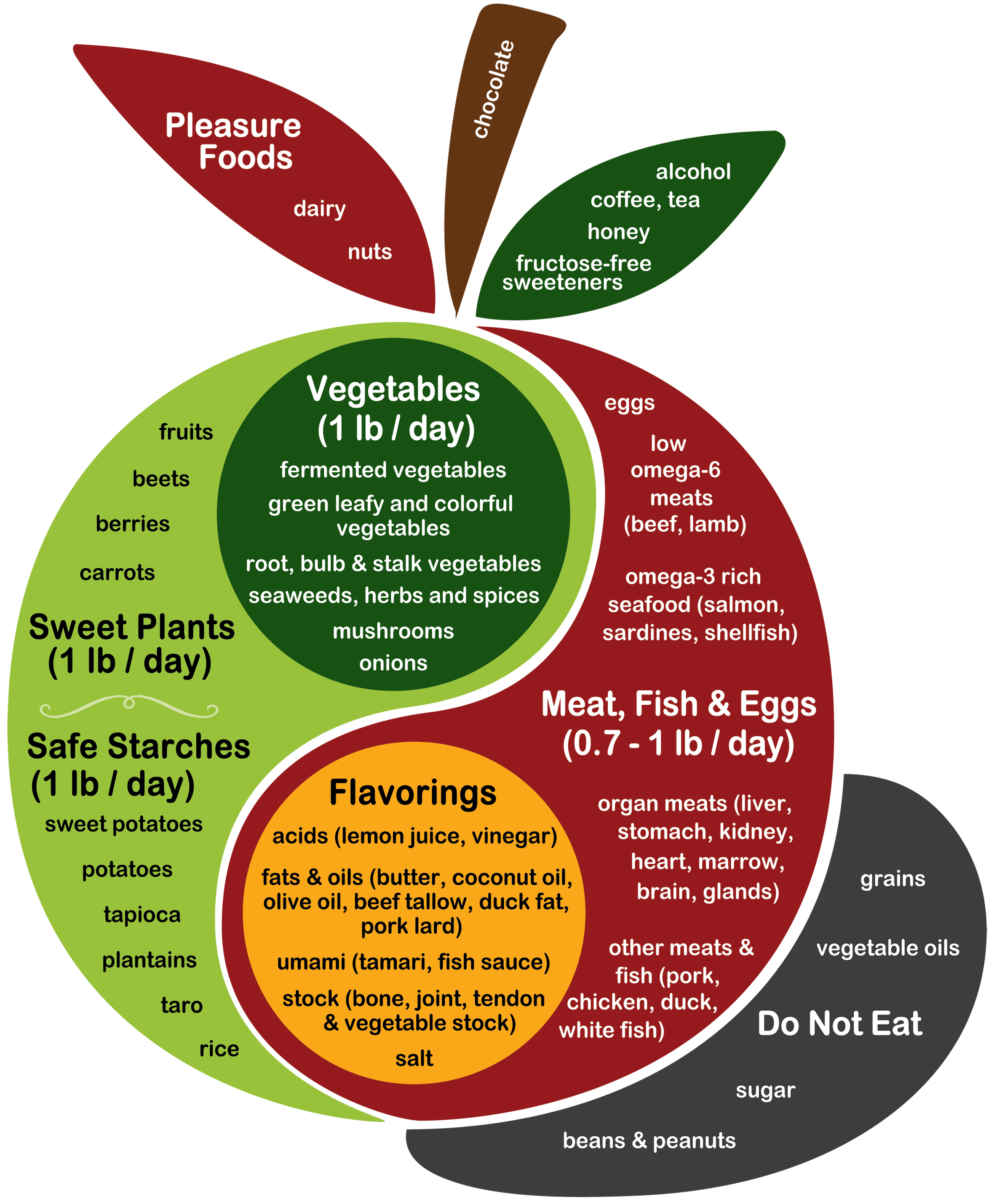
NOTE: This is our new food plate, updated 2015. Foreign translations of the original food plate may be found here.
We recommend:
- About 3 pounds [1.4 kg] of plant foods per day, including:
- About 1 pound [0.45 kg] of safe starches, such as white rice, potatoes, sweet potatoes, and taro;
- About 1 pound [0.45 kg] of sugary in-ground vegetables (such as beets or carrots), fruits, and berries;
- Low-calorie vegetables to taste, including fermented vegetables and green leafy vegetables.
- One-half to one pound [0.25 to 0.5 kg] per day of meat or fish, which should include organ meats, and should be drawn primarily from:
- ruminants (beef, lamb, goat);
- birds (especially duck and wild or naturally raised birds);
- Shellfish and freshwater and marine fish.
- Low omega-6 fats and oils from animal or tropical plant sources, to taste. Good sources include:
- butter, sour cream, beef tallow, duck fat;
- coconut milk or oil
- palm oil, palm kernel oil, olive oil, avocado oil, macadamia nut butter, almond butter, cashew butter
- Acids to taste, especially citric acid (lemon juice, lime juice, orange juice, grapefruit juice), lactic acid from fermented or pickled vegetables, vinegars, tannic acids from wine, and tomatoes.
- Broths or stocks made from animal bones and joints.
- Snacks or desserts from our pleasure foods: fruits and berries, nuts, alcohol, chocolate, cream, and fructose-free sweeteners like dextrose or rice syrup.
By weight, the diet works out to about 3/4 plant foods, 1/4 animal foods. By calories, it works out to about 600 carb calories, primarily from starches; around 300 protein calories; and fats supply a majority (50-60%) of daily calories.
In the shadow of the apple are foods forbidden because of their high toxin content. Notably:
- Do not eat cereal grains — wheat, barley, oats, corn — or foods made from them — bread, pasta, breakfast cereals, oatmeal. The exception is white rice, which we count among our “safe starches.” Rice noodles, rice crackers, and the like are fine, as are gluten-free foods made from a mix of rice flour, potato starch, and tapioca starch.
- Do not eat calorie-rich legumes. Peas and green beans are fine. Soy and peanuts should be absolutely excluded. Beans might be acceptable with suitable preparation, but we recommend avoiding them.
- Do not eat foods with added sugar or high-fructose corn syrup. Do not drink anything that contains sugar: healthy drinks are water, tea, and coffee.
- Polyunsaturated fats should be a small fraction of the diet (~4% of total calories). To achieve this, do not eat seed oils such as soybean oil, corn oil, safflower oil, sunflower oil, canola oil, or the like.
We highly recommend certain foods for their micronutrients. These include liver, kidney, egg yolks, seaweeds, shellfish, fermented vegetables, and bone broths.
We also recommend augmenting the diet with certain supplements. See our Supplement Recommendations page. These nutrients are deficient in modern diets due to removal of minerals from drinking water by treatment, depletion of minerals from soil by agriculture, or modern lifestyles that deprive us of vitamin D by indoor living.
We recommend tweaking the diet for certain diseases. Neurological disorders often benefit from a diet that is ketogenic; other conditions may benefit from lower carb diets. These variations are discussed in the book:
See the “Buy the Book” page for other purchase options.



 via this link:


Hi Paul,
Thank you so much for your thoughtful reply, your advice, and especially for continuing to pray for my father.
I want you to know that I will include you, your family, and Angiex in my daily prayers from now on. I will continue praying for you and your cancer research company for as long as I can. It genuinely makes me happy to know that my prayers mean something to you, just as your prayers for my father mean so incredibly much to me.
I have always had a strong desire to do things as correctly and thoroughly as possible, especially when it comes to the health of the people I love.
That is also why my brother and I have read your book several times. I wanted to understand everything properly, remember all your recommendations, and put the principles of the Perfect Health Diet into practice as carefully as possible.
Looking back, however, I think I may sometimes have taken certain things too far.
For example, I initially increased our consumption of saturated fats quite substantially because I felt better when I started eating more of them. I suppose I fell into the trap of thinking that if something was beneficial, having more of it would necessarily be even better.
But as you have often emphasized, the dose makes the poison, and even something beneficial can become harmful when consumed in excessive amounts. I am trying to keep that lesson in mind and find a better balance.
I am also deeply saddened by the thought that my father may have been living with undiagnosed and untreated diabetes for many years, possibly experiencing repeated episodes of very high blood glucose without any of us realizing how serious the situation was.
The doctors explained that the main artery supplying his leg was so severely calcified and obstructed that, according to their estimate, only about 5% of the necessary blood supply was reaching the lower part of his leg.
They also described the development of collateral vessels, which had apparently been compensating for the blocked artery to some extent.
From what I understood, the surgeons were able to improve the circulation on the left side during the operation, and they also inserted a stent.
I sincerely hope that the blood flow is now sufficient to nourish his left leg properly and that the reddish discoloration of his toes will gradually disappear.
Once his left leg has recovered, they intend to perform another procedure on his right leg. After that, they have mentioned the possibility of a third, smaller intervention.
I pray with all my heart that everything heals properly, that he develops no thrombosis or other complications, that an amputation will never become necessary, and that all his future procedures will go smoothly.
I am praying to God constantly for his protection.
Something else that continues to worry me enormously is the condition of the other arteries throughout his body.
I am frightened that the arteries supplying his heart, brain, or other organs might also be severely narrowed or obstructed without us knowing about it.
The possibility of coronary artery disease or problems with his carotid arteries is particularly frightening to me.
Nevertheless, I know that I must place my trust in God and allow the doctors to help my father. I pray that we are now taking the right steps and that his medical team will be able to stabilize his condition and protect him from further complications.
The doctors have also started administering insulin during his hospital stay.
Originally, our family doctor had recommended beginning treatment with metformin rather than insulin. However, before my father was admitted to the hospital, we had not yet started either medication.
Instead, we had been making substantial dietary changes and following the Perfect Health Diet more strictly. During that period, we managed to bring his fasting blood glucose down to approximately 177 mg/dL without glucose-lowering medication, compared with the much higher values he had initially.
At the time, I was hoping that his metabolism might continue to recover through diet and lifestyle changes alone.
I also had some concerns about whether starting medication might somehow interfere with his body’s natural ability to recover, or whether he might become dependent on medication in the long term.
I realize now that his blood glucose had probably been far too high for far too long, and that protecting him from further damage is the most important thing. I understand that the doctors are using insulin to manage his glucose safely during this critical postoperative period, and I do not want to interfere with his treatment.
Today, his pulse was approximately 92 beats per minute, and his blood pressure was around 140/80 mmHg.
After receiving insulin, his blood glucose was initially measured at 105 mg/dL. A few hours later, without having eaten anything in between, it had risen to approximately 130 mg/dL.
He is currently receiving antibiotics, blood-thinning medication, and painkillers.
His toes are still reddish, which continues to worry me. I pray that the discoloration will gradually subside as his circulation improves and his leg heals.
Regarding your comments about dairy and autoimmunity, I found your explanation and the studies you shared very interesting.
My father worked as a baker for decades and consumed large amounts of bread and baked goods throughout much of his life. Because of that, I have sometimes wondered whether certain foods might have contributed to inflammation or immune-related problems over the years.
Of course, I cannot know whether he has actually developed an autoimmune reaction to any particular food.
I also find the question of dairy products difficult.
Both my father and I really enjoy dairy, especially yogurt and sour cream, but I honestly do not know whether either of us reacts negatively to them. I am not even entirely sure how to recognize such a reaction in myself.
For now, I was thinking of continuing with moderate amounts of plain yogurt and sour cream, while observing how well my father tolerates them and how his glucose levels respond, provided that his doctors approve.
I will also try to keep his egg consumption moderate, perhaps around three eggs per day at most, because I do not want his omega-6 intake to become excessive.
Otherwise, my brother and I intend to continue preparing nutritious meals based on your recommendations, including homemade beef oxtail broth, beef as a main meat source, occasional beef liver, cooked and cooled potatoes with a little vinegar and fat, plenty of vegetables, and the other foods recommended in the Perfect Health Diet.
We will also include beets and green leafy vegetables, as you suggested.
I want to be especially careful not to overdo any single food or nutrient this time, but instead provide him with a balanced diet that supports his recovery.
I will make sure that anything we bring him is approved by the hospital staff and compatible with his current medications, diabetes treatment, and postoperative care.
As for supplements, I will continue holding off for now and will keep your suggestion about magnesium in mind for when his doctors consider it appropriate to reintroduce supplements.
Paul, is there anything else you would particularly recommend that we pay attention to during his recovery, whether in terms of nutrition, lifestyle, or anything else you think might be important?
I know that restoring his ability to walk comfortably is one of the most important goals, and I hope that once his circulation has improved sufficiently and the surgeons allow it, he will gradually be able to become active again.
I apologize if this message is somewhat long or disorganized. My brother and I have barely slept over the past few days, and I am finding it difficult to collect my thoughts properly.
My father means everything to me, and I am trying my very best to help him through this situation.
Thank you, Paul, for everything. I am so grateful that there are people like you who are willing to share their knowledge, show compassion, and take the time to help others.
I thank God for bringing us through the operation, and I continue praying for my father’s recovery.
I will also continue praying for you, your family, Angiex, and everyone who is suffering or in need.
May God bless you and your family, guide your work, and protect you always.
With heartfelt gratitude,
Marvin
Hi Marvin,
Everything can heal – the body has great restorative powers. But he has to be functional, able to walk and live naturally, otherwise it will be hard to stop a decline.
Yes, it’s important that he not overeat calories. His appetite will be a good guide. Just focus on equal amounts starch, meat/fish/eggs, fruits/berries/beets, and vegetables; then flavor with butter or sour cream, vinegar or lemon juice, stock, and fermented flavorings and foods, to taste.
Try time-restricted feeding, if he can limit calorie intake to a 6-8 hour window in morning and mid-day, that will help him recover. Then daily exercise and sunshine early in the day and at mid-day. For a 12-hour night, rest, relaxation, and red light.
Best, Paul
Hi Paul,
I just wrote you a rather long message, but unfortunately, I think it may have ended up in the spam filter again.
When I try to submit it once more, the website tells me that I have already posted the message. However, it does not appear, even when I refresh the page.
I have experienced this problem before, as you may remember. Perhaps it has something to do with the length of my message.
I just wanted to let you know in case it is waiting for approval in the spam filter.
Thank you so much, Paul!
Best regards,
Marvin
Yes, it was in spam, I’ve pulled it out and replied.
Best, Paul
That happened to me too.
Hi Ralph,
I’ve looked through spam and it doesn’t currently have one from you. I must have deleted the spam after you posted it. If you post again, let me know with a brief link-less comment and I’ll search the spam folder. You can also email me directly.
Best, Paul
Hi Paul
Not sure if this is the best place for a comment such as this, I’ve never commented or had social media, this is somewhat against the grain for me but I feel its important to be open and share right now instead of shutting everything out. I had a look at the Angiex page but it didn’t seem the appropriate place.
Ive been a longtime reader of your work, since 2012, and the essence of why I’m writing now is to express my gratitude. I take great inspiration from your work and your person as a man of great integrity; you are a light of inspiration right now as the outlook given me by doctors is very dark, your work has given me some sense of agency with diet and lifestyle choices (circadian entrainment) and positivity even though the outcome is out of my hands. It feels important to me to reach out now and express my gratitude. Any advice would be greatly appreciated, though I know you can’t offer direct medical advice.
Sorry to dump this, you are a light, the first place I thought to turn. I am writing from Melbourne, Australia and was also curious if clinical trials of Angiex cancer therapy would ever be available here, I am in the public system. To try and succinctly share my situation, I am/was an otherwise healthy almost 49 year old man, good blood pressure, lean, and strong. In recent weeks I suddenly started experiencing focal seizures. Scans revealed a large lesion in right temporal lobe up into the insular, initially thought to be slow moving tumour. Went onto craniotomy and debulking of tumour. Molecular analysis revealed darker picture. I have now been told grade 4 molecular glioblastoma, point blank I was told I have incurable brain cancer. Once craniotomy heals in next week, I think they intend to treat, though not cure, with radiation and chemo. I immediately thought of you … what would Paul do ? Your presence is a great light of inspiration and though I understand you may not be able to comment directly and I know you must have an incredible workload you are carrying with Angiex, love for family and all you do. I wanted to say thank you and god bless. And ask the question, what would Paul think/do and any hope of Angiex down under ? God bless mate
Hi Tom,
I’m sorry to hear of your cancer. That is horrible luck.
At this time, brain cancers are excluded from the Angiex clinical trial, so that is not an option. What can be an option, and I am not sure how this works in Australia, but in the US we have something called “compassionate use” or “expanded access” in which an investigational drug can be given on a one-patient basis by a cooperative doctor. In the US the doctor is required to make certain regulatory submissions to our FDA: the doctor has to file a treatment protocol and get it approved, and then file report any adverse events that could inform the FDA’s evaluation of drug safety. I don’t know how this would work in Australia. Since we don’t have a trial in Australia, an equivalent of the US regulatory pathway may not be available.
If you can find a doctor willing to administer our drug through compassionate use, we may be able to supply the drug and help with the protocol (contingent upon Australian regulations permitting shipment into the country of investigational drugs, which I would need to investigate). It should be a clinical oncologist at a research facility with experience as a clinical trial investigator.
Alternatively, if you are willing to travel to the US and reside here for the treatment period, I can ask a neuro-oncologist of my acquaintance if he would be willing to do it. If you were to come to the US for compassionate use, you would have to bear all the costs of travel and medical care. Health care is expensive in the US.
Why don’t you write me at my Angiex address, pjaminet@angiex.com, and let me know if either of these is feasible. From the sound of it you don’t have time to wait for us to start a brain cancers trial, which is planned to begin second half of 2027. So I think a compassionate use administration is the only way we can help.
Best, Paul
Hi Paul is your drug effective in stage 4 lung cancer?
Hi Bret,
Yes. AGX101 has potent on-tumor activity against all solid cancers, and so far our best results have been in lung tumors. We’ve dosed 38 patients total and 13 have had lung tumors as target lesions. The number of lung tumors treated is 24 target lesions (i.e. measured in size by the radiologist) and a similar number of non-target lesions. To date those have been metastases from other cancers rather than primary tumors, but it doesn’t really matter whether the tumors are primary or metastatic, they respond the same.
Here is an example. This is a fused PET-CT image with CT on the gray scale and PET in color.
The way our drug works is to attack both the tumor blood vessels and the tumor cells. Eliminating the blood vessels generates a coagulative necrosis that heals by scarring, while killing the tumor cells reduces metabolic activity and prevents spread of any tumor cells out of the tumor. As a result, the “success signal” is stable lesion size on CT with reduction in metabolic activity on FDG-PET. You see that success signal achieved in the linked image.
We believe that at the optimal dosing regimen we may achieve this success signal in most tumors of most solid cancer patients. We’re homing in on that dosing regimen now.
You can write me at one of the emails on the Angiex contact page, https://angiex.com/contact, for more information.
Best, Paul
Thank you very much
Tom,
You may find The book Surviving Terminal Cancer by Ben Williams worthwhile, if you haven’t read it already. Williams was diagnosed with glioblastoma in the 1990s and beat it by researching the condition and devising an unconventional treatment (which, in practice, was actually several treatments used in concert). Copies are available on Libgen, Annas Archive, etc.
The book is from 2002, and Williams subsequently published several articles updating his ideas/recommendations in light of new science, the most recent from 2017:
https://virtualtrials.org/williams.cfm
Good luck and God bless.
Dear Tom,
I am so sorry to hear about your diagnosis. I sincerely wish you all the best and, above all, lots of strength, courage, and a full recovery. Please know that you are in my thoughts and prayers. I will be praying for you and hoping with all my heart that everything turns out well.
Stay strong, Tom. Wishing you all the very best!
Warm wishes,
Marvin
Hi James
Thank you kindly mate, I appreciate you sharing that. I will look into Ben’s story and experience, it all helps.
All the best,
Tom
Thank you Paul for your compassionate and thoughtful response, it was very heartening to read. I will be in touch through that email depending on how things go here with oncology and initial treatment.
All the best,
Tom
Hi Paul,
Thank you so much from the bottom of my heart for your thoughtful reply, your incredibly valuable advice, and especially for continuing to pray for my father. I am also very grateful that you found my previous message in the spam filter and took the time to reply.
My brother and I will do our very best to put all your recommendations into practice, including a balanced Perfect Health Diet, appropriate calorie intake, time-restricted feeding, circadian rhythm entrainment, and eventually regular physical activity and sunlight.
I also want you to know that I will continue including you, your family, Angiex, and all your endeavors in my daily prayers.
I sincerely pray that God blesses Angiex and that the cancer treatment your company has developed will prove successful in clinical trials, helping as many people as possible and hopefully contributing to a future in which all forms of cancer can be cured. How wonderful it would be if, through your work, no one had to suffer from this terrible disease anymore.
I also pray that your extensive nutritional research and the valuable knowledge you have already brought together in the Perfect Health Diet will continue reaching more and more people, helping them improve their health and quality of life.
I deeply admire the dedication, effort, and care you have put into your research and all your projects.
I pray that God guides you in all your future endeavors, gives you strength and good health, and blesses your work with continued success. I sincerely hope that you will be able to accomplish all the good you have set out to achieve.
I wanted to give you another update on my father.
He is expected to be discharged from the hospital today, and my brother and I are currently here with him.
According to the surgeons, his left foot is now warm, and they successfully placed a stent in the artery supplying his left leg. I am deeply grateful that they were able to improve his circulation.
I sincerely hope and pray that over the coming weeks, the inflammation, redness, and swelling will gradually subside and that his toes and foot will eventually return to their normal, healthy color.
Unfortunately, there is something else that worries me.
On the heel of his left foot, where he previously had a small wound, an area has developed that the doctors described as necrotic.
They told us that the affected tissue should gradually separate as the wound heals and that it should not be removed at this stage.
The word “necrosis” frightens me enormously. I pray that the affected area is only superficial, that the underlying tissue is still healthy, and that the wound will heal completely without further complications.
The doctors have also told him that he should remain in bed and rest during the first weeks of recovery, at least until the staples in his left groin have been removed.
This made me think about what you have repeatedly emphasized regarding the importance of walking and restoring his natural physical activity.
I understand how important it is for his recovery that he becomes able to walk comfortably again, and I very much hope that he will soon be able to do so.
However, I am now wondering what you think about the recommendation that he should remain in bed for such a long period after the procedure, especially considering the importance of movement for his circulation and overall recovery.
Would you consider this amount of bed rest reasonable in his situation, or do you think it would be worth asking the surgeons whether some gentle, carefully supervised movement might be possible earlier?
I would be very grateful for your thoughts on this.
Yesterday at approximately 7 p.m., he received his last injection for thrombosis prevention. According to the doctor, no further injections are necessary from today onward.
He has now also received the following medication plan:
– Clopidogrel 75 mg once every morning, until November 18, 2026.
– Aspirin Protect 100 mg once daily at midday, long-term.
– Atorvastatin 20 mg once every evening, long-term.
– Candesartan 16 mg once every morning, long-term.
– Metformin 500 mg twice daily, once in the morning and once in the evening.
– Toujeo insulin U-300, 10 units at bedtime.
In a few weeks, the doctors intend to perform a similar procedure on his right leg.
I continue praying to God that everything heals without complications, that he never suffers a thrombosis, stroke, or heart attack, and that an amputation will never become necessary.
I am also praying that the necrotic area on his heel remains limited, that the wound heals properly, and that the arteries supplying his heart, brain, neck, and other organs are not affected to the same severe extent as those in his legs.
The doctors also mentioned that his cholesterol was approximately three times higher than it should be.
I have been wondering why his cholesterol levels became so elevated.
Could this be related to his longstanding diabetes and metabolic health? Or could chronic inflammation from dental problems he had many years ago have played a role?
He previously suffered from severely damaged teeth, but these were extracted years ago, and he has worn removable dentures ever since.
I know it is impossible to determine the exact cause from a distance, but I would be very interested in your thoughts.
Thank you again, Paul, for everything you have done for us.
Your kindness, your guidance, and your prayers have given me a great deal of strength during this incredibly difficult time.
My father means everything to me, and I am so grateful that he has made it through the first operation.
I will continue praying for his recovery, and I will also continue praying for you, your family, Angiex, your nutritional research, and all your other endeavors.
May God continue to bless you and your family, guide your work, and help you bring healing, hope, and relief to people around the world.
With heartfelt gratitude,
Marvin
Hi Martin,
Unfortunately diabetes causes deficits in wound healing and it is not uncommon for diabetics to have wounds that are slow to heal or that generate necroses. I’m sure his doctors have extensive experience in diabetic wound care.
The surgery and the staples have also left wounds which will be slow to heal. I can’t advise on what to do while the staples are in place, as I have no knowledge of the risks. Once the staples are removed he should move gently, but walk regularly. He should aim for 20 minutes walking outdoors in the early morning and 20 minutes outdoors walking at mid-day, with additional time on his feet as he feels comfortable.
As he recovers he should implement natural health methods fully. He should find then that he can bring his glucose into normal ranges. As that happens he will be able to reduce dose of his medications. It is good to have a home glucose monitor and home blood pressure monitor, and keep track of numbers.
High cholesterol is generally a result of small intestinal bacterial overgrowth or infection, leading to influx of microbial cell wall components into the body. Time-restricted feeding, natural whole foods, circadian rhythm entrainment, and support for mucosal immunity (e.g. eating liver and sunshine on bare skin) will help.
Dental problems and tooth or gum infections commonly do lead to intestinal infections and high cholesterol, as he is constantly swallowing the germs with his saliva. So a healthy mouth is helpful to everything downstream, including vascular health.
Best, Paul
Hi Paul,
Thank you so very much from the bottom of my heart for your thoughtful and detailed reply, your valuable advice, and especially for always taking the time to respond to me so quickly. I cannot adequately express how much your kindness, compassion, and continued support mean to me and my family.
Next Tuesday, we have another appointment at the hospital, where the staples are scheduled to be removed and the doctors will discuss the next steps in my father’s recovery and treatment.
I understand your advice about the importance of walking, and I sincerely hope that once his wounds have healed sufficiently and he is able to move safely, he will gradually be able to enjoy regular walks outdoors again, especially in the morning and around midday, as you recommended.
I also wanted to share some encouraging news with you: today, my father’s blood glucose was 122 mg/dL after eating! I was so happy to see this improvement, and I sincerely hope that his glucose levels will continue to stabilize as he recovers.
Nevertheless, I am still very worried about the condition of his other arteries, particularly those supplying his heart, brain, and lungs. These have not yet been examined in detail, and the thought that they might also be severely narrowed or obstructed frightens me enormously.
I pray every day that his other blood vessels are in better condition, that his wounds heal completely, that his circulation continues to improve, and that he will be spared any further serious complications.
I continue placing my trust in God and praying for my father’s recovery.
And of course, Paul, I continue praying every day for you, your family, Angiex, and all your other endeavors. I sincerely hope that God blesses your work and helps you accomplish everything you are striving to achieve.
Thank you again for everything, Paul. I truly cannot express how much your guidance, your prayers, and your willingness to help us mean to me. Your kindness has given me so much comfort and strength during one of the most difficult periods of my life, and I will never forget it.
May God continue to bless you and your family, protect you, and guide you in everything you do.
With heartfelt gratitude,
Marvin
Hi Marvin,
Thank you for sharing the good news. His other vessels are probably injured at present as well, but if he can practice good natural health practices, they will heal. Our body has remarkable healing powers and if we give the right inputs, we will get good outputs.
I wish you and him the best, please keep us posted.
Best, Paul
Hi Paul,
Thank you, thank you, thank you so much for everything, from the very bottom of my heart!
I truly cannot express how grateful I am for your kindness, your encouragement, your valuable advice, and your continued prayers for my father. Everything you have done for us means more to me than words could ever convey.
I also wanted to share some more encouraging news with you.
The redness in my father’s left foot is gradually decreasing day by day! I am so incredibly grateful for this improvement, and I continue praying to God that the procedure has successfully restored sufficient blood flow and that the collateral vessels, together with the treated artery, will now be able to supply his leg, foot, and toes with enough blood to heal properly.
And there is another wonderful development: today, his blood glucose was only 105 mg/dL two hours after eating!
Seeing these improvements gives me so much hope. I thank God every day, and I pray with all my heart that my father will continue recovering, that his wounds will heal completely, and that no further complications will arise.
I also sincerely hope and pray that all his upcoming procedures will be just as successful and that he will eventually be able to walk comfortably again.
Next Tuesday, we have another appointment at the hospital, where the doctors will examine his recovery and discuss the next steps.
Paul, I cannot thank you enough. Sometimes I feel that I could never possibly repay all the kindness, patience, and compassion you have shown me and my family. Please know that I will never forget what you have done for us.
I will certainly continue keeping you updated, as you kindly asked.
And I will continue praying every day for you, your family, Angiex, and all your endeavors. May God bless you, protect you, and guide you in everything you do.
Thank you for everything, Paul. Truly, from the bottom of my heart.
With heartfelt gratitude,
Marvin
Hi Marvin, thank you for the continued updates. I’m very happy for you and your father. God bless you both, and thank you for your prayers.
Hi Paul,
I hope you, your wife, your family, and everyone at Angiex are doing well.
I wanted to give you another update on my father’s situation. There have been some very encouraging developments regarding his diabetes, but unfortunately, there have also been some developments concerning his vascular condition that have left me extremely worried and frightened.
Before I tell you about everything that has happened, I want to thank you again from the very bottom of my heart for everything you have done for us.
I cannot adequately express how much your guidance, your compassion, your patience, and your prayers have meant to me throughout these past weeks. You have given me so much strength and hope during an incredibly difficult period of my life.
My father’s blood glucose and his progress with the Perfect Health Diet
My father is still taking the medications prescribed to him during his hospital stay. However, instead of the original 10 units of insulin, he is now injecting only 2 units once a day, at 10 p.m., which is the time of administration originally specified by the hospital.
His fasting blood glucose is now consistently between 80 and 90 mg/dL, and his blood glucose two hours after a meal no longer exceeds 110 mg/dL.
Considering that his fasting blood glucose was initially above 300 mg/dL and his HbA1c was approximately 11%, I am incredibly grateful for this development.
My hope would be that, as his metabolic health continues to improve, he might eventually be able to reduce his medications further under medical supervision. However, with his second vascular operation approaching, I do not want to make any further changes that might destabilize his condition before the procedure.
My brother and I have continued to follow the principles of the Perfect Health Diet very consistently, taking your recommendations into account as carefully as possible.
I am deeply grateful for the contribution your work and your personal guidance have made to these improvements, alongside the medical treatment he is receiving.
I thank God for guiding me to your book and your blog. I cannot imagine how much more difficult this entire situation would have been without the knowledge you have shared with us and the encouragement you have given me.
Every evening, I include you, your wife, your family, Angiex, and all your endeavors in my prayers.
I pray with all my heart that the cancer treatment you and your team have developed will be successful, that it will ultimately be effective against every form and stage of cancer, and that it will one day be able to help every person suffering from this terrible disease.
I also pray that the knowledge you have gained through your extensive nutritional research and brought together in the Perfect Health Diet will continue to reach more people and help them recover their health.
I pray for everything you, your wife, and your team are researching, developing, and working to accomplish. I ask God to guide you along the right paths, bless your work with success, protect you, and give you the strength and good health to continue helping others.
I will continue to include all of these things in my daily prayers.
The exact diagnoses and findings from my father’s hospital discharge report
As you may remember, my father underwent his first vascular operation on the left side on October 15, 2026, and was discharged from the hospital on October 20, 2026.
I would like to share the detailed findings from his discharge report with you so that you have a more precise understanding of his vascular condition and the procedure that was performed.
The following principal diagnoses are listed in the discharge report dated October 20, 2026. I have translated the original German medical terminology into English as accurately as possible.
Principal diagnoses:
– Peripheral arterial disease (PAD), Fontaine stage IV, on the left: subtotal stenosis of the common iliac artery (CIA), high-grade stenoses of the common femoral artery (CFA) and profunda femoris artery (PFA), and proximal occlusion of the superficial femoral artery (SFA).
– Peripheral arterial disease (PAD), Fontaine stage IIb, on the right: occlusion of the external iliac artery (EIA), occlusion of the common femoral artery (CFA), and stenoses of the superficial femoral artery (SFA).
Treatment:
Left groin thromboendarterectomy (TEA) and percutaneous transluminal angioplasty with stent placement (stent-PTA) of the left common iliac artery on October 15, 2026.
Medical history, diagnostic findings, and treatment:
The discharge report states that the patient presented with peripheral arterial disease classified as Fontaine stage IV.
Duplex ultrasonography revealed functional occlusions of the left common iliac artery and the left common femoral artery. Consequently, additional CT angiography was performed for further treatment planning.
A thromboendarterectomy of the left groin and stent angioplasty of the left common iliac artery were subsequently performed.
According to the discharge report, the postoperative course was uncomplicated.
Due to the additional presence of intermittent claudication on the right side, with a pain-free walking distance of less than 100 meters, a right-sided groin thromboendarterectomy with an intraoperative attempt to recanalize the external iliac artery was identified as a potential subsequent treatment option.
Because his cardiovascular risk factors had previously been inadequately controlled, basal insulin-supported therapy was initiated in view of an HbA1c of 11%.
Due to an LDL cholesterol concentration of 180 mg/dL, lipid-lowering therapy with atorvastatin was also initiated.
Because his systolic blood pressure was above 150 mmHg, treatment with candesartan was started.
Following stent angioplasty in the pelvic arterial circulation, the hospital recommended dual antiplatelet therapy with aspirin and Plavix (clopidogrel) for four weeks, followed by antiplatelet monotherapy.
The patient was discharged from inpatient treatment on October 20, 2026.
That is the information contained in his hospital discharge report.
My concerns about the blood supply to his legs and feet following the first operation
Unfortunately, there have been some developments concerning his vascular condition that are causing me considerable distress.
I am finding it extremely difficult to cope with the situation emotionally because I am so frightened for my father.
I am particularly afraid that the blood supply to his legs and feet might still be inadequate, that his wounds might not heal properly, that an amputation could eventually become necessary, or that something could go wrong during his second operation, which is currently scheduled for December 1, 2026.
I have been trying very hard to arrange additional medical examinations because I am also concerned about the condition of the other arteries throughout his body.
My father has statutory health insurance here in Germany rather than private health insurance. Unfortunately, we have found it extremely difficult to obtain timely appointments with specialists and to have enough time with the doctors to discuss our concerns properly.
I eventually managed to arrange an appointment with an outpatient angiologist on November 19, 2026, after repeatedly expressing my concerns to our family doctor.
Our family doctor arranged an expedited specialist appointment through a referral system known here in Germany as a Hausarztvermittlungsfall.
The original reason for arranging this appointment was to have my father’s carotid arteries examined by ultrasound because I am concerned that the severe atherosclerosis in his legs might also be present in the arteries supplying his brain.
Unfortunately, the carotid ultrasound examination was not performed during the appointment.
Instead, the appointment primarily focused on his legs.
This was also the first time since his operation on October 15 that, to my knowledge, a doctor had specifically examined the arterial circulation in his legs again.
The angiological examination on November 19, 2026
At the beginning of the appointment, the medical assistant measured his blood pressure in both arms.
The results were:
– Left arm: 130/80 mmHg.
– Right arm: 160/80 mmHg.
As you know, my father is already taking blood pressure medication.
The difference of approximately 30 mmHg in systolic blood pressure between his two arms also worries me, and I wonder whether this finding should be investigated further.
The medical assistant subsequently placed what appeared to be blood pressure cuffs around both of his lower legs, just above his ankles.
She applied ultrasound gel to different areas of both feet and attempted to measure the arterial blood flow using an ultrasound device.
She spent quite some time performing these measurements and repeatedly asked my father to turn and reposition his feet.
Eventually, she told us that she could not obtain a measurable blood flow signal in his right foot and that she could detect only a very minimal signal in his left foot.
Hearing this frightened me enormously.
I told her that this did not sound good, and she agreed. However, she explained that she could not provide a medical interpretation and that the doctor would have to discuss the results with us.
I immediately thought back to what had happened at the hospital before my father’s first operation.
When we initially took him to the emergency department in October, the doctors performed an ultrasound examination and initially told us that a Y-shaped vascular graft might be necessary.
However, after performing CT angiography, they told us that the findings on the CT images did not appear quite as severe as they had initially expected based on the ultrasound examination, and that a Y-shaped graft would not be necessary after all.
Instead, they proceeded with the left groin thromboendarterectomy and stent angioplasty of the left common iliac artery.
Remembering this makes me wonder whether the difficulty detecting blood flow during the recent outpatient examination might not necessarily reflect the full extent of the actual blood supply to his feet.
Nevertheless, I am extremely worried.
If the medical assistant could detect almost no arterial blood flow in either foot on November 19, does that mean the first operation on his left side might not have restored sufficient circulation?
Could there still be enough blood reaching his feet through collateral vessels, even if the usual arterial signals are difficult to detect during such an examination?
I simply do not know how to interpret these findings, especially because his left foot looks considerably better than it did before the operation.
Unfortunately, the angiologist himself spent very little time examining my father, and we did not receive a detailed explanation of the measurements performed by the medical assistant.
He performed a brief ultrasound examination around my father’s upper thighs and groin area.
He mentioned that the stent was located in the left pelvic arterial circulation, and when I specifically asked him whether the stent was open, he told me that it was patent.
However, he did not explain the overall condition of the arteries in my father’s legs or the significance of the difficulty detecting blood flow in his feet.
I left the appointment with many unanswered questions and even more anxiety than before.
The persistent numbness in his left thigh
Since the first operation, my father has also experienced numbness in his left thigh.
The surgeons at the hospital had previously told us that this numbness should improve over time.
However, the outpatient angiologist told us that the numbness would not disappear and described it as a “cosmetic defect,” or a permanent minor consequence of the operation.
I was very surprised by this statement because it was completely different from what the surgeons at the hospital had told us.
I do not understand how two doctors can give such different assessments of the same symptom, particularly when the angiologist examined my father only very briefly.
I sincerely hope that the numbness will gradually improve as the tissues and nerves recover from the operation.
The large hematoma in his left groin
My father has also developed a considerable hardened area beneath the surgical wound in his left groin, where the surgeons accessed the artery during the first operation.
He had initially thought that the hardened area might be the stent itself.
The angiologist explained that this was not the stent, as the stent was located further up in the pelvic artery. Instead, he described the hardened area as a very large hematoma.
He told us that it would take a long time for it to resolve.
When I asked him whether a hematoma of this size was normal following such an operation, he told me that it was larger than what would normally be expected.
This was another thing that left me worried, particularly because my father is taking antiplatelet medication.
I hope that the hematoma will gradually resolve without complications and that it is not affecting the surrounding tissues or blood vessels.
The necrotic areas on his left heel and the current appearance of his foot
As I mentioned in my previous messages, my father still has necrotic areas on his left heel.
Before he knew that he had diabetes and severe arterial circulation problems, he thought he had a splinter in his heel and attempted to remove it himself.
In doing so, he created a wound that subsequently failed to heal properly and developed areas of necrotic tissue.
The doctors at the hospital previously told us that the necrotic tissue should be left in place for the time being and that it would gradually separate as the wound healed.
When I asked the outpatient angiologist about this, he essentially told us the same thing.
From its external appearance, the necrotic tissue does not seem to be particularly deep, although I realize that I cannot reliably assess the depth of the wound myself.
The encouraging thing is that the appearance of his left foot has improved considerably since the operation.
The pronounced redness of his left toes has almost completely disappeared. His heel is still somewhat reddish, and the necrotic areas remain, but overall, his foot looks much better than it did before the operation.
Nevertheless, he is still experiencing pain.
I find it extremely difficult to assess his condition based on the appearance of his foot alone.
On the one hand, I can clearly see that the redness has decreased. On the other hand, I cannot stop thinking about the medical assistant’s statement that almost no arterial blood flow could be detected in either foot.
I pray to God that the operation has restored enough blood flow, including through the collateral vessels, to adequately nourish his leg, foot, toes, and heel, and that the remaining wounds will eventually heal completely.
The angiologist also told us that if my father were to develop a wound on his right foot now, the same thing could happen there as happened to his left heel.
Hearing this made me even more frightened about the severity of his vascular condition.
The cardiological examination on November 17, 2026
Because I am also extremely concerned about the arteries supplying his heart and other organs, I managed to arrange an appointment with an outpatient cardiologist on November 17, 2026.
Again, this was only possible because our family doctor arranged an expedited specialist appointment.
The cardiologist performed a brief electrocardiogram (ECG) and an ultrasound examination of my father’s heart.
He told us that he had found no evidence indicating that my father had previously suffered a heart attack or that he had a weak heart.
He also told us that the arteries and structures he was able to visualize during the ultrasound examination appeared appropriate for my father’s age. My father is 68 years old.
However, the cardiologist explained that there could still be narrowing or blockages in coronary arteries that could not be adequately visualized during the ultrasound examination.
He therefore recommended that my father undergo a cardiac CT examination, which is currently scheduled for December 23, 2026.
I am now uncertain about what to do.
On the one hand, I desperately want to know whether the arteries supplying my father’s heart are in a similarly severe condition to those supplying his legs.
On the other hand, I am concerned about exposing him to additional radiation and contrast agents, particularly because he has already undergone CT angiography and a vascular intervention and is scheduled to undergo another operation on December 1.
I do not want to overlook a potentially serious problem, but I also do not want to expose him to unnecessary examinations or additional risks.
I would be very interested in your thoughts on this and whether there are particular questions you think I should discuss with his cardiologist before the cardiac CT examination.
I am also still concerned about his carotid arteries, the arteries supplying his brain, and the vascular condition of his other organs, including his lungs.
These concerns have been constantly on my mind.
His upcoming second vascular operation on December 1, 2026
My father is scheduled to be admitted to the same hospital again on Monday, November 30, 2026.
The second operation, this time on the right side, is currently scheduled for the following day, Tuesday, December 1, 2026.
Based on the previous discharge report, the intended procedure may involve a right-sided groin thromboendarterectomy and an intraoperative attempt to recanalize the right external iliac artery.
I sincerely hope that the surgeons will be able to restore sufficient circulation to his right leg and foot without complications.
However, Paul, I must admit that I am extremely frightened.
I am struggling to cope with the uncertainty surrounding his condition, and I keep wondering whether we have chosen the right hospital and whether my father is receiving the best possible treatment.
Most of the doctors at the hospital were very friendly toward us during his first admission, and I am grateful to the surgeons for performing his first operation.
The hospital has an angiological department, and this is the department where he has been receiving treatment.
Nevertheless, during his previous hospital stay, we repeatedly heard distressing news about other patients requiring amputations and suffering from severe vascular complications.
The atmosphere on the ward was often very tense, and seeing so much suffering made me even more frightened about what might happen to my father.
I know that the experiences of other patients do not necessarily predict what will happen to him. Nevertheless, it is very difficult for me not to think about these things.
Unfortunately, we do not personally know anyone with expertise in vascular medicine or vascular surgery who could recommend a particular hospital, specialist, or surgical team to us.
My father has statutory health insurance, and arranging timely specialist appointments has already been extremely difficult.
I often feel that we are navigating this entire situation without knowing whom to turn to for independent guidance.
I keep asking myself whether the hospital we have chosen is the right one, whether the surgeons have sufficient experience with such severe arterial disease, and whether there might be another hospital or specialized vascular center that would be better suited to his condition.
At the same time, I do not want to delay a potentially important operation or make a decision based purely on fear.
I remember your previous advice very well. You told me that restoring his ability to walk was extremely important and that I should not delay treatment of his leg arteries because of concerns about the other vessels in his body.
I also remember you telling me before his first operation that I needed to allow the doctors to help him because they were in a better position to assess his condition than either you or I.
I have not forgotten your words, and I am trying very hard to keep them in mind.
What makes the situation particularly difficult is that the doctors often seem to have very little time.
Sometimes it feels as though we are fortunate if we can speak to a doctor for even two minutes.
There are so many questions I would like to ask, but often there is barely enough time to ask even the most important ones.
I understand that the doctors have many patients and enormous responsibilities. I do not want to criticize them unfairly.
But as a son who is desperately worried about his father, it is extremely difficult to leave him in the hands of people I hardly know, without fully understanding what is happening, what the risks are, or whether we are making the best possible decisions.
My father means everything to me.
I am terrified of the possibility of an amputation, of his wounds not healing, of his feet not receiving enough blood, or of something going wrong during the upcoming operation.
I am also frightened that he might suffer a heart attack, a stroke, thrombosis, or another serious complication.
Sometimes I find it very difficult to manage all these fears.
I pray to God every day that He protects my father, guides the surgeons, helps them make the right decisions, and allows them to restore adequate blood flow to both of his legs and feet.
I pray that the first operation has been sufficiently successful, that the left-sided circulation will remain stable, that the hematoma will resolve, that the numbness will improve, and that the necrotic areas on his heel will heal without any further tissue loss.
I also pray that the upcoming operation on his right side will be successful and that all subsequent procedures will go well.
My greatest hope is that my father will eventually be able to walk comfortably again, spend time outdoors, enjoy the morning and midday sunlight, regain his independence, and fully implement the natural health practices you have recommended to us.
I want him to be able to enjoy his life again.
I would be very grateful for your thoughts and prayers
Paul, I know that you cannot assess the quality of a particular hospital or determine the exact condition of my father’s arteries from a distance.
I would never want to place that responsibility on you.
Nevertheless, your knowledge, your perspective, and your advice mean an enormous amount to me.
If there is anything else you think we should pay particular attention to, anything you think we should ask the vascular surgeons, or anything we could do to support my father’s recovery alongside his medical treatment, I would be very grateful for your thoughts.
I would also be interested in your perspective on the discrepancy between the considerable visual improvement in his left foot and the difficulty detecting arterial blood flow during the recent examination.
Do you think the improvement in his blood glucose, together with adequate nutrition and eventually regular physical activity once he is medically able to walk safely, could give his body a better opportunity to heal and recover from the damage that has accumulated over the years?
I am trying to hold on to the hope you have given me through your repeated reminders of the body’s remarkable restorative abilities.
I would be especially grateful if you could keep my father in your prayers again on Tuesday, December 1, when his second operation is scheduled to take place.
Please pray that God protects him throughout the procedure, guides the surgeons’ hands and decisions, and allows them to restore sufficient blood flow to his right leg and foot.
I pray that there will be no complications, no thrombosis, no heart attack, no stroke, and that an amputation will never become necessary.
I pray that his wounds will heal completely and that he will gradually regain his health, strength, and ability to walk.
Your prayers during his first operation meant more to me than I could ever adequately express. As I told you at the time, knowing that you were praying for him also gave my father comfort shortly before he was taken into surgery.
I will never forget that.
Thank you, Paul, from the very bottom of my heart, for everything.
Thank you for always taking the time to read my messages, even when they are very long. Thank you for answering my questions, for sharing your knowledge with us, for encouraging me when I am frightened, and for continuing to pray for my father.
I know that you have your own family, your own responsibilities, your company, your research, and countless other things that require your time and attention. The fact that you still take the time to help us means more to me than you could possibly imagine.
I sometimes feel that I could never repay the kindness you have shown me and my family.
Please know that if there is ever anything I can do to help you, I would gladly do so.
I thank God for guiding me to your work and for giving me the opportunity to get to know you.
I will continue praying every evening for you, your wife, your family, Angiex, the success of your cancer treatment, the Perfect Health Diet, and every project and endeavor that is close to your heart.
I pray that your cancer treatment will fulfill its greatest potential and that one day, through the work you and your team are doing, no person will have to suffer or lose a loved one to cancer anymore.
I pray that God blesses all the knowledge you have already gained through your research and allows it to reach and help countless people around the world.
May He guide you in everything you do, protect you and your loved ones, give you strength and good health, and bless all your endeavors with success.
I will certainly continue keeping you updated on my father’s condition.
Thank you for everything, Paul. I truly cannot thank you enough.
May God continue to bless you and your family.
With my deepest and most heartfelt gratitude,
Marvin
Hi Marvin,
Congratulations on the progress your father has made. There is plenty of opportunity for further progress toward normal health.
Please keep in mind that I am not a doctor and the following is not medical advice.
He definitely has arterial issues throughout his body, not just in his legs. You can see that in the differential blood pressures in his arms. The pulse pressure (systolic – diastolic blood pressure) is 50 in the left arm and 80 in the right arm. Both are elevated, 40 is normal, but the left arm is close to normal while the right arm indicates peripheral arterial disease.
You are right to assume that vessels within or to the brain are probably also affected. However, the brain controls the heart. The brain knows how much blood it needs and forces the heart to provide it. You can be confident his brain, on average, is getting the right amount of blood. So if his legs are getting too little, that means the state of his leg arteries is worse than the state of his brain arteries, especially given that gravity pulls the blood downward. So you shouldn’t be panicked about his brain arteries.
Moreover, there are limits to what doctors can do. What will cure this condition are natural health methods. Fundamental to natural healing of vascular disease is the ability to walk, and to heal wounds. So you need to continue to focus on enabling him to walk, and improving metabolic health. The doctors are right to focus on his legs because enabling him to walk is the best way to help the arteries to his brain and arms.
Improving his metabolic health is the best way to improve his wound healing. Diabetics do not heal wounds well, including vascular wounds. If you improve his diabetes enough that his foot wound heals, then you can be confident his arteries will have begun healing likewise.
Similarly, the wound healing impairment caused by his diabetes may be what led to the poor healing and injuries at the surgical site. Given his poor wound healing, I would be cautious about more surgeries than are necessary to enable him to walk. I would try to get the leg issues resolved as best as possible, and then get him diagnosed for blockage in arteries to the heart or brian, which would create a risk for heart attacks or strokes. But once you know the status, the best treatment may still be natural health approaches.
He should walk as much as he can without pain, and continue to focus on good diet, an extended overnight fast, and circadian rhythm entrainment. In addition to walking, he can do yoga-style stretching, doing both folded and stretched positions, and seeking to expand his range of motion; and he should do something that elevates his pulse to create “shear stress” on his vessel walls which promotes healing. That might be something like body weight squats. Any exercise done vigorously for 7 seconds may raise his pulse for 30-60 seconds. Try to keep the pulse elevated for several minutes in the early morning and several minutes at mid-day.
Again, not medical advice, but if it were me I would monitor biomarkers and as things improve, reduce the dosage of drugs: (1) Keep reducing drugs for glucose control starting with insulin — exogenous insulin is not good. Already it seems like he probably does not need insulin. Consider less aggressive drugs like metformin. (2) Target 130 mg/dl for LDL cholesterol and reduce the dose or come off statins as the number lowers. (3) Target normalization of blood pressure to 110 over 70 and reduced pulse. Natural methods for blood pressure and pulse are best. (4) As his health improves try to reduce the dose of any other drugs he has been prescribed.
I think the most critical thing continues to be improving the supply of blood in his legs and enabling him to walk.
Best, Paul
Hi Paul,
Thank you so incredibly much from the very bottom of my heart for taking the time to reply to me so quickly and in such detail.
I am deeply grateful for all your thoughts, explanations, encouragement, and guidance. Your words mean an enormous amount to me, especially during this difficult time.
Please rest assured that I fully understand that you are not a medical doctor and that I do not regard your comments as medical advice. I greatly appreciate your willingness to share your general thoughts, knowledge, and personal perspective with me.
There is just one point I would like to clarify to make sure I have understood you correctly.
When you mentioned that, given my father’s impaired wound healing, you would be cautious about performing more operations than are necessary to enable him to walk, I wondered whether you were also referring to his upcoming second operation on the right side.
Given the arterial occlusions and stenoses described in his hospital discharge report, and considering everything I have told you about his current condition, would you personally still proceed with the second operation on his right side this coming Tuesday, December 1, if you were in his position and the vascular surgeons considered it necessary?
Or would you personally be more cautious about proceeding with this particular operation at this time?
I fully understand that the necessity and risks of the operation must ultimately be assessed by his treating vascular surgeons. I am simply interested in your personal perspective and want to make sure that I have understood your previous message correctly.
I am just so frightened for my father, and the uncertainty surrounding his condition and the upcoming operation is very difficult for me to cope with.
Thank you again, Paul, from the very bottom of my heart, for everything you have done and continue to do for us.
I cannot thank you enough for your kindness, your patience, your willingness to share your knowledge with me, and especially your prayers for my father.
I will continue praying every evening for you, your wife, your family, Angiex, and all your endeavors.
May God continue to bless you and your family, protect you, and guide you in everything you do.
With my deepest and most heartfelt gratitude,
Marvin
Hi Marvin,
As far as that procedure, it has to be your call, I am too far removed from the situation to form an opinion. A few key considerations:
– What exactly is preventing him from walking? Does the pain arise on the right side, the left, or both? The more indication you have that right side vascular impairment is stopping him from walking, the more he should pursue the procedure.
– Is the necrotic wound on the left or right? Is the right foot cold? When you palpitate it does the color change between pink and white? The more severe the right side problem, the more he should pursue the procedure.
You can probably expect similar healing issues on the right side as he’s had on the left, so weigh those against having the procedure.
The doctors have experience in this area so you should give weight to their recommendation. At the same time, to the man whose only solution is a hammer, all problems look like nails. You have to compare their recommendation to your alternatives. But the alternative natural health approach depends on an ability to walk. If he can’t walk, you need their help.
Best, Paul
Hi Paul,
Thank you so incredibly much from the very bottom of my heart for your quick reply, for taking the time to think about my father’s situation, and for raising these important questions.
I am deeply grateful that you are willing to share your thoughts with me. Please know that I fully understand that you are not a medical doctor, that you cannot assess my father’s condition from a distance, and that I do not regard your comments as medical advice.
I would like to answer your questions as thoroughly and accurately as possible and explain the reasons why my brother and I are finding this decision so difficult.
I have spoken extensively with my father again today, asked him about his symptoms, and carefully examined the appearance of both of his feet. I hope that the following information will give you a more complete understanding of his current situation.
1. My general concerns about further vascular surgery
I have several concerns regarding the upcoming operation.
First, as you mentioned, I am very worried about his impaired wound healing.
During the first operation on his left side, the surgeons performed a thromboendarterectomy, meaning that they surgically removed obstructive material from inside the artery, as well as placing a stent in his left common iliac artery.
As I understand it, they are planning a similar procedure on his right side, although we have not yet been given a detailed explanation of the exact surgical approach.
I am concerned not only about the healing of the external surgical wound in his groin, but also about the healing of the arterial walls themselves after they have been surgically manipulated.
Given his diabetes, which has presumably been present for some time, his severe circulatory impairment, and his apparent difficulties with wound healing, I wonder whether the internal injuries caused by such procedures could also take considerably longer to heal or lead to additional complications.
My second concern is that doctors, like all human beings, can make mistakes, even when they are experienced and have the best intentions.
I also worry that performing several separate vascular interventions might create complications in the future that would not otherwise have occurred.
During his first hospital stay, the doctors explained that they would initially focus on reopening the arteries higher up in his left leg and pelvic region rather than attempting to reopen all the obstructed arteries further down his leg.
My understanding was that they hoped improving the blood supply at this higher level would allow sufficient blood to reach the lower leg and foot, including through the collateral vessels.
I sincerely hope that this approach will prove successful.
However, as someone without medical training, I cannot help wondering about the long-term consequences of performing these interventions in stages.
I imagine there must be limits to how often an artery can be surgically treated and how many interventions can be performed before the procedures themselves potentially create additional difficulties.
I worry that if interventions are performed too quickly, without sufficient consideration of their long-term consequences, or if they do not achieve the intended improvement, we might eventually reach a situation in which fewer treatment options remain available.
I realize that I do not have the medical knowledge necessary to determine whether these concerns are justified in my father’s particular case.
Nevertheless, these thoughts are constantly on my mind.
I would like every intervention to be carefully considered, with a clear understanding of why it is necessary, what improvement is realistically expected, what risks are involved, and what alternatives might exist.
2. My father’s current physical and emotional condition
Unfortunately, my father is not feeling particularly well at the moment, either physically or emotionally.
He believes that some of the medications he is currently taking may be causing side effects.
He has developed a facial rash and has been experiencing pain in his hands and wrists, which he suspects may be related to his medications. Of course, we do not know whether the medications are actually responsible for these symptoms.
He is currently inclined to proceed with the second operation.
He told me that he does not want to risk having his legs amputated because insufficient blood is reaching them.
He also told me something that made me realize even more clearly how much he is suffering. He said that I am not the one who has to endure his pain and live with the fear of what might happen to his legs, and that I cannot fully understand how bad he is feeling at the moment.
He did not say this to hurt me, and I did not take it that way.
He is absolutely right that neither my brother nor I can fully understand what it feels like to be in his position.
I can see that he is physically and emotionally exhausted and that the entire situation has taken an enormous toll on him.
I sometimes have the impression that his pain, fear, and exhaustion are making it difficult for him to think through all the possible risks and alternatives calmly.
Although he gives us the impression that he wants to proceed with the operation, I am not entirely sure that he himself feels completely certain about the decision.
I understand that he wants relief from his pain and that he is terrified of losing his legs.
My brother and I want exactly the same thing for him. We want him to recover, regain his ability to walk, and be able to enjoy his life again.
We simply want to make sure that everything possible is being done to achieve that goal without exposing him to unnecessary additional risks.
Ultimately, I also want to respect my father’s wishes and his right to make decisions about his own treatment.
3. The two necrotic wounds are located exclusively on his left heel
To answer your question about the location of the necrotic wounds, both of them are on his left foot.
More precisely, they are located at the very back of his left heel, over the heel bone, approximately where the back of a shoe would normally come into contact with the heel.
There are no necrotic wounds on his right foot.
The two wounds on his left heel developed before his first operation and before he knew that he had diabetes and severe arterial circulation problems.
At that time, he believed that he had two small splinters in his heel.
He therefore used a pair of scissors to open the skin slightly in two places in an attempt to remove what he believed were splinters.
Unfortunately, these small injuries did not heal properly, and necrotic tissue subsequently developed in both areas.
One of the wounds resembles a slightly widened crack or fissure, with black tissue visible inside it.
The second wound, located next to the first, is larger and approximately round. I would estimate that it is roughly the size of the tip of an index finger. It also contains black tissue.
The skin around these areas appears to be peeling or gradually separating, and it looks as though the affected tissue might eventually detach.
This seems consistent with what the doctors at the hospital and the outpatient angiologist told us, namely that the necrotic tissue would gradually separate as the wounds healed.
However, I realize that I cannot reliably determine the actual depth of these wounds or the condition of the underlying tissue simply by looking at them.
There is also some mild redness in the heel itself, around or beneath the area where the two necrotic wounds are located.
The heel is not extremely red or severely swollen. Nevertheless, it appears slightly reddish beneath the skin, and I am worried that there might be some inflammation or possibly an infection deeper within the heel.
It is very difficult for me to assess this visually.
An orthopedic doctor also told my father some time ago that he had a heel spur. My father believes that it was in his left foot.
We do not know whether this might be contributing to some of the discomfort in his left heel or foot.
I am also concerned that encouraging him to walk more at this stage could place additional mechanical pressure on the heel, the two necrotic wounds, and any potentially inflamed tissue underneath.
I understand the importance of walking for his recovery, but I also want to make sure that walking does not interfere with the healing of his heel.
4. The appearance of his left foot before and after the first operation
Before his first operation, my father’s left foot suddenly became considerably swollen, and all the toes on his left foot became red.
The redness extended from his toes toward approximately the middle of his foot, but it did not extend all the way to his heel.
This appeared to be separate from the two small injuries he had previously created on his heel.
At that time, he was barely able to walk at all.
The sudden swelling and pronounced redness of his toes were what prompted me to take him to the emergency department.
Following the operation on October 15, the swelling in his left foot initially disappeared.
During his hospital stay, he also received antibiotics and intravenous infusions for several days.
Unfortunately, his left foot has since become mildly swollen again, and this slight swelling now seems to be present continuously.
His right foot is not swollen.
The most encouraging development, however, is that the pronounced redness of his left toes has almost completely disappeared.
His toes have returned to what appears to be a normal skin color, including when viewed from underneath.
Before the operation, the redness extended from his toes toward the middle of his foot. This is no longer the case.
Apart from the two necrotic wounds on his heel, the mild redness around the heel, and the slight persistent swelling, his left foot looks considerably better than it did before the operation.
If you were to look at both of his feet now without knowing his medical history, they would not appear particularly alarming at first glance.
Both feet have a relatively normal skin color.
What continues to concern me, however, is that during the angiological examination on November 19, the medical assistant was unable to detect a blood flow signal in his right foot and was able to detect only a very minimal signal in his left foot.
I still find it difficult to reconcile those findings with the considerable visual improvement of his left foot following the operation.
5. The improvement in his left leg following the first operation
I asked my father very specifically today about the changes in his pain and his ability to walk following the first operation.
He told me that the stabbing pain he previously experienced in his left calf and left thigh while walking has improved considerably.
The pain in his left thigh that he experienced before the operation is no longer noticeable.
However, part of his left thigh remains numb following the operation, as I mentioned in my previous message.
He now experiences only occasional pain or a stabbing sensation in his left calf or left foot.
These symptoms are considerably less severe than they were before the operation.
Sometimes he has no pain at all in his left foot. When he does experience pain there, he describes it as relatively mild and sometimes extending throughout the foot.
Nevertheless, my father says that he still has the subjective feeling that something might be obstructed in his left calf and that the circulation there might not yet be entirely adequate.
Of course, neither he nor I can determine whether this sensation actually reflects a remaining arterial obstruction.
As described in the original discharge report, the surgeons treated the left common iliac artery and the arteries in the left groin, while a proximal occlusion of the superficial femoral artery had also been diagnosed.
I do not know precisely what the current condition of the arteries further down his left leg is.
I sincerely hope that the blood supply restored by the first operation, together with the collateral circulation, is sufficient to support the tissues of his lower leg and foot and allow the heel wounds to heal.
6. His right leg and the pain that continues to prevent him from walking
Regarding your question about whether the pain arises on the right side, the left side, or both, my father’s description today was particularly interesting.
He told me that the most significant pain he currently experiences while walking is in his right calf.
After walking only a short distance, he develops considerable pain and a stabbing sensation in his right calf.
This continues to be a major obstacle to his ability to walk.
Interestingly, he also feels that the right side improved somewhat following the operation on his left side, although the right side has not yet been operated on.
I do not know why he experienced some improvement on the right side or whether this has any particular significance.
The pain that he previously experienced in both thighs is no longer noticeable.
He currently does not experience significant pain in his right thigh or right foot.
The main problem on the right side is the pain and stabbing sensation in his right calf when he begins walking or after walking a short distance.
On the left side, the symptoms are now much less severe than they were before the operation.
Therefore, based on what he told me today, it does appear that the right calf pain is now one of the principal factors limiting his ability to walk.
This is why I find your explanation particularly important: if the arterial impairment on his right side is what is preventing him from walking, then restoring the blood supply on that side could be an important step toward enabling him to become physically active again.
At the same time, I remain concerned about the risks of another operation and whether there might be a less invasive way to achieve the necessary improvement.
7. Numbness and sensory disturbances in both feet
Although my father’s feet look relatively normal externally, he continues to experience several sensory disturbances.
He describes numbness in the following areas:
– The toes of his right foot.
– The ball of his right foot.
– The ball of his left foot.
– Parts of the soles of his feet, extending on the left side slightly toward the heel.
– Part of his left thigh following the first operation.
He does not currently have significant pain in his right foot, despite the numbness in his right toes and the ball of his right foot.
His left foot occasionally hurts slightly, but the pain is not comparable to what he experienced before the operation.
I do not know to what extent these sensory disturbances might be related to diabetic neuropathy, inadequate arterial circulation, nerve irritation following surgery, or a combination of these factors.
This also makes it difficult for us to assess his condition because I worry that the absence of severe pain might not necessarily mean that the tissues are receiving enough blood.
8. The temperature, color, and response to pressure of both feet
You also asked whether his right foot is cold and whether its color changes between pink and white when pressure is applied.
I carefully checked both of his feet today, as you suggested.
Both feet feel warm to the touch.
Neither foot feels distinctly cold.
His right foot is not swollen, and there is no noticeable redness.
His left foot is mildly swollen, and there is still some slight redness around the heel, as described above. However, the toes have returned to a normal skin color.
When I gently apply pressure to the skin of his left foot, I cannot clearly observe a change in color between white and pink.
When I apply pressure to his right foot, there appears to be a slight change in color, although it is very subtle and difficult for me to see.
Overall, both feet look much better than one might expect from reading his vascular diagnoses.
Nevertheless, the persistent numbness, the right calf pain during walking, the necrotic wounds on his left heel, and the findings from the angiological examination continue to worry me greatly.
9. Your analogy about the hammer and the nail
I read your entire message aloud to both my brother and my father today.
In particular, when I read your words,
“To the man whose only solution is a hammer, all problems look like nails,”
my brother and I immediately agreed.
Paul, you expressed exactly what my brother and I have been thinking. Your words truly resonated with both of us. We could not agree with you more, and we see this exactly the same way you do.
We have great respect for the knowledge, experience, and abilities of doctors, particularly those who dedicate their lives to treating people with serious illnesses.
We are genuinely grateful for the improvement my father has experienced following his first operation.
At the same time, we believe that every medical intervention should be carefully evaluated in terms of its necessity, expected benefits, potential risks, and available alternatives.
This is particularly important to us because my father is currently in a physically vulnerable condition, with severe arterial disease, diabetes, and impaired wound healing.
If another intervention is necessary, my brother and I would naturally prefer the least invasive approach that can safely and effectively restore adequate blood flow.
We would prefer to avoid an unnecessarily aggressive surgical procedure, unless the severity and location of the arterial obstructions make such a procedure necessary or there is no equally effective alternative.
We understand that a minimally invasive procedure is not necessarily suitable for every type of arterial obstruction and that a more extensive operation may sometimes be the better option.
The difficulty is that we simply do not know what options are realistically available in my father’s case.
We do not know whether the hospital offers all the relevant treatment alternatives or whether another specialized vascular center might approach his condition differently.
Unfortunately, the doctors often appear extremely busy, stressed, exhausted, and under considerable pressure.
There is rarely enough time to have a detailed conversation about these questions.
Sometimes we feel fortunate if we can speak to a doctor for even two minutes.
It is therefore incredibly difficult for us, as people without medical training, to understand whether a particular procedure is truly necessary, whether less invasive alternatives exist, and whether the proposed treatment is the most appropriate option.
We do not want to question the doctors simply for the sake of questioning them.
We want to understand their reasoning so that my father can make an informed decision and we can support him with greater confidence.
10. Our particular fear of hospital-acquired infections
One of the greatest fears my brother and I have regarding the second operation, or any subsequent operation, is the possibility of my father acquiring a hospital-associated infection.
Given his already impaired arterial circulation, diabetes, and difficulties with wound healing, we are extremely concerned about what might happen if he developed a serious infection in one of his surgical wounds or in his foot.
We fear that such an infection could be particularly difficult to treat and, in the worst-case scenario, might contribute to further tissue damage or even make an amputation necessary.
I know that this is not an inevitable consequence of an infection, but the possibility frightens us enormously.
This is one of the main reasons why we would like to avoid every operation that is not genuinely necessary.
At the same time, we understand that leaving a severe arterial obstruction untreated can itself carry substantial risks, including further deterioration of the circulation, impaired wound healing, and tissue loss.
We therefore find ourselves in an extremely difficult position.
We are frightened of the potential consequences of performing another operation, but we are also frightened of the potential consequences of not performing it.
How are we, as complete medical laypeople, supposed to determine which of these risks is greater?
How can we know whether the proposed second operation is genuinely necessary, whether it should be performed now, or whether a different approach might be preferable?
We want to make the right decision for our father, but we lack the medical knowledge and experience necessary to independently assess the situation.
11. My father’s wish to proceed with the operation
My father currently gives us the impression that he wants to proceed with the second operation.
His greatest fear is that the blood supply to his legs will continue to deteriorate and that he might eventually lose one or both of his legs.
He wants to be able to walk again without experiencing severe pain in his right calf.
I understand his reasoning completely.
My brother and I are not the ones who have to endure his physical pain every day. We are therefore able to consider some of the potential risks and alternatives with a little more emotional distance, even though we are also extremely frightened for him.
I sometimes worry that my father’s understandable desire for immediate relief and his fear of an amputation may make it difficult for him to calmly consider the potential complications of another operation.
However, I also realize that our own fear of surgical complications could influence our judgment in the opposite direction.
We do not want our fear to prevent him from receiving treatment that he genuinely needs.
Nor do we want his fear of losing his legs to lead him into a procedure without a proper understanding of its benefits, risks, and alternatives.
I simply want him to have the best possible chance of recovering.
12. The encouraging improvement in his metabolic health
What gives me considerable hope amid all these worries is the remarkable improvement in his blood glucose levels.
As I mentioned in my previous message, his fasting blood glucose is now consistently between 80 and 90 mg/dL, and his blood glucose two hours after eating generally does not exceed 110 mg/dL.
He is currently injecting only 2 units of insulin at 10 p.m., compared with the original 10 units prescribed during his hospital stay.
He continues taking his other prescribed medications.
We are continuing to follow the Perfect Health Diet very consistently, and I sincerely hope that his improved metabolic health will give his body a better opportunity to heal.
I am deeply grateful for everything you have taught us.
I thank God every day for guiding me to your book and your blog and for allowing me to benefit from the knowledge you have gained through your years of research.
I sincerely hope that the improvements in his blood glucose will also be accompanied by gradual improvements in his wound healing, his overall health, and his ability to recover from medical procedures.
13. My thoughts about your questions and the upcoming operation
After speaking with my father again today, I can see why you asked specifically whether the right-sided arterial impairment is preventing him from walking.
Based on his description, it does seem that the right calf is now the main source of significant pain when he attempts to walk.
His left leg has improved considerably since the first operation, although the wounds on his left heel and some other symptoms remain.
Both feet are warm and have a relatively normal skin color, and there are no necrotic wounds on his right foot.
Nevertheless, he still experiences significant right calf pain after walking a short distance, and the original hospital discharge report documented substantial arterial occlusions on the right side.
I understand your reasoning that if the right-sided arterial impairment is preventing him from walking, he may need the doctors’ help to restore sufficient circulation before he can fully benefit from regular physical activity and the natural health practices you have recommended.
I also understand your concern that he might experience similar wound healing problems on the right side to those he has experienced following the operation on the left.
Taking all of these additional details into consideration, I would be very grateful for any further general thoughts you might have.
Do you think that the fact that his right calf pain is now the principal factor limiting his ability to walk makes the reasoning behind the second operation more understandable?
Are there any particular questions you think we should ask the surgeons regarding the necessity of the operation, the possibility of a less invasive intervention, the condition of his remaining arteries, and his ability to heal following the procedure?
I would also be interested in your thoughts regarding the balance between allowing him to walk more and protecting the two necrotic wounds on his left heel from excessive mechanical pressure.
Please know that I am not asking you to make this decision for us.
I fully understand what you said about being too far removed from the situation to form a definitive opinion.
I am simply trying to understand the situation as thoroughly as possible and to make sure that we are considering all the relevant factors.
14. My fears and my gratitude to you
Paul, I must admit that I dread every operation.
The thought of my father undergoing another major medical procedure, knowing that complications can occur and that nothing can ever be guaranteed, frightens me enormously.
I love my father so much, and the thought of losing him or seeing him suffer even more is almost unbearable to me.
I am frightened that his wounds might not heal, that an infection might develop, that his circulation might deteriorate further, that the doctors might encounter unexpected difficulties during surgery, or that an amputation might eventually become necessary.
I am also frightened that we might make the wrong decision, regardless of which decision we make.
I know that I cannot control everything, but it is extremely difficult for me to accept that uncertainty when someone I love so deeply is affected.
My father is scheduled to be admitted to the hospital again on Monday, November 30, and the operation on his right side is scheduled for Tuesday, December 1.
I pray with all my heart that God protects him, guides the doctors, helps them recognize the best possible treatment approach, and allows them to restore adequate blood flow without causing unnecessary harm.
I pray that the first operation will continue to prove beneficial, that the wounds on his left heel will heal completely, that the swelling and remaining redness will disappear, that the numbness will improve, and that no infection or further tissue damage will occur.
If the second operation is necessary and goes ahead, I pray that it will be successful, that both the external surgical wound and the treated arteries will heal properly, and that he will be spared all serious complications.
I pray that he will never need an amputation and that he will eventually be able to walk outdoors again, enjoy the sunshine, regain his independence, and live a happy and fulfilling life.
I would be deeply grateful if you could continue to include my father in your prayers, particularly on Tuesday.
Thank you, Paul, from the very bottom of my heart, for everything you have done for us.
Thank you for reading my incredibly long messages, for responding so quickly, for asking thoughtful questions, for sharing your knowledge and general perspective, and for giving me hope during this extremely difficult period of my life.
I know how valuable your time is and how many responsibilities you have. The fact that you continue to take the time to help us means more to me than I could ever adequately express.
I sometimes feel that I could never repay the kindness, patience, and compassion you have shown me and my family.
Please know that I will never take any of it for granted.
Every evening, I continue praying for you, your wife, your family, Angiex, your cancer treatment, your nutritional research, and everything you and your team are working to accomplish.
I pray with all my heart that your cancer treatment will ultimately be successful against every form and stage of cancer and that it will one day help every person suffering from this terrible disease.
I pray that the knowledge you have already brought together through your nutritional research will continue reaching countless people and helping them improve their health and quality of life.
I pray that God guides you, your wife, and your entire team in everything you undertake, blesses your work with success, protects you, and grants you good health and strength.
If there is ever anything I can do for you, please know that I would gladly do it.
Thank you for everything, Paul. Truly, thank you from the very bottom of my heart.
I will continue keeping you updated on my father’s condition.
May God continue to bless you and your family.
With my deepest and most heartfelt gratitude,
Marvin
Hi Marvin,
It is your father’s life and his decision. You can research and put information before him, but he has to decide. If the Holy Spirit gives guidance, He will give it to the person who is deciding and who is affected most directly, not a helper however close. So you need to respect your father’s authority here. At some point you have to put aside your concerns and fears, and focus on supporting him.
I don’t think the first procedure will impair a second one. I am not familiar with these procedures, but I think it’s good to proceed conservatively, or in stages as you say. It is probably easier to improve the larger arteries than the smaller ones. It was prudent to let the doctors get some experience with the patient and how he heals, now they are better placed to make judgments about subsequent care.
I think your father is probably right that he is taking too many drugs, and too high a dose, and that they may be harming him. He should trust his intuition and use his judgment to decide what to take. Doctors often err on the high side for prescriptions.
It’s a good idea to look up drug labels and look at the adverse effects, or to search for “effects of overdose of ___” or “effects of excessive exogenous insulin”. For example, excess exogenous insulin can cause “Early autonomic signs: trembling, sweating, anxiety, nausea. Later neuroglycopenic signs: confusion, dizziness, slurred speech, drowsiness, seizures, loss of consciousness. Severe or prolonged hypoglycemia can cause brain injury due to lack of glucose supply. Repeated or chronic insulin excess may promote weight gain or strain the cardiovascular system.” I would try to get off the insulin and try to reduce any drugs whose adverse effects or overdose effects are similar to the unwellness he is experiencing.
He should talk to his doctor about diabetic peripheral neuropathy and what can be done about it. You can continue to improve his diabetes and maybe that will help.
Thank you for the updates!
Best, Paul