





The Perfect Health Diet
Here’s our Perfect Health Diet food plate:
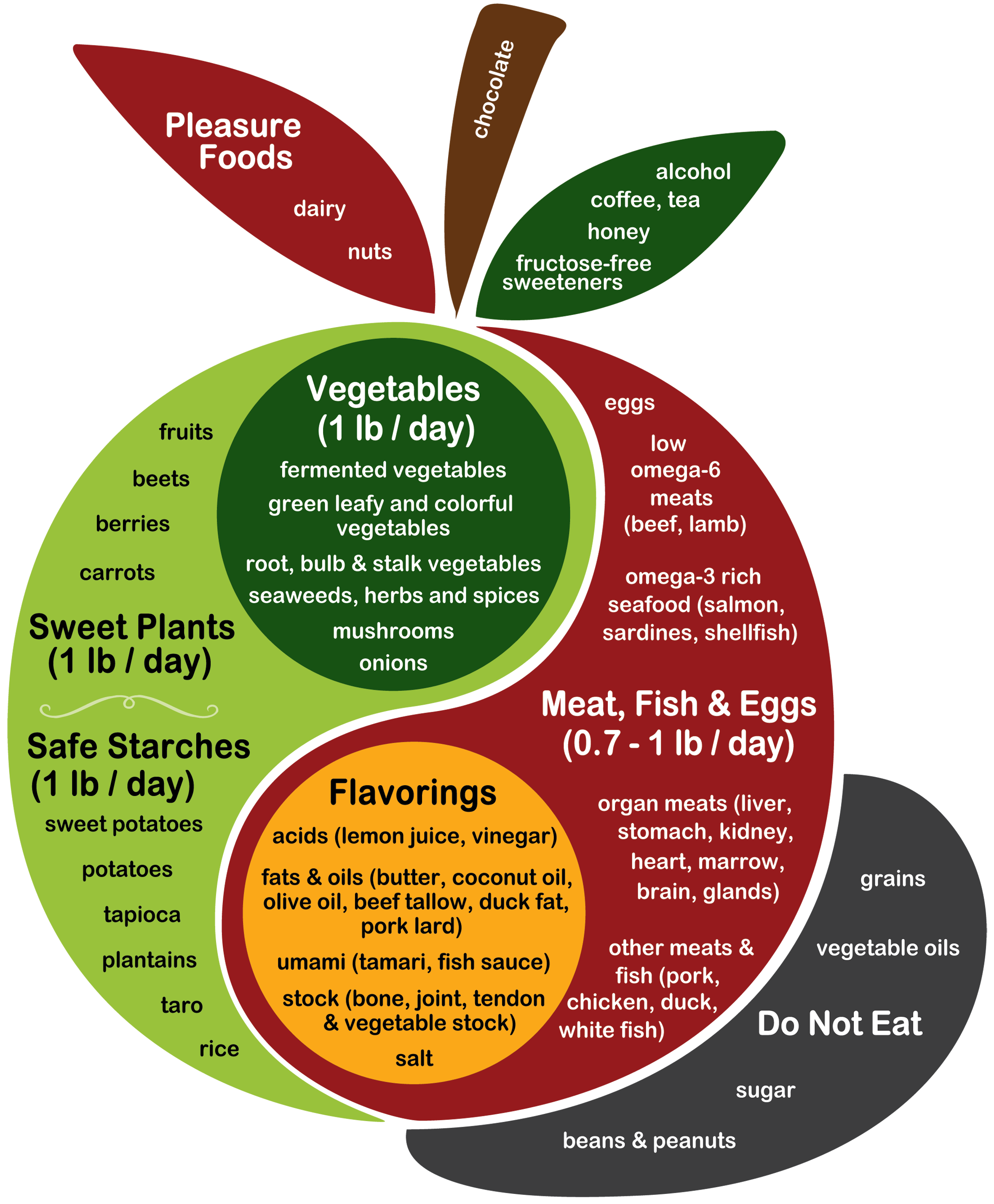
NOTE: This is our new food plate, updated 2015. Foreign translations of the original food plate may be found here.
We recommend:
- About 3 pounds [1.4 kg] of plant foods per day, including:
- About 1 pound [0.45 kg] of safe starches, such as white rice, potatoes, sweet potatoes, and taro;
- About 1 pound [0.45 kg] of sugary in-ground vegetables (such as beets or carrots), fruits, and berries;
- Low-calorie vegetables to taste, including fermented vegetables and green leafy vegetables.
- One-half to one pound [0.25 to 0.5 kg] per day of meat or fish, which should include organ meats, and should be drawn primarily from:
- ruminants (beef, lamb, goat);
- birds (especially duck and wild or naturally raised birds);
- Shellfish and freshwater and marine fish.
- Low omega-6 fats and oils from animal or tropical plant sources, to taste. Good sources include:
- butter, sour cream, beef tallow, duck fat;
- coconut milk or oil
- palm oil, palm kernel oil, olive oil, avocado oil, macadamia nut butter, almond butter, cashew butter
- Acids to taste, especially citric acid (lemon juice, lime juice, orange juice, grapefruit juice), lactic acid from fermented or pickled vegetables, vinegars, tannic acids from wine, and tomatoes.
- Broths or stocks made from animal bones and joints.
- Snacks or desserts from our pleasure foods: fruits and berries, nuts, alcohol, chocolate, cream, and fructose-free sweeteners like dextrose or rice syrup.
By weight, the diet works out to about 3/4 plant foods, 1/4 animal foods. By calories, it works out to about 600 carb calories, primarily from starches; around 300 protein calories; and fats supply a majority (50-60%) of daily calories.
In the shadow of the apple are foods forbidden because of their high toxin content. Notably:
- Do not eat cereal grains — wheat, barley, oats, corn — or foods made from them — bread, pasta, breakfast cereals, oatmeal. The exception is white rice, which we count among our “safe starches.” Rice noodles, rice crackers, and the like are fine, as are gluten-free foods made from a mix of rice flour, potato starch, and tapioca starch.
- Do not eat calorie-rich legumes. Peas and green beans are fine. Soy and peanuts should be absolutely excluded. Beans might be acceptable with suitable preparation, but we recommend avoiding them.
- Do not eat foods with added sugar or high-fructose corn syrup. Do not drink anything that contains sugar: healthy drinks are water, tea, and coffee.
- Polyunsaturated fats should be a small fraction of the diet (~4% of total calories). To achieve this, do not eat seed oils such as soybean oil, corn oil, safflower oil, sunflower oil, canola oil, or the like.
We highly recommend certain foods for their micronutrients. These include liver, kidney, egg yolks, seaweeds, shellfish, fermented vegetables, and bone broths.
We also recommend augmenting the diet with certain supplements. See our Supplement Recommendations page. These nutrients are deficient in modern diets due to removal of minerals from drinking water by treatment, depletion of minerals from soil by agriculture, or modern lifestyles that deprive us of vitamin D by indoor living.
We recommend tweaking the diet for certain diseases. Neurological disorders often benefit from a diet that is ketogenic; other conditions may benefit from lower carb diets. These variations are discussed in the book:
See the “Buy the Book” page for other purchase options.



 via this link:

Hi Paul,
Thank you so much for your thoughtful reply, your advice, and especially for continuing to pray for my father.
I want you to know that I will include you, your family, and Angiex in my daily prayers from now on. I will continue praying for you and your cancer research company for as long as I can. It genuinely makes me happy to know that my prayers mean something to you, just as your prayers for my father mean so incredibly much to me.
I have always had a strong desire to do things as correctly and thoroughly as possible, especially when it comes to the health of the people I love.
That is also why my brother and I have read your book several times. I wanted to understand everything properly, remember all your recommendations, and put the principles of the Perfect Health Diet into practice as carefully as possible.
Looking back, however, I think I may sometimes have taken certain things too far.
For example, I initially increased our consumption of saturated fats quite substantially because I felt better when I started eating more of them. I suppose I fell into the trap of thinking that if something was beneficial, having more of it would necessarily be even better.
But as you have often emphasized, the dose makes the poison, and even something beneficial can become harmful when consumed in excessive amounts. I am trying to keep that lesson in mind and find a better balance.
I am also deeply saddened by the thought that my father may have been living with undiagnosed and untreated diabetes for many years, possibly experiencing repeated episodes of very high blood glucose without any of us realizing how serious the situation was.
The doctors explained that the main artery supplying his leg was so severely calcified and obstructed that, according to their estimate, only about 5% of the necessary blood supply was reaching the lower part of his leg.
They also described the development of collateral vessels, which had apparently been compensating for the blocked artery to some extent.
From what I understood, the surgeons were able to improve the circulation on the left side during the operation, and they also inserted a stent.
I sincerely hope that the blood flow is now sufficient to nourish his left leg properly and that the reddish discoloration of his toes will gradually disappear.
Once his left leg has recovered, they intend to perform another procedure on his right leg. After that, they have mentioned the possibility of a third, smaller intervention.
I pray with all my heart that everything heals properly, that he develops no thrombosis or other complications, that an amputation will never become necessary, and that all his future procedures will go smoothly.
I am praying to God constantly for his protection.
Something else that continues to worry me enormously is the condition of the other arteries throughout his body.
I am frightened that the arteries supplying his heart, brain, or other organs might also be severely narrowed or obstructed without us knowing about it.
The possibility of coronary artery disease or problems with his carotid arteries is particularly frightening to me.
Nevertheless, I know that I must place my trust in God and allow the doctors to help my father. I pray that we are now taking the right steps and that his medical team will be able to stabilize his condition and protect him from further complications.
The doctors have also started administering insulin during his hospital stay.
Originally, our family doctor had recommended beginning treatment with metformin rather than insulin. However, before my father was admitted to the hospital, we had not yet started either medication.
Instead, we had been making substantial dietary changes and following the Perfect Health Diet more strictly. During that period, we managed to bring his fasting blood glucose down to approximately 177 mg/dL without glucose-lowering medication, compared with the much higher values he had initially.
At the time, I was hoping that his metabolism might continue to recover through diet and lifestyle changes alone.
I also had some concerns about whether starting medication might somehow interfere with his body’s natural ability to recover, or whether he might become dependent on medication in the long term.
I realize now that his blood glucose had probably been far too high for far too long, and that protecting him from further damage is the most important thing. I understand that the doctors are using insulin to manage his glucose safely during this critical postoperative period, and I do not want to interfere with his treatment.
Today, his pulse was approximately 92 beats per minute, and his blood pressure was around 140/80 mmHg.
After receiving insulin, his blood glucose was initially measured at 105 mg/dL. A few hours later, without having eaten anything in between, it had risen to approximately 130 mg/dL.
He is currently receiving antibiotics, blood-thinning medication, and painkillers.
His toes are still reddish, which continues to worry me. I pray that the discoloration will gradually subside as his circulation improves and his leg heals.
Regarding your comments about dairy and autoimmunity, I found your explanation and the studies you shared very interesting.
My father worked as a baker for decades and consumed large amounts of bread and baked goods throughout much of his life. Because of that, I have sometimes wondered whether certain foods might have contributed to inflammation or immune-related problems over the years.
Of course, I cannot know whether he has actually developed an autoimmune reaction to any particular food.
I also find the question of dairy products difficult.
Both my father and I really enjoy dairy, especially yogurt and sour cream, but I honestly do not know whether either of us reacts negatively to them. I am not even entirely sure how to recognize such a reaction in myself.
For now, I was thinking of continuing with moderate amounts of plain yogurt and sour cream, while observing how well my father tolerates them and how his glucose levels respond, provided that his doctors approve.
I will also try to keep his egg consumption moderate, perhaps around three eggs per day at most, because I do not want his omega-6 intake to become excessive.
Otherwise, my brother and I intend to continue preparing nutritious meals based on your recommendations, including homemade beef oxtail broth, beef as a main meat source, occasional beef liver, cooked and cooled potatoes with a little vinegar and fat, plenty of vegetables, and the other foods recommended in the Perfect Health Diet.
We will also include beets and green leafy vegetables, as you suggested.
I want to be especially careful not to overdo any single food or nutrient this time, but instead provide him with a balanced diet that supports his recovery.
I will make sure that anything we bring him is approved by the hospital staff and compatible with his current medications, diabetes treatment, and postoperative care.
As for supplements, I will continue holding off for now and will keep your suggestion about magnesium in mind for when his doctors consider it appropriate to reintroduce supplements.
Paul, is there anything else you would particularly recommend that we pay attention to during his recovery, whether in terms of nutrition, lifestyle, or anything else you think might be important?
I know that restoring his ability to walk comfortably is one of the most important goals, and I hope that once his circulation has improved sufficiently and the surgeons allow it, he will gradually be able to become active again.
I apologize if this message is somewhat long or disorganized. My brother and I have barely slept over the past few days, and I am finding it difficult to collect my thoughts properly.
My father means everything to me, and I am trying my very best to help him through this situation.
Thank you, Paul, for everything. I am so grateful that there are people like you who are willing to share their knowledge, show compassion, and take the time to help others.
I thank God for bringing us through the operation, and I continue praying for my father’s recovery.
I will also continue praying for you, your family, Angiex, and everyone who is suffering or in need.
May God bless you and your family, guide your work, and protect you always.
With heartfelt gratitude,
Marvin
Hi Marvin,
Everything can heal – the body has great restorative powers. But he has to be functional, able to walk and live naturally, otherwise it will be hard to stop a decline.
Yes, it’s important that he not overeat calories. His appetite will be a good guide. Just focus on equal amounts starch, meat/fish/eggs, fruits/berries/beets, and vegetables; then flavor with butter or sour cream, vinegar or lemon juice, stock, and fermented flavorings and foods, to taste.
Try time-restricted feeding, if he can limit calorie intake to a 6-8 hour window in morning and mid-day, that will help him recover. Then daily exercise and sunshine early in the day and at mid-day. For a 12-hour night, rest, relaxation, and red light.
Best, Paul
Hi Paul,
I just wrote you a rather long message, but unfortunately, I think it may have ended up in the spam filter again.
When I try to submit it once more, the website tells me that I have already posted the message. However, it does not appear, even when I refresh the page.
I have experienced this problem before, as you may remember. Perhaps it has something to do with the length of my message.
I just wanted to let you know in case it is waiting for approval in the spam filter.
Thank you so much, Paul!
Best regards,
Marvin
Yes, it was in spam, I’ve pulled it out and replied.
Best, Paul