



Homemade Seasoned Seaweed

Most Americans, if they ever tried seaweed at all, probably gave up on it after the first try because it is either very tough (kelp) or bland (nori).

However, well-prepared seaweed can be very tasty as well as extremely nutritious.

Korean Seasoned Seaweed

Koreans have developed a wide menu of tasty seaweed snacks. The basic strategy is to soak seaweed in oil, season it, and bake it briefly. The oil and seasonings make the seaweed taste much better.

The only trouble is that, like most food products sold in this country, commercial varieties tend to use low-quality oils. On our supplement recommendations page, we mistakenly linked to some Korean seasoned seaweed products that used unhealthy oils – canola oil or corn oil. (We’ve since corrected that; the current versions use olive oil and sesame oil.) Commercial varieties are also unreasonably expensive (in our view).

But seasoned seaweed is very easy to make at home. Today we’ll show you how.

Ingredients

First, get some nori – the classic Japanese sushi seaweed. In Korea, seasoned seaweed is made from unroasted seaweed, but we used roasted nori and it worked just fine. Here’s what we used:

The sheets are about 8” by 8”. You’ll also need:

  • A healthy, low-omega-6 oil. We used olive oil on some sheets and coconut oil on others. Next time, we’ll try beef tallow and clarified butter.
  • Seasonings. We used sesame oil and sea salt.

Here was our work area:

Spread the healthy oil on the seaweed. Each sheet will require about 1/2 to 1 teaspoon of oil (dried seaweed can really soak up oil). We favor using the back of a spoon to spread the oil.

Sprinkle the salt (and any other seasonings) on the seaweed:

Place a new sheet on top of the previous one and repeat the application of oil and seasoning. It will pick up some oil and salt from the sheet underneath. In this photo, we’re applying coconut oil:

When you’ve finished your whole stack of sheets, place a few sheets on a baking sheet and bake at 350 degrees Fahrenheit (175 Celsius) for 2 minutes:

We baked each sheet individually, but it might be possible to bake a whole stack at once — we’ll try that next time.

The baked sheets may be easily folded and torn into more convenient sizes:

Here’s a finished stack:

Voila! Just like grandma in Korea makes it. Eat the seaweed alone or with rice.

Chris Kresser’s Paleo Detox Program

Occasionally readers email us and ask if we do health consultations for an hourly fee. We don’t. (We do our best to respond to questions however.)

We’re happy to refer those looking for advice to Chris Kresser, who recently launched his own alternative medicine practice. We have great confidence in Chris.

Chris has created a service called the “Paleo Detox Program.” Here is a video in which he describes the program:

The program starts in February. Here is a link to register:

Hans Rosling: 200 Countries, 200 Years, 4 Minutes

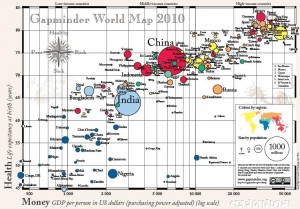
I’ve previously cited charts from Hans Rosling’s Gapminder to point out that U.S. longevity is worse than would be expected based on our GDP. Click for a legible plot:

If you fit a curve and measure distance beneath the curve, among rich nations only Brunei, Qatar, and maybe Luxembourg and Liechtenstein perform worse than the US. Americans die years earlier than we ought. I believe the reason for this is probably our agricultural subsidies for wheat, corn, and soybeans and the high intake of toxins they have engendered.

Well, Dr. Rosling has a nice new video, produced by the BBC. It does a great job illustrating how strongly longevity depends on income. In all countries, as incomes have risen over the last 200 years, lifespans have increased as well. Probably this has a lot to do with food quality and investments in water, sewage removal, and sanitation.

Here’s Dr. Rosling’s tour of 200 countries and 200 years in 4 minutes:

Unfit for the Paleo Rodeo

Diana Hsieh of the Modern Paleo blog does yeoman’s work running the Paleo Rodeo each week, which is a fun collection of Paleo posts. (Here’s this week’s rodeo.)

It turns out that a contribution got rejected from this week’s Rodeo as spam. It was titled “Linguine with Seafood Sun-dried Tomatoes and Lemon”:

I must admit that for a time I couldn’t see anything wrong with this meal, other than that it is rather light in the meat, vegetables, and sauce. But de gustibus non est disputandum. After a half minute of puzzlement I remembered that pasta is forbidden by conventional Paleo.

Of course, the Perfect Health Diet forbids wheat noodles but happily supports rice noodles. In our house we often have rice-noodle dishes, as I mentioned recently to Kratos.

I guess it’s just as well I didn’t submit Cambridge Fried Rice to the Rodeo!