



Chronic Disease: Don’t Ever Give Up

Two days before Christmas, Amy left a heart-rending comment:

My dad has Alzheimers and was just put in a nursing home because my mom can’t handle taking care of him anymore. He shouldn’t be there and I believe there’s still hope for recovery in him…. What are your thoughts in this situation?

You can visit the comment to see my immediate response. But I thought I’d say a bit more here.

Don’t Ever Give Up

Two erroneous beliefs encourage people to give up too quickly.

  • Many diseases are wrongly considered to be inevitable and natural consequences of aging. Aging, unlike disease, is considered to be incurable.
  • The ineffectiveness of conventional medicine makes us think that cures are impossible. But I believe that dietary, nutritional, and antimicrobial therapies can effectively treat many of the diseases of aging, including Alzheimer’s.

As regular readers know, I had a chronic illness that seemed to progress relentlessly – until I started fixing my diet. It took another 5 years, but I eventually found a cure.

I think my case was far from unique. Many chronic illnesses can be cured. The path to recovery is not yet well mapped, and may require considerable experimentation. But I think we know enough now to see the general direction. It is worth embarking on the journey. And worth adopting the motto of Jim Valvano: “Don’t give up. Don’t ever give up.”
Pumpkin Mousse (from erp)

We have been neglecting the blog to be with family, but luckily for us reader erp is much more diligent, and has sent us a recipe for Pumpkin Mousse.

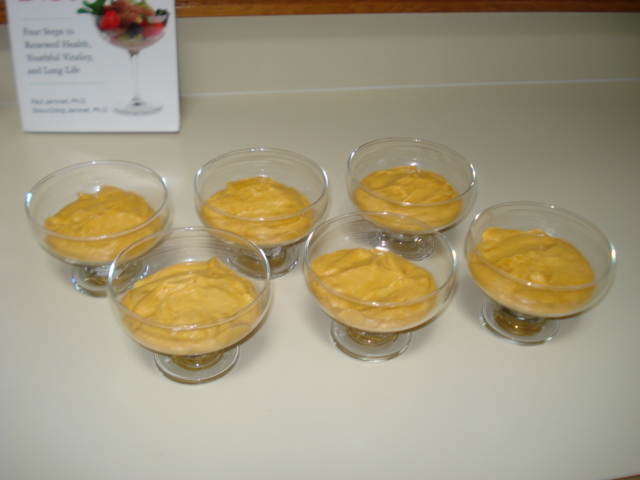
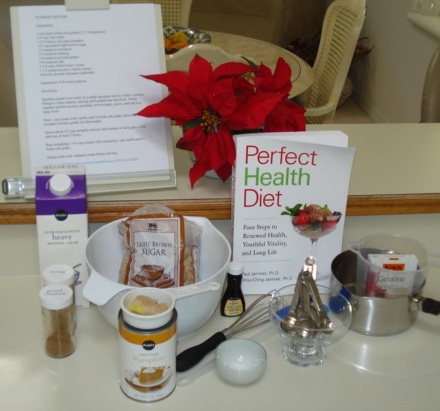
Erp tells us that this is her assemblage of ingredients:

We are quite pleased to see our book included, but be aware that this may provide too much roughage for some and can be excluded from the recipe!

A more conventional list of ingredients is:

  • 1 envelope unflavored gelatin (2 1/4 teaspoons)
  • 1/4 cup cold water
  • 1 (15-ounce) can pure pumpkin
  • 1/4 cup packed light brown sugar  (original recipe calls for 3/4 cup!!!)
  • 1/2 teaspoon cinnamon
  • 1/2 teaspoon nutmeg
  • 1/4 teaspoon ground ginger   
  • 1/8 teaspoon salt
  • 2 1/4 cups chilled heavy cream
  • 1 1/2 teaspoons pure vanilla extract
  • Garnish: ground cinnamon (optional)
  •  Equipment: 8 (8-ounce) glasses

Sprinkle gelatin over water in a small saucepan and let soften 1 minute. Bring to a bare simmer, stirring until gelatin has dissolved. Whisk together gelatin mixture, pumpkin, brown sugar, spices, and salt in a large bowl.

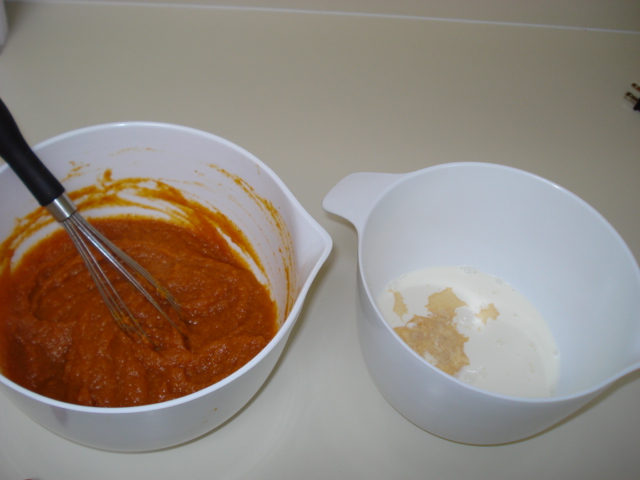
Beat 1 cup cream with ½ tsp. vanilla until it holds soft peaks, then fold into pumpkin mixture gently but thoroughly. Spoon about 1/2 cup pumpkin mixture into bottom of each glass. Here it is at this stage:

Chill until set, at least 2 hours.

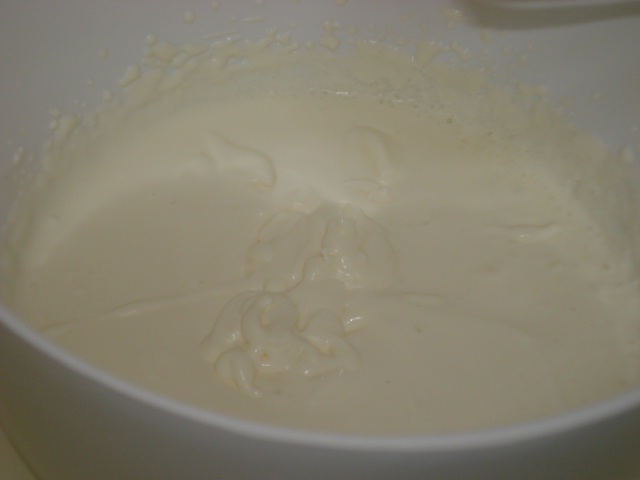
Meanwhile, beat remaining 1 1/4 cups cream with remaining 1 tsp vanilla until it holds soft peaks:

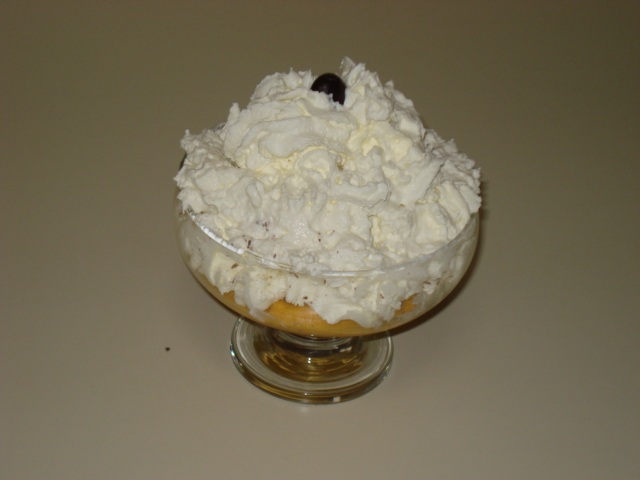
Dollop each with whipped cream before serving. Top with shaved dark chocolate or sprinkles if desired. The finished product:

Hat tip: KitchenDaily.com.

Thanks erp!

Merry Christmas!

This is what God is like. The Angel had said to the shepherds: “This will be a sign for you: you will find a babe wrapped in swaddling clothes and lying in a manger” (Lk 2:12; cf. 2:16). God’s sign, the sign given to the shepherds and to us, is not an astonishing miracle. God’s sign is his humility. God’s sign is that he makes himself small; he becomes a child; he lets us touch him and he asks for our love. 

—  Pope Benedict XVI, Christmas sermon 2009

A very merry and blessed Christmas to all our readers!

Fasting and the Ketogenic Diet for Migraines

We’ve previously argued that people with migraines should try a ketogenic diet. There are two reasons: (1) ketones can evade certain mitochondrial defects which might cause migraines, and (2) ketones reduce glutamate levels, and glutamate toxicity is implicated in migraines.

Reader Rob Sacks has had lifelong migraine headaches. As an experiment he turned to desperate measures – a long fast. Here’s his story:

I fasted for 30 days.   When I say “fast” I mean that I stopped eating all food.   I consumed only water and occasionally sea salt and potassium tablets.

As part of the fast I stopped taking Imitrex which I had been using almost daily to control my migraines.   I did this because I thought Imitrex was increasing the number of migraines due to a rebound effect.   I also stopped consuming caffeine to which I was addicted.

As the fast went on, my migraines lasted for shorter periods of time, and they became less painful. 

By day 23 I became free of headaches.  There was still some sort of migraine activity — I could often feel the sensations that in all my previous life, had always been followed by a headache — but no headache resulted.   Judging from what I could feel, there is a cascade of events that leads to a migraine, and the metabolic changes induced by the fast were interrupting the cascade at a certain point.

I was quite happy with this result and continued the fast as long as I could in the hopes that this would increase the chances that the change would be permanent.

Unfortunately, after the fast ended, the headaches gradually came back. I think this happened because after the first few post-fast meals, I made no effort to keep my diet ketogenic. An intense craving for fruit developed and once the danger of refeeding syndrome seemed to be over, I gave in. This was interesting because before the fast I had been on low carb diets since 2007 and hadn’t craved carbs in years.

When I saw the gains slipping away, I fasted again for two days to get back into ketosis as quickly as possible. Then I started following a diet similar to those used by neurologists at Johns Hopkins to treat children with epilepsy, with calorie restriction, frequent meals, and a ratio of fat to protein (by weight) of four to one. After two days of this diet, my headaches stopped again. That was only 48 hours ago but I’m sure the diet is working because I challenged myself last night with a sure-fire migraine trigger by staying up past my bedtime to watch the eclipse. Normally this would create a debilitating headache, but the only result was a slight migrainy feeling that was easily controlled with two aspirin. Before the fast, aspirin had no apparent effect on my migraines.

The next step will be to try more moderate diets and find the least extreme one that controls the headaches.

The fast proved that migraine headaches can be stopped by the metabolic changes induced by fasting.  Hopefully I can find a way to make that same metabolic state occur permanently.

Incidentally, the fast had some unexpected beneficial effects.  A bad varicose vein is dramatically improved, and a teary eye problem (which I think was caused by a clogged tear duct, and which I previously controlled with large amounts of vitamin C) has resolved almost completely.

I think this kind of experimentation is extremely important. Through experiments like Rob’s we can learn more about the causes of these seemingly incurable health conditions and find dietary and nutritional methods for healing or mitigating them. Experiments in lab mice are important, but the mice don’t tell us what they’re experiencing!

Rob lost 22 pounds during his 30-day fast, equivalent to 2200 calories per day if taken equally from protein and fat. Such an extended loss of lean tissue can be quite dangerous. If he had taken coconut oil or medium chain triglycerides during his fast, he would have conserved lean tissue mass and might have actually increasing ketone availability.

Fortunately it looks like ketogenic dieting is the key to Rob’s migraine relief, so extreme fasting should not be necessary.

Fasting does have therapeutic actions apart from its elevation of ketones. For instance, it promotes autophagy. It is possible that the fasting, not the ketones, was responsible for Rob’s cure of his varicose vein and teary eyes.

Rob might wish to experiment with protein restriction and other techniques for autophagy promotion, in order to see if they might also be beneficial in addition to ketosis.

Also, experimenting with micronutrients is important. Magnesium and riboflavin are often helpful for migraines.

Good luck Rob! Keep us posted.