



Micronutrient Deficiencies: An Underappreciated Cause of Hypothyroidism

A significant number of our readers have hypothyroidism with normal T4 but low T3. For instance, Kratos:

I followed a strict low carb diet with around 50g of carb per day for over 1 year and I think I have developed hypothyroidism …

TSH 3.4 (0.3-4.0)

FT3 2.2 (2.1-4.9)

FT4 11.4 (6.8-18.0)

This situation can have many causes. Our last post discussed how shift work and disrupted circadian rhythms can cause hypothyroidism. Another often-overlooked cause of hypothyroidism is nutrient deficiencies.

As noted in the book, selenium and iodine deficiencies are classic causes of hypothyroidism. Here I want to look at a few other possiblities.

Copper and Iron Deficiency

Copper deficiency, iron deficiency, and iodine deficiency during pregnancy or infancy generate similar neurological defects, and during adulthood generate similar hypothyroid symptoms:

Cu, Fe, and iodine/TH deficiencies result in similar defects in rodent brain development, including hypomyelination of axons, aberrant hippocampal structure and function, altered brain energy metabolism, and altered neuronal signaling (8–13). In addition, the behavioral and neurochemical abnormalities associated with perinatal Cu, Fe, and iodine/TH deficiencies are irreversible and persist into adulthood (14–16). These similarities suggest that there may be a common underlying mechanism associated with all three deficiencies contributing to the observed neurodevelopmental defects.

Several studies in postweanling rodents show that Cuand Fe deficiencies impair thyroid metabolism. Fe deficiency reduces circulating thyroxine (T4) and triiodothyronine (T3) concentrations (17–20), peripheral conversion of T4 to T3 (18, 19), TSH response to TRH (19), and thyroid peroxidase (TPO) activity (20). Cu deficiency also reduces circulating T4 andT3 concentrations and peripheral conversion of T4 to T3  (21, 22). In addition, Cu deficiency reduces serum and brain Fe levels, which may contribute to the Cu-dependent effect on thyroidal status (23). [1]

In infant rats, deficiencies of either copper or iron cause hypothyroidism:

Cu deficiency reduced serum total T(3) by 48%, serum total T(4) by 21%, and whole-brain T(3) by 10% at P12. Fe deficiency reduced serum total T(3) by 43%, serum total T(4) by 67%, and whole-brain T(3) by 25% at P12. [1]

Note that copper deficiency hypothyroidism reduces serum T3 levels more strongly than T4 levels, the same pattern that Kratos displays.

While We’re On the Topic of Micronutrients and Hypothyroidism …

Hypothyroidism induces the symptoms of riboflavin deficiency. This is because thyroid hormone is needed for production of the enzyme flavin kinase, which is in turn needed to generate flavin adenine dinucleotide (FAD). Riboflavin deficiency and thyroid hormone deficiency lead to the same low FAD levels in both rats and humans. [2]

This suggests that hypothyroid persons may wish to supplement with riboflavin, so that extra riboflavin may help make up for deficient flavin kinase.

Conclusion

I believe that those with health problems should strive to “overnourish” themselves. Micronutrient deficiencies can have insidious disabling effects, yet be impossible to diagnose. In disease conditions, needs for many micronutrients are increased. Many micronutrients are non-toxic up to fairly large doses and can be safely supplemented.

An effort to eat micronutritious foods and supplement micronutrients into their “plateau ranges” to eliminate deficiencies might generate startling health improvements.

Minerals like copper, selenium, and iodine are among the most important nutrients – they are among our eight essential supplements – yet also among the most widely deficient. Most supplementers neglect key minerals; but optimizing their intake can pay large health dividends.

References

[1] Bastian TW et al. Perinatal iron and copper deficiencies alter neonatal rat circulating and brain thyroid hormone concentrations. Endocrinology. 2010 Aug;151(8):4055-65. http://pmid.us/20573724.

[2] Cimino JA et al. Riboflavin metabolism in the hypothyroid newborn. Am J Clin Nutr. 1988 Mar;47(3):481-3. http://pmid.us/3348160.


Intermittent Fasting as a Therapy for Hypothyroidism

Reader Adam Kadela has begun intermittent fasting and wonders how it might affect his hypothyroidism:

I have a question pertaining to the section at the end of the book covering extended fasts. I regularly practice the 16-8 fast/feast protocol (breakfast at noon, last meal before eight), and plan to throw in a 36 hour fast once a month per your book. However, I am hypothyroid (hashimoto’s) and take synthetic T4 and T3 (unithroid and cytomel), so I’m wondering if an extended fast could affect my thyroid function negatively.

This is a great question. I think the daily 16-hour fast should be therapeutic for hypothyroidism, but I’m not sure about the 36-hour fast.

In today’s post I want to talk about why daily intermittent fasting may be therapeutic for Hashimoto’s, which is an autoimmune hypothyroidism.

Food Sets The Circadian Clock

The circadian clock is strongly influenced by diet: indeed, food intake dominates light in setting the circadian clock. If you regularly eat at night and fast during the day, the body will start treating night as day and day as night. [1]

(Alcohol consumption at night will also tend to reset the clock, which may explain why college students are often night owls!)

This suggests that controlling the timing of food consumption can help to maintain circadian rhythms.

The Circadian Clock and Hypothyroidism

The thyroid follows circadian rhythms. There is a circadian pattern to TSH levels:  high at night, low during the day.

The thyroid’s circadian pattern is diminished in autoimmune hypothyroidism. In a study of hypothyroid children, the night-time surge of TSH averaged 22%, compared to 124% in normal children. Only one of 13 hypothyroid children had a night-time TSH surge in the normal range. [2]

The study authors concluded:

We suggest that the nocturnal surge of TSH is important for maintenance of thyroid function and conclude that the nocturnal TSH surge is a much more sensitive test than the TSH response to TRH for the diagnosis of central hypothyroidism. [2]

Shift Work and Hypothyroidism

If circadian rhythms are important for thyroid function, we would expect shift workers to have high rates of hypothyroidism. Shift workers sleep during the day and eat at night, which disrupts circadian rhythms.

It turns out that shift work doubles the risk of autoimmune hypothyroidism:

Stress induces autoimmune disorders by affecting the immune response modulation. Recent studies have shown that shift work stress may enhance the onset of the autoimmune Graves hyperthyroidism. On the other hand, the possible association between occupational stress and autoimmune hypothyroidism has not yet been investigated…. Subclinical autoimmune hypothyroidism was diagnosed in 7.7 percent shift workers and in 3.8 percent day-time workers with a statistically significant difference: Odds Ratio (OR) 2.12, 95 percent Confidence Interval (CI) 1.05 to 4.29; p=0.03…. Our data show a significant association between shift work and autoimmune hypothyroidism. This finding may have implications in the health surveillance programs. [3]

Shift Work Affected Adam Too

In a follow up email, Adam told me that night shift work may have helped cause his hypothyroidism:

[T]he paper about thyroid and fasting … is particularly interesting to me due to my experience with night shift work for 10 months last year. My circadian rhythm was all out of whack due to experimenting with different sleep schedules and trying to workout around midnight before going into work at two a.m. I also played around with different diet strategies (grazing method w/ small meals, warrior diet, and ultimately settling on the 16-8, which is by far superior imo). My thyroid, along with other hormones, did not enjoy these trials.

Intermittent Fasting May Be Therapeutic

Since the circadian rhythm is affected by both food and light exposure, lifestyle practices can enhance natural circadian rhythms. These practices should optimize the circadian cycle:

  • Light entrainment:  Get daytime sun exposure, and sleep in a totally darkened room.
  • Daytime feeding: Eat during daylight hours, so that food rhythms and light rhythms are in synch.
  • Intermittent fasting: Concentrate food intake during an 8-hour window during daylight hours, preferably the afternoon. A 16-hour fast leading to lower blood sugar and insulin levels, and the more intense hormonal response to food that results from concentration of daily calories into a short 8-hour time window, will accentuate the diurnal rhythm.
  • Adequate carb intake:  Eat at least 400 “safe starch” carbohydrate calories daily during the afternoon feeding window. Relative to a very low-carb diet, this will increase daytime insulin release and, by increasing insulin sensitivity, may reduce fasting insulin levels. It will thus enhance diurnal insulin rhythm.

Adam tells me that intermittent fasting seems to be improving his hypothyroidism:

I think you’re correct in that I’ve experienced some curative effects. However, with the improved nutrient absorption and gut health from healthier eating and fasting, I think I fluctuate a lot b/w slightly hypo, normal, and hyper, since my medication is constant. I’m still in the process of finding a balance, but it’s a bigger improvement than my past state.

Conclusion

Many doctors mistakenly assume that little can be done to cure autoimmune disorders. In fact, however, autoimmune conditions commonly disappear once the chronic infections, food toxins, or poor health practices that cause them are eliminated.

Circadian rhythms have powerful influences on many biological processes, and disrupted circadian rhythms are a common feature of disease. Without clinical trials it’s impossible to be sure, but efforts to enhance circadian rhythms may be therapeutic for diseases such as hypothyroidism.

Intermittent fasting, daytime light exposure, excluding light from the bedroom, night fasting and daytime feeding are simple practices. But they may be underappreciated keys to good health.

References

[1] Fuller PM et al. Differential rescue of light- and food-entrainable circadian rhythms. Science. 2008 May 23;320(5879):1074-7. http://pmid.us/18497298.

[2] Rose SR et al. Hypothyroidism and deficiency of the nocturnal thyrotropin surge in children with hypothalamic-pituitary disorders. J Clin Endocrinol Metab. 1990 Jun;70(6):1750-5. http://pmid.us/2112153.

[3] Magrini A et al. Shift work and autoimmune thyroid disorders. Int J Immunopathol Pharmacol. 2006 Oct-Dec;19(4 Suppl):31-6. http://pmid.us/17291404.

Non-Perfect Health Food of the Day

Pumpple Cake: A pumpkin pie within chocolate cake, an apple pie within vanilla cake, all surrounded by sugary icing.

We’ve said that any recipe can be repaired by substituting healthy ingredients. This concoction, from the Flying Monkey Bakery in Philadelphia, could be the exception!

What We’ve Been Up To

The in-laws are now “in-laws once removed,” and life is back to normal.

Our guests like nature as much as we do, so we spent most of the last 5 days outdoors. Since I haven’t had time to do a real post, I thought I’d share a few photos (click to enlarge).

This is a New Hampshire landmark, the Indian Head:

A leading New Hampshire tourist attraction, the Basin:

A light snow fell as we hiked.

The trail crosses the stream here, and we decided to end the hike rather than try to step across these rocks:

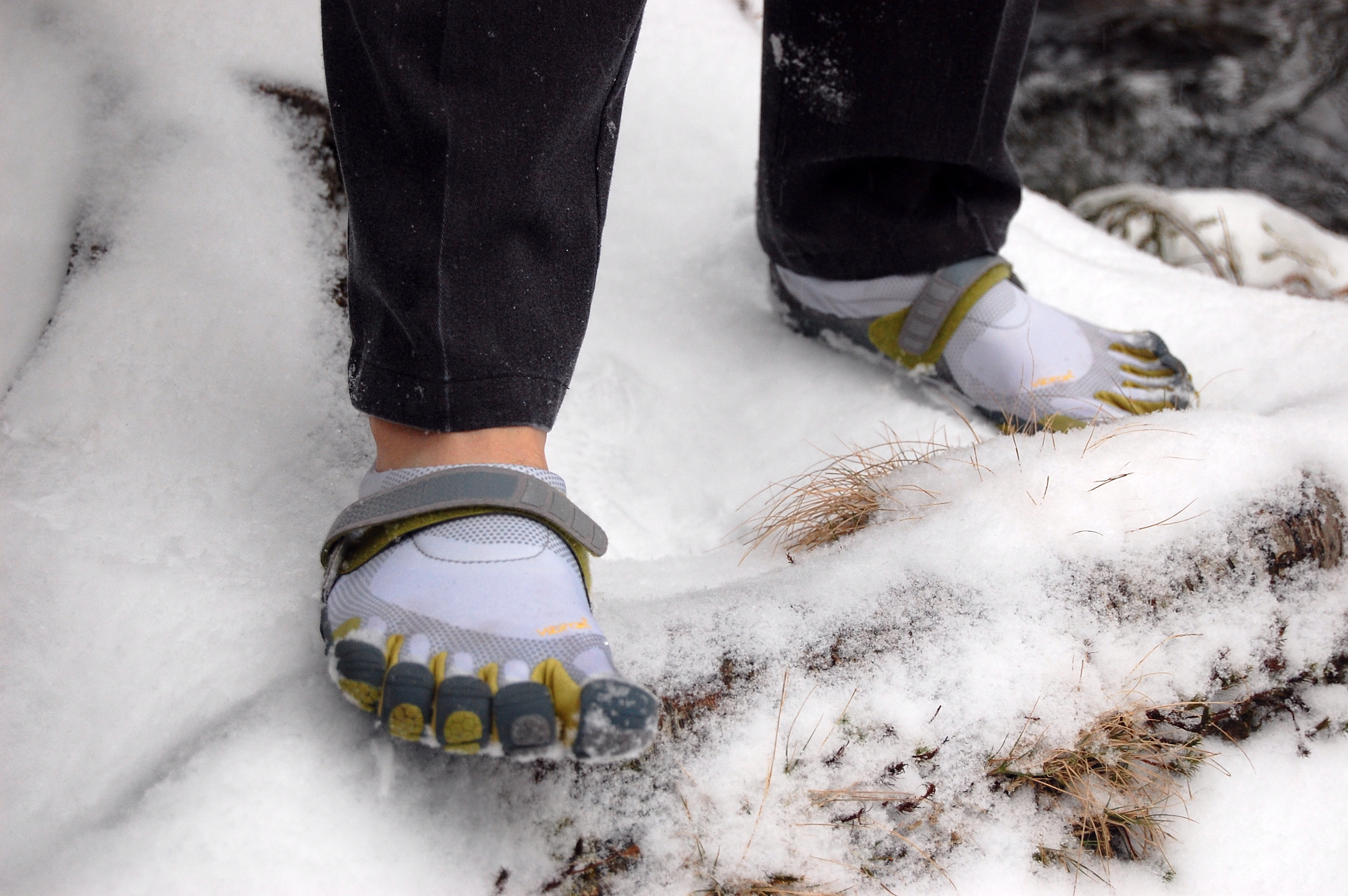
I’ve been wearing Vibram Fivefingers for the last two years and a new model, the Bikila, is much better for winter hiking. No frostbite in these:

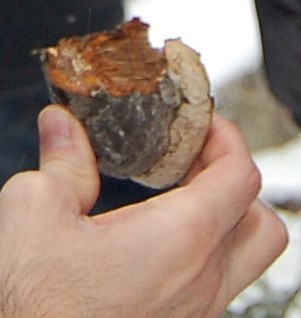
Our guests thought the fungi on these trees were the ingredient for Chinese Lingzhi herbal tea, but I have my doubts:

We gathered one for scientific examination: