



Thinking With Your Gut Bacteria

Is your personality really yours – or is it your bacteria’s?

What prompts this thought is a new paper that studied mate preference in fruit flies. It turns out that the gut bacteria in fruit flies influence their mate preference. [1]
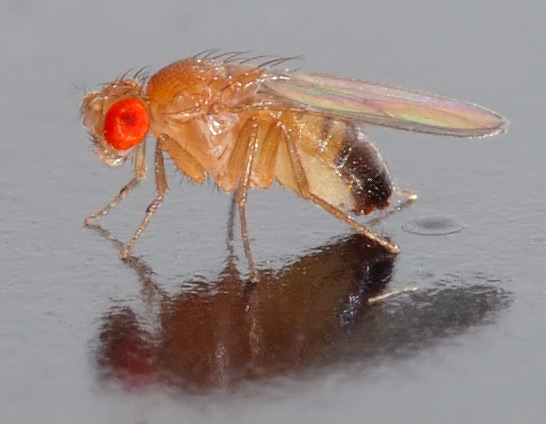
Image source: Wikimedia commons.

It’s been known for 20 years that fruit flies raised on one type of food prefer to mate with fruit flies raised on that same food. Now, researchers have proven that the preference is dictated by gut bacteria. When fruit flies are given antibiotics, they forget their mate preference and will mate with fruit flies that eat different diets. [2]

Mating preference seems to be dominated by a single species:  Lactobacillus plantarum. This species is common in probiotic supplements and in fermented vegetables. So if you find yourself developing an attraction to starch-fed fruit flies, your probiotic could be to blame.

Personality-Altering Pathogens

Personality-altering pathogens may not be that rare. In the book we mention that Toxoplasma gondii, a protozoal parasite, infects 20% to 60% of the population in most countries, forms cysts throughout the body including the brain, and makes its victims behave recklessly:

  • Rats infected with T. gondii lose their fear of cats. [3]
  • Humans infected with T. gondii are 6 times more likely to get in traffic accidents. [4]

Conclusion

If people seem to be behaving increasingly oddly lately, perhaps it’s not your misanthropism. It might be a bug going around.

References

[1] “Gut Bugs Affect Mating,” The Scientist, Nov 2, 2010, http://www.the-scientist.com/news/display/57793/.

[2] Sharon G et al. Commensal bacteria play a role in mating preference of Drosophila melanogaster. PNAS, www.pnas.org/cgi/doi/10.1073/pnas.1009906107, 2010. http://pmid.us/21041648.

[3] Webster JP et al. Parasites as causative agents of human affective disorders? The impact of anti-psychotic, mood-stabilizer and anti-parasite medication on Toxoplasma gondii’s ability to alter host behaviour. Proc Biol Sci. 2006 Apr 22;273(1589):1023-30. http://pmid.us/16627289.

[4] Flegr J et al. Increased incidence of traffic accidents in Toxoplasma-infected military drivers and protective effect RhD molecule revealed by a large-scale prospective cohort study. BMC Infect Dis. 2009 May 26;9:72. http://pmid.us/19470165.


Why Wheat Is A Concealed Cause of Many Diseases, III: Adjuvant Activity

We’ve been looking into how wheat can cause autoimmune diseases other than the “classic” wheat-associated diseases, celiac disease and Hashimoto’s thyroiditis.

The first post in the series discussed how wheat can cause a leaky, permeable gut that lets toxins and bacteria into the body. The second post discussed how wheat can itself generate a variety of auto-antibodies that attack nerves, brain, connective tissue and joints.

Now, we want to look at how wheat can create diseases by binding to other molecules and causing the body to form antibodies to them. Wheat can thereby cause allergies against foods as well as autoimmune attacks on self molecules.

Adjuvant Activity of Wheat Germ Agglutinin

Immunologically speaking, an “adjuvant” is a molecule that when bound to another molecule makes it much more immunogenic. Adjuvants such as aluminum salts are used in vaccines to make the immune system produce antibodies more readily against the target protein. This lowers the vaccine dose needed for immunity.

Wheat germ agglutinin (WGA) is a wheat lectin. (It is not part of gluten.) WGA can act as an adjuvant, causing the body to generate antibodies against proteins that, in isolation, the body would not form antibodies against. 

For instance, antibodies against the egg protein ovalbumin are not generated if it enters the body alone, but are generated if it is accompanied by WGA. [1]

So don’t eat toast with your eggs! If you have a leaky gut, the wheat might give you an egg allergy.

Haptenization Activity of Wheat Gliadin

A similar process that helps create auto-antibodies is “haptenization.” The immune system forms antibodies more readily against large molecules than small ones. (This helps avoid autoimmunity, since small molecules are more likely to have similar human peers.)

When two small molecules bind together, so they look like one big one, the immune system is more likely to form antibodies against the large complex. These antibodies may then react against one of the molecules individually, even if it is not paired up. If the targeted molecule is human, then the antibody is an auto-antibody.

One reason wheat gliadin is so disruptive to the body is that it binds strongly to sugars. The average molecule of wheat gliadin is bound to 1 to 2 molecules of glucose and 2 molecules of sialic acid, another sugar. [2] Since a lot of human molecules have sialic acid residues, gliadin can bind to them.

One of the sialic acid-containing molecules gliadin binds to is called GM1 ganglioside. This molecule is found on the intestinal brush border, but it is also found in nerves. When wheat binds to GM1 ganglioside on the intestinal surface, it induces the formation of auto-antibodies that attack the ganglioside in nerves. In 65% of patients with gluten sensitivity and peripheral nerve damage, anti-ganglioside antibodies are found. [2]

Conclusion

Wheat could be a concealed cause of many food allergies, through WGA’s adjuvant activity. If so, then many food allergies may gradually disappear after wheat is given up.

Wheat proteins can also bind to an extraordinarily large number of human proteins, in part by binding to sialic acid or other carbohydrate residues of glycoproteins or glycolipids, and has a chance to induce antibody formation against many of those proteins.

The bewildering array of ways in which wheat can trigger attacks on human tissue makes it impossible to identify all the wheat-caused diseases.  The only thing we can say for sure is that if you have a disease, it’s a good idea to give up wheat. You may give up your illness at the same time.

Related Posts

Other posts in this series:

  1. Wheat Is A Cause of Many Diseases, I: Leaky Gut Oct 26, 2010.
  2. Why Wheat Is A Concealed Cause of Many Diseases, II: Auto-Antibody Generation Oct 28, 2010.

References

[1] Lavelle EC et al. The identification of plant lectins with mucosal adjuvant activity. Immunology. 2001 Jan;102(1):77-86. http://pmid.us/11168640

[2] Alaedini A, Latov N. Transglutaminase-independent binding of gliadin to intestinal brush border membrane and GM1 ganglioside. J Neuroimmunol. 2006 Aug;177(1-2):167-72.  http://pmid.us/16766047.

Healthy Monster Diets

It’s no surprise to students of diet that none of the long-lived monsters eat wheat.

Vampires, of course, live for centuries, and their diet resembles the traditional diet of the Masai. Both groups, indeed, are known for their teeth; like vampires, the Masai rarely get cavities.

There are, to be sure, some monsters with a predilection for sweets. They tend to be short, often barely three feet tall; and their lifespan seems to be short. Often, a sweet-toothed monster is never seen again after a single night spent gorging on sweets.

In searching the web for information on monster diets, I came across this song, which I take to be a celebration of monsters’ favorite way of preparing “safe starches.” Enjoy!

Book is Available at Amazon and Barnes and Noble

Amazon and Barnes and Noble have put up pages for the book. For some reason they didn’t post the cover image, I’m looking into that.

Here are the pages:

Amazon: http://www.amazon.com/Perfect-Health-Diet-Youthful-Vitality/dp/0982720904/

Barnes and Noble:  http://search.barnesandnoble.com/Perfect-Health-Diet/Paul-Jaminet/e/9780982720905/

Also we shipped out a hundred or so books this morning, and expect to do the rest Saturday and Monday. So those who pre-ordered can expect their books soon!