



Thanks But No Thanks

“Humanity Needs to Start Farming Bugs for Food, Says United Nations Policy Paper”:

The raising of livestock consumes two-thirds of the planet’s farmland, and is a major source of greenhouse gases. Meanwhile, tons of edible, sustainable protein swarms all around us, free for the taking. In a new policy paper being considered by the UN’s Food and Agriculture Organization (FAO), Belgian entomologist Arnold van Huis makes the sensible recommendation that the western world eat more insects.

Farming edible insects like mealworms and crickets would produce far less greenhouse gas — 10 times less methane and 100 times less nitrous oxide — than the large mammals we currently farm. Insects are metabolically much more efficient, which makes them far cheaper to feed and raise; and, since they’re so biologically different from humans, they are less subject to contagious disease scares like mad cow. They are high in protein and calcium, and, with over 1,000 edible species, offer plenty of delicious variety.

Protein is 15% of energy in a healthy diet. What about the other 85%?

True, a few mealworms might make an apple more nutritious. But modern diets are deficient in saturated and monounsaturated fat, not protein.

Is inexpensive protein so dear, or an unchanged climate so sweet, as to be purchased at the price of fatty foods and health? I know not what insects the UN may eat. But as for me, give me steak, or give me fasting!


The China Study: More Evidence for the Perfect Health Diet

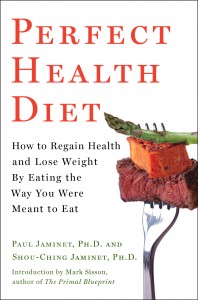
I previously noted that data from the China Study reported by Denise Minger were highly supportive of the Perfect Health Diet. In particular, the China Study supported our claims that:

  1. Animal protein is healthier than plant protein.
  2. Dairy fats are good, but dairy proteins can be problematic.
  3. Grains are bad – especially wheat – but rice is OK.
  4. Calories should come predominantly from fat.

Now, Stan the Heretic has done more work in the raw China Study data and shows charts that support the Perfect Health Diet and similar diets such as Jan Kwasniewski’s Optimal Diet.

What the Perfect Health Diet and the Optimal Diet have in common is that around 65-70% of calories come from fats, not carbs or protein. (The Optimal Diet is a bit higher in protein than carbs, the Perfect Health Diet a bit higher in carbs than protein, but the two are close.) By the standard of both diets, popular diets all over the world have too much carbs and (arguably) too much protein, not enough fats.

So we would expect to see that in China, people who eat more fat have better health, while people who eat fewer carbs or less protein have better health. And that’s exactly what Stan reports.

His charts show that:

  1. Cardiovascular mortality trends down as fat increases, but trends up as carb or protein intake increases.
  2. Cancer mortality trends down as fat increases, but trends up as carb or protein intake increases.

Go to Stan’s site to see the charts!

Puzzler of the Day

Dr. James Carlson’s daughter’s teacher recently posed a brain teaser:

Ok, so I’m eating lunch with my daughter yesterday when she shares with me that she had a nutritional quiz last week….

The question asked “Pick the healthiest snack from the foods listed below:”

  1. apple
  2. potato chips
  3. cookie
  4. ice cream

Wow, this is an awfully tough question for high school students! No doubt it would baffle most nutritionists, but I’ll give it a shot. (Fools rush in, etc.)

The worst of these snacks is surely the cookie. Wheat is the single most toxic food in everyday diets, most cookies have excessive sugar, and many commercial cookies are made with omega-6-rich vegetable oils – a triple dose of toxins.  Of course, almost any recipe can be repaired. Some people, but not us, have baked Paleo cookies. Paleo-Zone’s recipe has a lot of fructose and omega-6 fats – not recommended.  Andrew’s Paleo Cookies and Paleo Mama’s Almost-Oatmeal Raisin Cookies look better. But, since cookies are for kids and kids love chocolate chip cookies, we’ll go with Josephine’s recipe from Nutty Kitchen.

The healthfulness of potato chips is primarily determined by the oil used in their preparation.  McDonald’s French fries used to be healthy when they were made with beef tallow; now that they are made with vegetable oil, not so much. Since vegetable oils are so prevalent, I would avoid any potato chips that aren’t home-made – especially ones that have sat on a shelf. If there’s anything worse than omega-6 fats, it’s rancid omega-6 fats. Condition of the potatoes is also important: potatoes develop toxins after exposure to light or heat, or if the peel is broken. This can be avoided by using sweet potatoes, or by keeping potatoes in cool, dark conditions throughout their life and discarding any that have changed color. Home-made chips or fries, made from thick-sliced sweet potatoes, with butter or beef tallow as the fat, are quite healthy. Salt on the chips is nothing to be alarmed about, indeed a little salt is essential for health.

Apples are, with pears, perhaps the least healthy of fruits due to their high fructose content. A little fructose is tolerable on a low-carb diet, especially after a period of fasting, but on a high-carb diet is a pretty effective poison. The quick browning of apple slices exposed to air is a clue to their toxicity. Berries, which have significantly less fructose, are safer, healthier, and to my palate tastier. Especially if combined with heavy cream.

Ice cream can be among the healthiest of desserts. Again, homemade is best: commercial ice creams often include skim milk, which adds undesirable dairy proteins, and excessive sugar. We make ice cream with 6 egg yolks, a pint of heavy cream, and flavorings to taste.  We usually flavor with berries, nuts, vanilla extract, and sometimes cocoa powder, with a bit of sugar. As long as the sugar content is low, and you aren’t sensitive to the dairy proteins in the cream, this is a very healthy dessert. Some dark chocolate doesn’t hurt its healthfulness. Tapioca can be mixed in to provide fructose-free carbs and “resistant starch” fiber.

So, what’s the healthiest snack?  In our home, probably the ice cream, thanks to the nutritious egg yolks, the fat-rich macronutrient ratio, and the berries and nuts. Sweet potato chips would be second, and the apple third.

Of course, if the apple had a worm in it, that might put it over the top.  If it was a nutritious worm!

Thyroid: More Evidence That “Normal” is Unhealthy

Two inexpensive blood tests should be done routinely, but often aren’t: Vitamin D levels (by serum 25-hydroxyvitamin D) and thyroid stimulating hormone levels (TSH). There are few easier ways to substantially improve health than to normalize levels of these hormones.

One difficulty, however, is disagreement over what “normal” levels are. The standard “normal” range for TSH on lab tests is about 0.5 to 4.6 mIU/L. This range originally encompassed two standard deviations about the US mean, meaning that 95% of the population fell in the “normal” range. Unfortunately, evidence that TSH values in this range were healthy has always been lacking.  In fact, many people with “normal” TSH live with symptoms of hypothyroidism.

As awareness has grown of the biological significance of thyroid hormone, researchers have looked more closely into the correlation of TSH levels with health.  This research is revealing is that many people are thyroid-deficient and that improving thyroid status can dramatically improve health.

The best research has been conducted in Europe:

  • The HUNT study of 25,000 healthy Norwegians found that their prospects were substantially affected by thyroid function. Those with a TSH level of 1.5 to 2.4 were 41% more likely to die over the next 8 years than those with TSH below 1.5; those with TSH 2.5-3.4 were 69% more likely to die. [1]
  • An Italian study showed that pregnant women with TSH between 2.5 and 5.0 had a miscarriage rate 70% higher than women with TSH below 2.5. [2]

Now, a Dutch study shows that the likelihood of breech birth rises monotonically with the mother’s TSH levels at gestational week 36. [3] Breech birth is a significant hazard:  it commonly requires a Caesarean section delivery, and both mother and infant are more likely to die or otherwise suffer damaged health if the baby presents in the breech position. The Dutch study found that:

  • Pregnant women with a TSH of 0.5 or less had NO breech births at all, and those between 0.51 and 0.71 had only a 1% chance of a breech birth.
  • Pregnant women with a TSH between 0.71 and 2.49 had about a 5% chance of breech birth.
  • Pregnant women with TSH of 2.50 to 2.89 had an 11% chance of breech birth, while those with TSH above 2.89 had a 14% chance of breech birth.

The authors didn’t provide a detailed breakdown of breech rates for TSH levels in the middle range, but it is a safe bet that TSH levels of 1.5 to 2.49 were much more dangerous than TSH levels of 0.72 to 1.0.

What these studies are telling us is that:

  1. People with the healthiest thyroid status have very low TSH. A TSH level below 0.5 can indicate either hyperthyroidism (too much thyroid hormone) or perfect health. Any TSH above 0.5 is suggestive of, at a minimum, a slight deficiency of either iodine or selenium.
  2. You can have impaired thyroid status with normal free T4 hormone levels. This study and others have found that TSH levels, not free thyroid hormone levels, are the best indicator of health.
  3. Health becomes significantly impaired above TSH levels of about 1.5. Any TSH above 1.5 should be addressed, if only through iodine and selenium supplementation (or abundant seaweed consumption with ~3 Brazil nuts per day.) Since a TSH of 1.5 is about the population mean, it’s a fair inference that most Americans are needlessly suffering impaired health due to impaired thyroid status.
  4. Especially during pregnancy, thyroid and iodine status are critical. Breech birth and miscarriage are far from the only negative consequences of impaired thyroid status. An elevated TSH usually indicates an iodine deficiency, and “even a mild iodine deficiency during pregnancy and during the first years of life adversely affects brain development.” [4] Iodine deficiency is the most common worldwide cause of mental retardation (cretinism), and elevated TSH during pregnancy can be expected to reduce the IQ of the child by up to 10 points and to produce other neurological deficits, including “visuomotor, memory, attention and posture” deficits. [5]

So, if your doctor doesn’t do it routinely, ask for TSH and vitamin D measurements at your next physical. There are few easier ways to improve your health than fixing thyroid and vitamin D status.

[1] Asvold BO et al. Thyrotropin levels and risk of fatal coronary heart disease: the HUNT study. Arch Intern Med. 2008 Apr 28;168(8):855-60. http://pmid.us/18443261.

[2] Negro R et al. Increased Pregnancy Loss Rate in Thyroid Antibody Negative Women with TSH Levels between 2.5 and 5.0 in the First Trimester of Pregnancy. J Clin Endocrinol Metab. 2010 Jun 9. [Epub ahead of print] http://pmid.us/20534758.

[3] Kuppens SM et al. Maternal thyroid function during gestation is related to breech presentation at term. Clin Endocrinol (Oxf). 2010 Jun;72(6):820-4. http://pmid.us/19832853.

[4] Remer T et al. Iodine deficiency in infancy – a risk for cognitive development. Dtsch Med Wochenschr. 2010 Aug;135(31/32):1551-1556. http://pmid.us/20665419.

[5] Joseph R. Neuro-developmental deficits in early-treated congenital hypothyroidism. Ann Acad Med Singapore. 2008 Dec;37(12 Suppl):42-3. http://pmid.us/19904446.