



Iodine, the Thyroid, and Radiation Protection

We have friends in Japan, living both north and south of the damaged reactors, and Shou-Ching asked me to do a post about how to protect against radiation.

The Concern

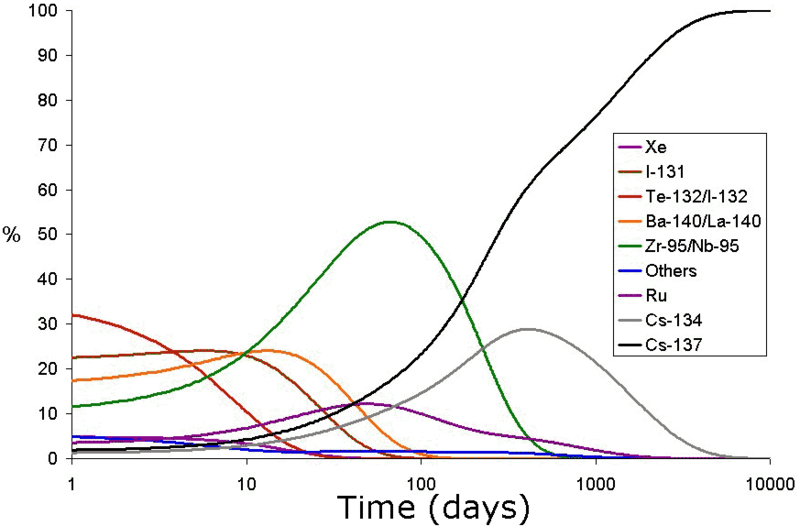
The radioactive substances released by the Chernobyl nuclear power plant meltdown are represented in this chart:
(Source. If you’re wondering what the other radioactive elements are, or why radioactive iodine is a byproduct of uranium fission, a possible place to start is Wikipedia, “Fission products by element” ).

Note first of all that the chart presents percentages of radioactive substances, not amounts. The amounts are highest on the first day and then decline rapidly. The great danger comes in the first few days.

During these dangerous first days, iodine-131 is, along with tellurium-132 and its decay product iodine-132, the dominant source of radioactivity. These radioactive iodine species account for over 50% of the radiation.

Not only its abundance, but also its effectiveness at causing biological damage make iodine far and away the greatest danger. Iodine radiation is highly effective at causing cellular damage:

Due to its mode of beta decay, iodine-131 is notable for causing mutation and death in cells which it penetrates, and other cells up to several millimeters away. [Source: Wikipedia, Iodine-131]

Worse, iodine is an important biological molecule that gets concentrated in the thyroid. So the dose of radiation becomes very high in the thyroid, and this leads to DNA damage producing a high risk for thyroid cancer.

Thyroid cancer is “the only unequivocal radiological effect of the Chernobyl accident on human health.” [1] Since Chernobyl released a great deal more radiation than the Japanese reactor meltdowns are likely to do, it’s likely that this will be the case in Japan also.

The rate of thyroid cancer after Chernobyl was higher the younger the age at time of exposure. Children and infants are at greatest risk:

It is now well documented that children and adolescents exposed to radioiodines from Chernobyl fallout have a sizeable dose-related increase in thyroid cancer, with the risk greatest in those youngest at exposure and with a suggestion that deficiency in stable iodine may increase the risk. [2]

The last point is crucial – iodine deficiency increases the risk.

Iodine deficiency and radiation risk

In iodine deficiency, the thyroid gland has difficulty generating enough thyroid hormone. T4 thyroid hormone, manufactured in the thyroid and so named because it has 4 iodine atoms, is 65.4% iodine by weight, so iodine is the key ingredient in thyroid hormone.

To compensate for an iodine deficiency, the body does two things:

  • The thyroid gland grows, so that it can more aggressively scan the blood for iodine. An enlarged thyroid is called a goiter.
  • The pituitary gland issues thyroid stimulating hormone (TSH), which induces the thyroid to aggressively scavenge iodine from the blood and turn it into thyroid hormone.

So in iodine deficiency the thyroid is aggressively scavenging all available iodine. This means that when a large dose of iodine-131 or iodine-132 arrives during radiation fallout, these radioactive iodine atoms are quickly picked up by the thyroid. There, they release their radiation and damage the thyroid.

On the other hand, in thyroid replete persons, the thyroid has all the iodine it needs and takes up little iodine from the blood. In this case, iodine that enters the body is distributed throughout the body, or excreted. Doses in any single cell are much lower. The danger to the thyroid is not much greater than that to other organs – which, the Chernobyl experience tells us, is not detectable to epidemiology. (There is even a theory that low-level radiation may be beneficial through hormesis.)

How can the thyroid be made replete with iodine?

The best way, which we recommend in our book, is to supplement with iodine and gradually build up the dose over a four to six month period. Start below 1 mg/day, take that for a month, then double the dose. After a month, double the dose again. Continue doubling until you reach your desired maintenance dose; we recommend at least 3 mg/day (a quarter Iodoral tablet), with 12.5 mg/day a reasonable dose. Some people taking as much as 50 mg/day.

At 12.5 mg/day, it can take a year or more to become replete with iodine in all tissues and to fully drive out other halogens, such as bromine, from the body. This has great benefits for immune function. So, it is best to get started!

Risks of high-dose iodine supplementation

If a person’s thyroid gland is adapted for iodine scarcity and the person takes a large dose of (non-radioactive) iodine, the likely course of events is:

1.      Hyperthyroidism. The thyroid, aggressively scavenging for iodine to repair a deficiency of thyroid hormone, scoops up all the iodine and makes a large amount of thyroid hormone. The person develops symptoms of hyperthyroidism (too much thyroid hormone): anxiety, intolerance of heat, muscle aches, hyperactivity, irritability, hypoglycemia, elevated body temperature, palpitations, hair loss, difficulty sleeping.

2.      Wolff-Chaikoff effect. As thyroid hormone levels become too high, the body induces mechanisms for suppressing thyroid hormone production. Simply reducing TSH output is not effective to suppress thyroid hormone production if a very large iodine influx is received. Fortunately there is another mechanism for suppressing thyroid hormone formation, mediated by iodine itself: the formation of iodine-rich proteins (iodopeptides) in the thyroid that inhibt synthesis of the thyroid peroxidase (TPO) enzyme. Normally, this mechanism operates for a few days and wears off, restoring normal thyroid function. [3]

3.      Reactive hypothyroidism? Usually, everything will normally return to normal after a few days. But sometimes in previously iodine-deficient adults and more commonly in newborns and fetuses and some diseased persons, after very high doses of iodine the Wolff-Chaikoff effect can persist. In this case the early hyperthyroidism is followed by a period of hypothyroidism (too little thyroid hormone). This “hypothyroidism is transient and thyroid function returns to normal in 2 to 3 weeks after iodide withdrawal, but transient T4 replacement therapy may be required in some patients.” [3]

4.      Risk for lasting hypothyroidism. People who develop a reactive hypothyroidism following a large dose of iodine are at high risk for later development of persistent hypothyroidism. [3]

So most people will experience transient hyperthyroid symptoms for a few days and then do fine. Some will develop a reactive hypothyroidism lasting a few weeks and then be OK, save for an elevated risk of hypothyroidism later which may or may not be due to the reactive episode.

Advice of the authorities to fallout victims

The advice from public health authorities is a compromise between the protective effects of high-dose iodine and the risk of messing up the thyroid.

A US Center for Disease Control (CDC) fact sheet explains the recommendations. A single large dose of iodine offers protection for about 24 hours. Recommended intakes are:

  • Adults should take 130 mg/day while exposure persists.
  • Children older than 3 and smaller than adults should take 65 mg/day while exposure persists.
  • Infants and toddlers aged 1 month to 3 years should take 32 mg/day.
  • Newborns should take 16 mg/day.

Our advice

The CDC dosage advice strikes us as very reasonable.

If you are not currently exposed to fallout, but think you may be exposed in the near future, you should consider beginning with small doses of iodine now – say, 3 mg/day. If that does not produce any symptoms, then try 6 mg/day; if it does, back off to half that dose. This will begin the adaptation process for your thyroid gland and help minimize hyperthyroid or hypothyroid reactions if you do have to take high doses.

Also, obtain your iodine tablets in advance. If fallout does occur, it may be hard to find iodine pills. NukePills.com says they are out of stock and have a large order backlog. I saw a story the other day that a 14-dose packet of potassium iodide was being sold at one site for $200, up from the normal $10 list price.

We recommend Iodoral 12.5 mg tablets. This is a good size for supplemental use; to reduce it to a 3 mg dose, cut the tablet in quarters with a razor blade. If fallout arrives, you can use ten Iodoral tablets to get a 125 mg adult dose.

For doses below 3 mg, smaller iodine tablets or liquid iodine solutions may be best; you can dilute liquid solutions to your desired dose. Some brands were recommended by readers in comments on our Supplement Recommendations page.

Conclusion

Outside of Japan, the risk is minimal, and even in Japan those who are replete with iodine are unlikely to develop thyroid cancer from exposure. After Chernobyl, thyroid cancer rates were high in Russia, the Ukraine, and Belarus which did not distribute iodine, but low in Poland which did. Fortunately, Japan has one of the highest iodine intakes in the world thanks to its high seaweed consumption. With that preparation plus proactive distribution of iodine tablets, we can expect and hope that the health effects of the reactor meltdowns will be minimal.

References

[1] Thomas GA et al. Integrating Research on Thyroid Cancer after Chernobyl-The Chernobyl Tissue Bank. Clin Oncol (R Coll Radiol). 2011 Feb 22. [Epub ahead of print] http://pmid.us/21345659.

[2] Cardis E, Hatch M. The Chernobyl Accident-An Epidemiological Perspective. Clin Oncol (R Coll Radiol). 2011 Mar 9. [Epub ahead of print] http://pmid.us/21396807.

[3] Markou K et al. Iodine-Induced hypothyroidism. Thyroid. 2001 May;11(5):501-10. http://pmid.us/11396709.
Protein for Athletes

How much protein should athletes consume?

Bodybuilders have long known that consuming extra protein makes it easier to add muscle. Yet low protein dieting can enhance immunity against viruses and bacteria, and extends lifespan in animals.

The Perfect Health Diet, because we’re positive toward saturated fats and starches, will often lead to lower protein consumption than other Paleo diets that restrict fatty or starchy foods. So it’s natural that some athletes and bodybuilders have asked how to optimize protein intake.

Robert recently asked about this, but let’s look specifically at the case of Advocatus Avocado:

I believe my performance improved (albeit marginally–the differences aren’t large) when I allowed my protein/carb/fat ratios to remain consistent despite my high caloric intake, which is ~3,600 calories/day. In other words, I had a sense of better performance when I lowered my fat% to around 65 and allowed around 200g/day of protein (I work out 2-3x a week for an hour).

At 3,600 calories per day, 65% fat is 2340 calories; 200 g protein is 800 calories; that leaves 460 calories carbs. How do these compare with Perfect Health Diet recommendations for athletes?

Nitrogen Balance, Exhaustion of Benefits, and Toxicity

There are a few magic numbers for protein intake that we want to be aware of:

  • Nitrogen balance. Nitrogen comes into the body in dietary protein and leaves the body in urine as ammonia, urea, and uric acid after proteins are metabolized. So when a person is in nitrogen balance, the amount of dietary protein matches the amount of metabolized protein, and the protein content of the body is unchanged. Very likely, the muscle content is unchanged too.
  • Exhaustion of benefits. We want to find the “plateau region” for nutrients. Athletes want to know: at what level of protein intake does protein no longer help build muscle?
  • Toxicity. At what level of protein intake does protein begin to damage health?

Luckily Ned Kock of the superb Health Correlator blog has done much of the work for us in his post “How much protein does one need to be in nitrogen balance?.”

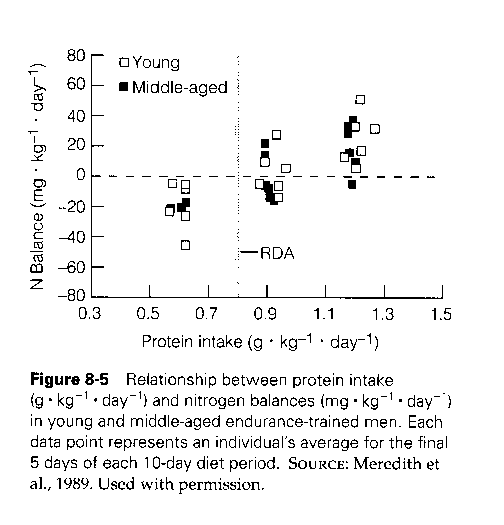
He presents this chart, from a book on Exercise Physiology [1]:

There’s a great deal of variability across persons. Some people are in nitrogen balance at protein intake of 0.9 g/kg/day; others need as much as 1.5 g/kg/day. At 1.2 g/kg/day, half the sample was in nitrogen balance.

Various factors influence the interpretation of this data:

  • The sample was of endurance athletes. Endurance exercise increases protein needs, so most people would reach nitrogen balance at lower protein intakes. Resistance exercise doesn’t require as much protein: Experienced bodybuilders are typically in nitrogen balance at 1.2 g/kg/day. [2]
  • Most of the sample probably ate a high-carb diet. Glucose needs were met from dietary carbohydrates. Low-carb dieters would need additional protein for glucose manufacture.
  • As Ned states, in caloric deficit, protein needs are increased; in caloric surplus, protein needs are decreased. If you’re restricting calories for weight loss, expect to need a bit more protein to avoid muscle loss.
  • Supplementing leucine “increased protein synthesis and decreased protein breakdown” [2], thus leading to nitrogen balance at lower protein intakes.
  • The point of nitrogen balance is dynamic: if everyone in the sample ate 0.9 g/kg/day, then they’d eventually get into nitrogen balance at 0.9 g/kg/day. The body adjusts to conserve muscle at given food availability.

The average person needs much less protein to be in nitrogen balance. The US RDA for protein, 0.8 g/kg/day, was set so that 97.5% of Americans would be in nitrogen balance. [2] But just to be conservative, and because we’re developing advice for athletes, let’s consider 1.5 g/kg/day as the protein intake that brings our athletes into nitrogen balance.

What about the protein intake that exhausts benefits?  At what intake is muscle synthesis no longer promoted?

Ned, citing a review paper [2], offers the following answer: “[P]rotein intake beyond 25 percent of what is necessary to achieve a nitrogen balance of zero would have no effect on muscle gain.”

On my reading it’s not so easy to infer a clear answer, but let’s go with this. If so, then muscle gains would be exhausted at 1.25*1.5 = 1.875 g/kg/day even for the most strenuous athletes.

What about toxicity?

We deal with this in our book (p 25). At a protein intake of 230 g/day (920 calories), the body’s ability to convert ammonia to urea is saturated. [3] This means the nitrogen from every additional gram of protein lingers in the body as ammonia, a toxin.

Clearly marginal dietary protein is toxic, via ammonia poisoning, at this intake level. A reasonable estimate for where toxicity begins is between 150 to 200 g/day.

Putting it together: A prescription for athletes

Let’s say our athlete is an 80 kg man. Then maximum muscle gain will be achieved at a protein intake of 1.875*80 = 150 g/day. Toxicity will begin somewhere between 150 to 200 g/day. So the “plateau region” where all the benefits, and none of the toxicity, are achieved is between 150 g/day and some protein intake not much above 150 g/day.

The plateau region is quite narrow! What this tells us is that athletes should consume about 150 g/day protein.

This assumes a high-carb diet, so that no protein is needed for gluconeogenesis. The body utilizes about 600 calories/day of glucose, plus another 100 calories per hour of intense training.

With carb intakes below 600 calories/day, additional dietary protein would be needed, because protein would be consumed nearly 1-for-1 with the missing carbs.

So we can summarize these results as follows:

  • On a high-carb diet (>600 calories/day), 600 protein calories/day maximizes muscle gain.
  • On a low-carb diet (<600 calories/day), 1200 carb+protein calories/day maximizes muscle gain.

Looking back at Advocatus Avocado’s personal experience, he eats a low-carb diet with 460 carb calories per day. We predict therefore that he would need 740 protein calories a day to maximize his muscle gain (plus up to another 100 calories per hour of training, to replace lost glycogen).

Advocatus says he needs 800 protein calories/day to maximize muscle gain. Close enough for blog work!

At these protein intake levels, Advocatus is probably experiencing mild ammonia toxicity. He might slightly improve his health by eating a few more carbs, and cutting his protein intake a bit.

He might also find that leucine supplementation would reduce his protein needs a bit.

Overall, however, I think his experiences are consistent with our framework for understanding nutritional needs. Those who are content with maintaining an ordinary person’s muscle mass can get by with relatively low protein intakes of 0.8 g/kg/day or less. But muscle-building athletes need high protein intakes, around 1.9 g/kg/day, to maximize the rate of muscle gain. If they eat low-carb, they may need even more protein. Such high protein intakes are likely to exceed the threshold of toxicity.

References

[1] Brooks, G.A., Fahey, T.D., & Baldwin, K.M. (2005). Exercise physiology: Human bioenergetics and its applications. Boston, MA: McGraw-Hill.

[2] Wilson, J., & Wilson, G.J. (2006). Contemporary issues in protein requirements and consumption for resistance trained athletes. Journal of the International Society of Sports Nutrition, 3(1), 7-27.

[3] Rudman D et al. Maximal rates of excretion and synthesis of urea in normal and cirrhotic subjects. J Clin Invest. 1973 Sep;52(9):2241-9. http://pmid.us/4727456.

Clam Chowder

Clam chowder is a New England favorite, and it’s quite a treat when made properly. However, even in New England most restaurants take shortcuts and their chowder often disappoints. Luckily, it’s easy to make an exquisite clam chowder at home.

Ingredients

Part of the secret is to have fresh ingredients. Clam chowder made with fresh clams is much better than clam chowder made from canned clams. In Boston, live clams are readily available in supermarkets; those who are farther from the sea may be able to find seafood stores that carry clams. It’s worth trying at least once so you know what you’re missing!

Here are most of the ingredients: potatoes, celery, onions, butter, 1 cup heavy cream, and 1 tbsp tapioca starch mixed with 2 tbsp water to make a paste that dissolves easily in water.

Here are the clams we used. Soak them in salt water (1/2 tsp salt in the water) for a half hour or more to help remove impurities; discard the soaking water:

We also used 2 cups chicken broth, but forgot to take a picture of it.

Cooking the Clams

The object is to steam the clams while collecting the juice that comes out of the clams when they open. This clammy juice adds great flavor to the chowder.

We used a pot with 2 steaming baskets, a deep one and a shallow one, and a glass cover. We put a bowl in the deep basket to collect the clam juice:

We brought the water in the bottom of the pot to a boil, then added the clams to the top shallow basket and covered:

If you don’t have a pot with 2 steaming basket, just put the clams in the bowl in your single steaming basket.

After about 5 minutes, the clams open. Turn off the heat – they are now cooked.

Any clams that refuse to open are bad and should be discarded. Scrape out the open clam meat into a bowl. You can dice the clams if you like; we chose to keep them whole.

The juice that came out of the clams will look like this:

The clams have a surprising amount of liquid inside; we gathered about 1 cup. Note that you don’t need to extract the bowl from the steamer basket; when ready you can pour this liquid directly into the soup with the bowl still inside.

Preparing The Chowder

While the clams are being prepared, you can be working simultaneously on the chowder.

In a wok, begin by sautéing the onions in a half stick of butter for one minute:

Add the celery and stir another minute:

Then the chicken broth:

At this point dice the raw potatoes and add them to the pot. (It’s best to avoid exposing the potato to air for long periods of time. If you want to cut the potatoes ahead of time, store them in water.) The potatoes need to boil about 15-20 minutes; they should be cooked but not totally softened.

When the clam juice and clams are ready, add them too. It will look like this:

When the potatoes are cooked, add the cup of heavy cream, and salt and pepper and any other spices you like, and return to a near-simmer.

Gradually mix in the tapioca starch paste, tasting periodically until you reach a thickness you like. When the chowder is properly thick, warm, and well-mixed, you’re done:

Serve:

Conclusion

Chowder that is made with tomatoes is called “Manhattan Clam Chowder.” This concoction is illegal in New England. If you make it and live in Massachusetts, take care not to post pictures on the Internet.

We predict you’ll love this chowder. Enjoy!

Around the Web; and “A Ray of Hope in the Dark Horizon of Obesity”

Our prayers to those in harm’s way: To the earthquake and tsunami victims in Japan, and earlier in Christchurch, our prayers and best wishes.

Here are things that caught my eye this week:

[1] Congratulations, Emily! Dr. Emily Deans is now writing for Psychology Today. It’s great that a wide audience will now be hearing her helpful ideas – for instance, that magnesium may be the healthiest antidepressant.

P.S. – Kurt Harris will be there too!

[2] Secrets to longevity: Longevity project authors say that careful, conscientious people live longer than optimists; hard-working people live the longest; worrying is OK; good marriages extend lifespan, difficult marriages don’t; starting school at a very young age shortens lifespan (that’s bad news for Shou-Ching, she started school early to be with her older brother). Their advice: make a lot of friends, and be active doing things you enjoy.

[3] What’s He up to now?: When commenters leave blog addresses I visit their blogs. Mary of Midlife Makeover Year made me smile with this:

Love this picture of Mary … keeping an eye on her Son who is probably messing up the spice rack again.

[4] Self-Recommending Paper: With Staffan Lindeberg, Loren Cordain, Pedro Bastos, and other leading Paleo figures in the author list, “The western diet and lifestyle and diseases of civilization” is bound to be good. Download here.

[5] Nice to hear: Our Ox Feet and Seaweed Soup is “Absolutely fantastic!”

[6] A new difference between chimps and humans: Penile spines. John Hawks explains that chimpanzees have pointy cactus-like penises while Neandertals and humans don’t. Scientists are wondering when and why our ancestors lost these prickly appendages. The loss makes sex far more enjoyable.

I’m glad I’m human!

[7] Animal photo for no reason whatsoever: Via Yves Smith

[8] Are smokers more creative?: Bruce Charlton wonders if smoking improves mental function.

[9] Don’t eat cardboard: Barry Groves says cardboard breakfast cereal boxes are no longer healthier than the cereals they contain. Sadly, not because the cereals got better.

[10] Don Rumsfeld works at a standing desk, Piers Morgan thinks it’s odd: There are few single life adjustments more likely to improve your health than working at a standing desk. I’ll blog about why after I finish building mine. Don Rumsfeld looks great for 78, and his standing desk probably has something to do with it. Here’s Piers Morgan trying to make it sound weird:

I wonder what would have happened if Rummy had worn his Vibrams!

[11] Cure worse than the disease syndrome: In Science Daily, some excited scientists proclaim a new cure for obesity:

An important discovery in mice may make a big difference in people’s waistlines thanks to a team of Harvard scientists who found that reducing the function of a transmembrane protein, called Klotho, in obese mice with high blood sugar levels produced lean mice with reduced blood sugar levels. This protein also exists in humans, suggesting that selectively targeting Klotho could lead to a new class of drugs to reduce obesity and possibly Type 2 diabetes for people….

“Our study is a small step toward reducing the sufferings of obese and diabetic individuals to bring back the joy of healthy life,” said M. Shawkat Razzaque, M.D., Ph.D., a researcher involved in the work from the Department of Oral Medicine, Infection and Immunity at Harvard School of Dental Medicine in Boston. “In the dark horizon of obesity and diabetes, Klotho brings a ray of hope.”

I happen to have a passing familiarity with Klotho; it is discussed in this paper which was cited in my post The Amazing Curative Powers of High-Dose Vitamin D in Aging and Autism. Klotho knockout mice experience accelerated aging and die young. Another paper summarizes, “Klotho hypomorphic mice (klotho(hm)) suffer from severe growth deficit, rapid aging, and early death.” From a Nature article, here’s a picture of a normal mouse and a Klotho deficient mouse. Can you guess which mouse had its obesity cured?

Of course, rapid aging and early death is a problem for the longevity researcher, not the obesity researcher. If Klotho blocking cures obesity, the obesity researcher’s job is done, and it’s up to longevity researchers to find a drug that extends the life of anti-Klotho-drug-consuming humans.

[12] 88% of Bavarian doctors have prescribed placebos: Guardian story here.  The study (in German) is here. Hat tip: Tyler Cowen.

I suspect that if US doctors could follow their own clinical judgment without fear of lawsuit or clinical review or patient complaints, placebos might make up a majority of prescriptions. And health might improve! Not because the patients are psychosomatic, either.

[13] Jamie Scott, “That Paleo Guy,” is eloquent about constipation.

[14] Fallon, Nevada, provides evidence for an infectious origin of leukemia.

[15] Weekly Video: The rhythms of traditional life (via Fanatic Cook)