



The Virtues of Spicy Food

I’ve been blogging recently about gut health, and emphasizing that an impaired gut often leads to systemic diseases (“Disease Begins in the Mucus,” June 23, 2015).

Impairment of the gut most commonly comes from (or is associated with) infections, or what amounts to the same thing, microbial overgrowth. Small intestinal bacterial overgrowth (SIBO) is a very common disorder, afflicting about 5% of younger adults and 15% of older adults. [1]

If SIBO is a precursor to systemic diseases, then any intervention that clears germs from the small intestine should help prevent disease.

Spices: A Natural and Beneficial Antibiotic

The traditional cooking spices, such as onions, garlic, and ginger, are all antimicrobial. [3] So if clearing microbes out of the small intestine is important for health, then eating spicy food should be a good thing. The hotter, perhaps, the better: the hottest spice, chili peppers, are known for their antimicrobial and antiviral properties. [4]

But how large are the benefits of including spices on food? Evidence toward an answer comes from a new study out of China [2] using the China Kadoorie Biobank database. The study asked 487,000 people at baseline, “During the past month, about how often did you eat hot spicy foods?” Then it tracked their health outcomes for 7 years and analyzed death rates as a function of the number of spicy meals consumed per week. In this case, “hot spicy foods” means meals with chili peppers or chili oil.

Interestingly, the mortality benefits of spicing food were large. Here’s a table showing the relative risk of dying from various causes, as a function of chili pepper consumption:

  No spicy meals Spices eaten 1-2 days per week Spices eaten 3-5 days per week Spices eaten 6-7 days per week
Death from all causes 1.00 0.90 0.85 0.83
Death from cancer 1.00 0.96 1.01 0.95
Death from heart disease 1.00 0.83 0.75 0.73
Death from diabetes 1.00 0.77 0.46 0.59
Death from respiratory disease 1.00 0.60 0.59 0.57
Death from infections 1.00 0.87 0.68 0.71
Death from all other causes 1.00 0.90 0.89 0.81

The biggest benefits were for diabetes and respiratory disease, then infectious disease and heart disease. This makes sense:

  • Diabetes is probably often caused by small intestinal infections that spread to the pancreas.
  • Respiratory pathogens infect the mouth and throat, where food spices can kill them; also, they are frequently swallowed, after which they can infect the gut as well.
  • Systemic diseases often enter the body through the gut, so anything that clears pathogens from the gut will reduce infectious disease.
  • Heart disease is also known to have a major infectious component.

In the subgroup analyses, there were some interesting correlations. Here’s Figure 2 from the paper:
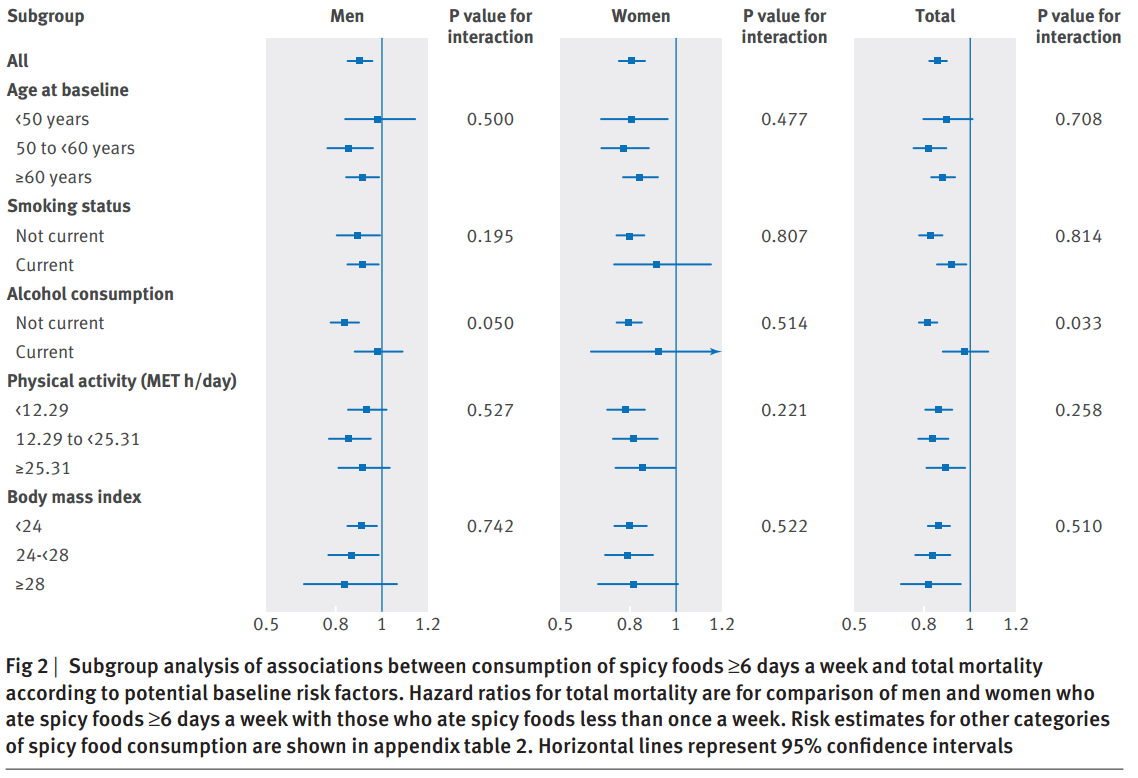
virtue_of_spices01

The interesting thing here is that alcohol consumption eliminates the benefits of chili pepper consumption. Alcohol intake is a known cause of SIBO [1], and possibly the alcohol is removing the beneficial effects of the chili peppers.

Another interesting finding was that fresh chili pepper seemed to be more protective than dried chili pepper or chili oil. Probably there are more bioactive and antimicrobial compounds in the fresh peppers.

Neurotoxicity: Pro or Con?

The study authors note that capsaicin in chili peppers has complex biological effects. So it’s possible that not all the benefits of chili peppers were due to antimicrobial action in the small intestine.

Razib Khan, tongue in cheek, suggests another possibility: maybe chili peppers kill off the neurons of the gut. Capsaicin is a ligand for the pain receptor TRPV1 on neurons; this is why eating hot chilis can be painful. In high doses, capsaicin can actually kill neurons. [5]

Now, it happens that TRPV1 knockout mice live 14% longer than wild type mice [6]. If capsaicin could kill off the TRPV1-positive neurons, then maybe the effect on longevity would be the same as in the knockout mice, who have the neurons but not TRPV1.

Entertaining as this idea is, it would require massive chili pepper consumption. Rats lost neurons after intraperiotoneal injection of 125 mg capsaicin per kg body weight, equivalent to 10 g in humans [5]. Since pure capsaicin has a rating of 16,000,000 on the Scoville scale, ten times hotter than the hottest known pepper, this would be like taking 100 grams of the Carolina Reaper, 600 grams per day of habanero chilis, 6000 grams of serrano peppers, or 60,000 grams of jalapeño peppers. I don’t know about you but I would rather not eat a hundred pounds of jalapeño peppers, at least not at one sitting.

Another consideration is that the chili consumption would have to be sustained. Capsaicin can kill neurons, but if you stop eating the chilis, the neurons come back. [5] [7]

More fundamentally, the neurons of the gut are crucial for digestion, gut motility, and tissue healing. Losing those neurons would itself be a potential cause of SIBO and all the diseases against which chili peppers are protective.

Conclusion

Killing off neurons seems an unlikely path to health; nor is it likely a good thing to make your soup so spicy that it burns a hole in your stomach, as happened to one Chinese man.

The best course, it appears, is to eat chili peppers, but in moderation. Nearly all the benefits are obtained with a couple of hot and spicy meals per week.

Reminder: The Perfect Health Retreat

The October Perfect Health Retreat, taking place October 10-17, still has spots remaining. If you’d like to learn PHD home cooking from Shou-Ching, the science of good health from me, and a course in movement and relaxation from our star trainers Court Wing and Jae Chung, plus health coaching from me, while enjoying a delightful time on a magnificent beach and luxury property with hot tubs and pools, come to the retreat!

For more information, see our web pages or write me at paul@perfecthealthretreat.com.
PHRetreat_img3_600x400px

References

[1] Dukowicz AC, Lacy BE, Levine GM. Small intestinal bacterial overgrowth: a comprehensive review. Gastroenterol Hepatol (N Y). 2007 Feb;3(2):112-22. http://pmid.us/21960820/.

[2] Lv J et al. Consumption of spicy foods and total and cause specific mortality: population based cohort study. BMJ 2015;351:h3942. Full text: http://www.bmj.com/content/bmj/351/bmj.h3942.full.pdf.

[3] Sherman PW, Billing J. Darwinian Gastronomy: Why We Use Spices. BioScience 49(6) June 1999: 453-463. http://www.nbb.cornell.edu/neurobio/BioNB427/READINGS/ShermanBilling1999.pdf.

[4] Khan FA, Mahmood T, Ali M, Saeed A, Maalik A. Pharmacological importance of an ethnobotanical plant: Capsicum annuum L. Nat Prod Res. 2014;28(16):1267-74. http://pmid.us/24650229.

[5] Czaja K, Burns GA, Ritter RC. Capsaicin-induced neuronal death and proliferation of the primary sensory neurons located in the nodose ganglia of adult rats. Neuroscience. 2008 Jun 23;154(2):621-30. http://pmid.us/18456414.

[6] Riera CE et al. TRPV1 pain receptors regulate longevity and metabolism by neuropeptide signaling. Cell. 2014 May 22;157(5):1023-36. http://pmid.us/24855942.

[7] Gallaher ZR, Johnston ST, Czaja K. Neural proliferation in the dorsal root ganglia of the adult rat following capsaicin-induced neuronal death. J Comp Neurol. 2014 Oct 1;522(14):3295-307. http://pmid.us/24700150.


 

Steve Hillbrand on the Perfect Health Retreat

Steve Hillbrand of Minnesota was a guest at the October 2014 Perfect Health Retreat. Steve kindly recorded a video for us discussing his experience at the retreat.

Some highlights:

  • “I’d like to say thank you for providing this opportunity, it was really nice.”
  • “Everybody here has been really friendly, very helpful, did everything to make me feel comfortable and welcome.”
  • “My purpose was to get the whole dimension of the diet and the lifestyle…. I wanted to see how it would feel to implement everything.”
  • “This couple weeks kind of gave me a good feeling for what it would be like.”
  • “I usually eat a lot, and I found that by the end of the first week and into the second week that one plate of food was all I really felt like eating. It filled me up. Very different than what I’m used to.”
  • “Cravings for alcohol kind of go with me, along with cravings for sweets and coffee, I’m constantly adjusting my mood with food. It was nice to have the wine in the evening and no problems staying within the two glasses, a couple of nights one glass. Even party night tonight I’ll probably have two glasses because that seems to be sufficient for me.”
  • “The other nice thing about the retreat for me was feeling physically stronger. Doing the weight training and the exercises, you start to realize, it doesn’t take that much. The training on the importance of consistency really rang home to me… Just the idea that you can do the 15 minutes a couple times a day and get the health benefits was nice for me to realize and I can imaging implementing it.”
  • “All the variety, looking at the barefoot running, looking at the heart rhythm training, those were all very interesting to me. I’d been exposed to them all before but it never really clicked in the same way as when you explained it.”
  • “I particularly liked the science classes. Looked forward to them every day.”
  • “Food was great. That was one of my big problems with implementing this diet…. I’d soon get bored with [meat and potatoes]. I didn’t really have the variety in my diet, didn’t really know how to make it. I have some new ideas now about doing it.”
  • “The more interesting conversation will be to talk to us a year from now…. Has it turned around some of the more chronic health issues that all of us seem to have?”
  • “I appreciate the idea that it’s not just one part, you do the whole thing.”
  • “I would heartily recommend the retreat to strangers…. I think everybody got something out of it.”
  • “I think the setting has been ideal for me. It’s been sunny, there’s a beach to walk on. I like a little bit of alone processing time, it’s very easy to walk down the beach and meander alone. That was wonderful. I really haven’t swam in the ocean hardly at all before, this was kind of exciting to be able to do that. The salt water pools right outside here were really nice. I never liked pools because I don’t like chlorine, and these were really nice for swimming and loosening up.”
  • “I don’t know if you can get a better setting.”
  • “I’m very happy I came. Very successful. I look at it as one of those pivotal points in my life. That’s my feeling right now…. It really feels like something big has shifted.”

Thank you Steve!

We are taking reservations now for the next Perfect Health Retreat to be held October 10-17, 2015. Don’t miss this opportunity for a luxurious vacation combined with a week of learning that will pay a lifetime of dividends.

To learn about the retreat, visit the various web pages under the Perfect Health Retreat tab, starting here. To reserve a room or for more information, please contact Paul Jaminet at paul@perfecthealthretreat.com or Whitney Ross Gray at whitney@perfecthealthretreat.com.

PHRetreat_img3_600x400px

PHD for MMA: Podcast with Toby MacEachern

Interested in mixed martial arts? I was pleased to appear on Toby MacEachern’s TNA4MMA podcast to talk abut what fighters can do to obtain terrific health while maximizing athleticism.

The podcast can be found on:

Thank you Toby!

Our Perfect Health Retreats were mentioned on the podcast. The next one is October 10-17. If you’re interested, check out our web pages starting here, or write me at paul@perfecthealthretreat.com.
PHRetreat_img3_600x400px for more information or to reserve a spot.

Ole Morten Grodås on the Perfect Health Retreat

Ole Morten Grodås of Trondheim, Norway was a guest at the October 2014 Perfect Health Retreat. Ole kindly recorded a video for us discussing his experience at the retreat.

Some highlights:

  • “I’m very glad I came. I learned some life habits and tips and tricks on these 14 days that I’ve not learned in like 4 years of reading blogs and books. It’s been really valuable.”
  • “I’ve been having stomach problems for two years and just being here for 14 days has improved them…. I’ve also after having health coaching with Paul I’ve gotten a strategy for how I can improve it when I get back home and I’m really looking forward toimplementing this strategy.”
  • “Heath coaching is maybe the most valuable part of the retreat for me – being able to ask Paul about my problems and his advice about them.”
  • “Paul has been available throughout the two weeks and I’ve been able to ask him about anything all the time. He’s been very helpful.”
  • “I like the concept that you can come here and everything’s optimized. When you read the blogs it’s hard to pick up on everything and fit it together into a complete lifestyle.”
  • “I think the setting of the Perfect Health Retreat is perfect. It’s sunny, it’s by the beach, it’s warm, but it’s not too warm. I’m from Norway and I think it’s perfect. In the night it’s cool enough that you can sleep easily.… It’s a quiet beach and that’s also very nice.”
  • “The science classes are another favorite of mine. I’ve been reading the Paleo books and blogs and trying to understand what’s needed to be done for good health. Attending the science classes at this retreat has improved my knowledge of what constitutes really good habits and healthy habits. I’ve learned important things that I think will really improve my health long term.”
  • “I think the exercise classes have been very good.”
  • “My favorite exercise class was the running exercises where Paul was teaching us running techniques…. That’s very hard to do on your own because you’re not aware of how you’re running and how it’s wrong.”
  • “I really liked the cooking classes as well. What I liked the most is that you can acquire skills that are also very hard to acquire just from reading or watching Youtube movies.”
  • “The food has been delicious, just as expected. I’ve been trying to eat the Perfect Health Diet for a long time, and I know it’s really good, but having a real chef make the food just makes it even better.”
  • “I think the retreat is something everyone will benefit from. Just to set aside one week, or 14 days, to just focus on my health has been really, really good…. For me it’s been very helpful to be here.”
  • “I highly recommend the retreat to anyone. I think everyone would benefit.”

Thank you Ole!

We are taking reservations now for the next Perfect Health Retreat to be held October 10-17, 2015. Don’t miss this opportunity for a luxurious vacation combined with a week of learning that will pay a lifestime of dividends.

To learn about the retreat, visit the various web pages under the Perfect Health Retreat tab, starting here. To reserve a room or for more information, please contact Paul Jaminet at paul@perfecthealthretreat.com or Whitney Ross Gray at whitney@perfecthealthretreat.com.

PHRetreat_img3_600x400px