



Chocolate: What is the Optimal Dose?

Bret asked us how much chocolate is needed for good health:

I have a question about having dark chocolate daily. Does it need to be every day or what is the mininum grams per day. I have been having around 35g a day of 70% but I wondered if less would be ok or not having it at all.

This is a great time for this question, since Halloween candy will be running out soon, and those on tight budgets may be tempted to skimp on their chocolate. Should they?

Chocolate Is Not Considered Essential … Yet

Chocolate has not yet been recognized by the Food and Nutrition Board of the National Academies as an essential nutrient. We haven’t either: Our food plate lists it among “pleasure foods,” which are healthful but optional.

However, we are becoming ever-more chocolate friendly. In the new edition of our book, we list chocolate among our “supplemental foods” which we recommend consuming regularly. But our suggested dose is “as desired.” Perhaps we should narrow that down a little.

Chocolate Against Cardiovascular Disease

We’ve previously warned of the danger of chocolate deficiency, based on a systematic review that found: “The highest levels of chocolate consumption were associated with a 37% reduction in cardiovascular disease and a 29% reduction in stroke.” [1]

Here’s a visual summary of their findings:
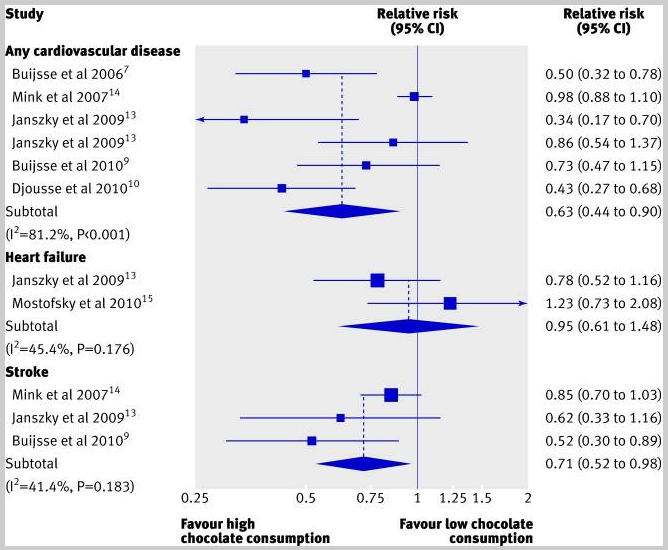
The review authors report that every study accounted for chocolate intake in a different way, so they could only compare the groups with highest and lowest chocolate consumption in each study, not specific doses of chocolate.

Chocolate Against Diabetes

Bret was concerned about the sugar in chocolate, but if this is a problem, it’s outweighed by the benefits of chocolate. A Japanese study found that the rate of diabetes was reduced by 30% in those who consume the most chocolate. [2]

Chocolate Against Dementia and In Support of Cognitive Function

Several studies [3, 4] have found that chocolate consumption reduces risk of dementia and enhances performance on tests of cognitive function.

One of them found that cognitive function was optimized with a relatively low dose of chocolate – ten grams per day:

The associations between intake of these foodstuffs and cognition were dose dependent, with maximum effect at intakes of approximately 10 g/d for chocolate and approximately 75-100 mL/d for wine, but approximately linear for tea. [3]

The other found that cognition improved with intake of cocoa flavanols up to quite high doses – elderly given 1 g/day cocoa flavanols performed significantly better on cognitive tests than those given lower doses. [4]

Unfortunately I don’t know what fraction of chocolate is made of flavanols. I’m guessing it’s not more than a few percent, in which case this research suggests the optimal dose of chocolate may be 50 g/day or more.

Chocolate in Support of Circadian Rhythms

Most authors attribute the benefits of chocolate to their flavanols, which are thought to improve endothelial function and increase blood flow to the brain, among other effects.

However, there are other active compounds in chocolate, include peptides that interact with the opioid receptor. The opioid receptor has a role in circadian rhythms, which is one reason low-dose naltrexone (which blocks opioid function at night) works. It’s possible that eating chocolate during the day may support circadian rhythms via opioid receptor stimulation, especially if the peptides can reach the systemic circulation.

Indirect evidence that this may be beneficial comes from a Russian study in which exorphins (opioid receptor ligands) were injected into rats:

The chronic intraperitoneal administration of the peptide at the same dose of 5 mg/kg significantly increased exploratory activity, decreased anxiety, and improved learning. [5]

I don’t know how much chocolate would have to be eaten to achieve a similar exorphin dose in humans, but I imagine it’s large.

Chocolate in Support of Nobel Prizes

So how shall we resolve the issue of optimal chocolate dose? For me, the decisive evidence comes from a recent study by Franz Messerli published in the New England Journal of Medicine.

Based on chocolate’s support for cognitive function, he decided to see if chocolate consumption was related to another measure of cognition – Nobel Prize awards per capita. He counted Nobel Prizes and compared them to the recipient’s country’s chocolate consumption. These were his findings [6]:
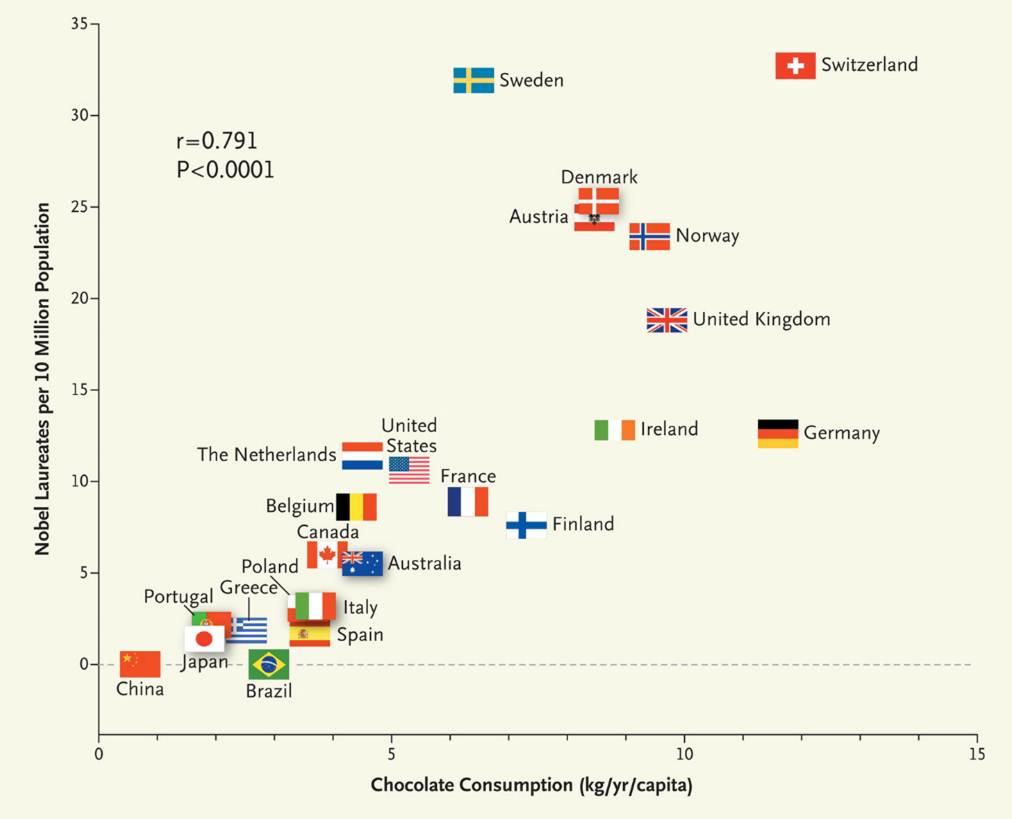
There is clearly a strong correlation. The correlation coefficient is .79; p < 0.0001.

The correlation coefficient if Sweden is removed increases to .86 – which is suspicious:

Given its per capita chocolate consumption of 6.4 kg per year, we would predict that Sweden should have produced a total of about 14 Nobel laureates, yet we observe 32. Considering that in this instance the observed number exceeds the expected number by a factor of more than 2, one cannot quite escape the notion that either the Nobel Committee in Stockholm has some inherent patriotic bias when assessing the candidates for these awards or, perhaps, that the Swedes are particularly sensitive to chocolate, and even minuscule amounts greatly enhance their cognition. [6]

Those dastardly Swedes! Giving themselves more Nobel Prizes than their chocolate consumption warrants!

But I apologize, I’ve been diverted. The key point is, is there an optimum chocolate consumption?

the dose–response curve reveals no apparent ceiling on the number of Nobel laureates at the highest chocolate-dose level of 11 kg per year. [6]

11 kg/yr is an average of 30 g/day. So benefits are still increasing at that dose.

Of course, this was only a population level study. We still need to measure the doses in individual laureates to gain confidence. But anecdotally, there appears to be a correlation:

“I attribute essentially all my success to the very large amount of chocolate that I consume,” said Eric Cornell, an American physicist who received the Nobel Prize in 2001. “Personally I feel that milk chocolate makes you stupid. Now dark chocolate is the way to go. It’s one thing if you want like a medicine or chemistry Nobel Prize…but if you want a physics Nobel Prize it pretty much has got to be dark chocolate.”

Dark chocolate is, indeed, the PHD-approved form of this highly beneficial food.

Conclusion

This dose-response data might not be strong enough to define an RDA, but I’m going to take a stand: Bret’s intake of 35 g/day is healthy. Indeed, it’s right in line with the Nobel Prize-maximizing chocolate intake of the Swiss.

In regard to your last question, Bret – can you eat less chocolate, or none at all – the answer is clear. Yes, you can. But you must accept the consequences. You probably won’t be winning the next Nobel Prize for Physics.

References

[1] Buitrago-Lopez A et al. Chocolate consumption and cardiometabolic disorders: systematic review and meta-analysis. BMJ. 2011 Aug 26;343:d4488. doi: 10.1136/bmj.d4488. http://pmid.us/21875885.

[2] Oba S et al. Consumption of coffee, green tea, oolong tea, black tea, chocolate snacks and the caffeine content in relation to risk of diabetes in Japanese men and women. Br J Nutr. 2010 Feb;103(3):453-9. http://pmid.us/19818197.

[3] Nurk E et al. Intake of flavonoid-rich wine, tea, and chocolate by elderly men and women is associated with better cognitive test performance. J Nutr. 2009 Jan;139(1):120-7. http://pmid.us/19056649.

[4] Desideri G et al. Benefits in cognitive function, blood pressure, and insulin resistance through cocoa flavanol consumption in elderly subjects with mild cognitive impairment: the Cocoa, Cognition, and Aging (CoCoA) study. Hypertension. 2012 Sep;60(3):794-801. http://pmid.us/22892813.

[5] Belyaeva YA et al. Effects of acute and chronic administration of exorphin C on behavior and learning in white rat pups. Moscow University Biological Sciences Bulletin Volume 64, Number 2 (2009), 66-70, DOI: 10.3103/S0096392509020035. http://www.springerlink.com/content/qt537481061656gt/?MUD=MP.

[6] Messerli FH. Chocolate consumption, cognitive function, and Nobel laureates. N Engl J Med. 2012 Oct 18;367(16):1562-4. doi: 10.1056/NEJMon1211064. Epub 2012 Oct 10. http://pmid.us/23050509.


PaleoFX, AHS, and Building Institutions

The next year could be huge for the ancestral health movement. We have a chance to leap into the mainstream. Shou-Ching and I will certainly be working hard to bring that about. A lot of other people are working hard at it, too.

In order to accomplish this, we have to work together, and to do that it’s extremely important to meet. That’s why I’m very excited about the two big ancestral health gatherings: PaleoFX and the Ancestral Health Symposium. Both have made announcements this week.

PaleoFX: Make Plans Now

PaleoFX will be held March 28-30 in Austin, Texas. March 30 is my birthday and I can’t think of a better way to celebrate than with lots of Paleo friends.

PaleoFX is a terrific event. The 2013 speakers include Mat Lalonde, Sarah Fragoso, Nora Gedgaudas, Kelly Starrett, Diane Sanfilippo, Jimmy Moore, Nell Stephenson, Cate Shanahan, Abel James, Emily Deans, Michelle Tam, and many more, including rising young stars like Dan Pardi of Dan’s Plan.

PaleoFX has strong fitness and food components, as you would expect given the backgrounds of Michelle and Keith Norris of Ancestral Momentum. Fitness sessions and cooking demos run alongside the talks, so PaleoFX is a great opportunity to improve body and spirit as well as mind.

It will be in a new location, the scenic Palmer Events Center, which unfortunately has space limitations placing a strict limit on the number of tickets that can be sold. PaleoFX 2013 is expected to sell out early, so it’s a good idea to make plans soon.

PaleoFX is offering a special deal on tickets purchased by December 1: you’ll be automatically entered in a contest to win access to a VIP dinner with speakers or a full refund of the PaleoFX ticket cost. Visit http://therealpaleofx.com/ to register for PaleoFX 2013.

Ancestral Health Society: Calling for Volunteers

The Ancestral Health Society has released a call for volunteers to help with the Ancestral Health Symposium 2013.

AHS 2013 will be held in Atlanta, Georgia on August 15-17. Right now the Society is looking for volunteers for the following positions:

  • Program Chair and Committee – invite presentation proposals, choose speakers, and craft the program schedule.
  • Public Relations Committee – help make the event successful.
  • Social Chair and Committee – arrange the parties!
  • Registration Chair.
  • Volunteer Chair.

If you’re interested, please let the Society know.

Building Institutions

At AHS 2012, I volunteered to help the Ancestral Health Society create a scholarly and clinical journal, the Journal of Evolution and Health. We’re currently choosing a publishing platform and solving technical issues; the editorial process is expected to begin in the new year.

We believe that this journal can bring scholarly, clinical, and popular communities together. The many health success stories that have appeared on Paleo/Primal/PHD blogs are strong evidence for the effectiveness of ancestral approaches to health. The journal will provide a forum to assemble evidence systematically and communicate it to a broader audience.

I know of a number of other promising initiatives underway in the community to bring ancestral health to the general public. Many, I’m sure, will bear fruit.

For our part, we’re hopeful that the new edition of our book can help the movement become more popular. We believe our diet is well-grounded scientifically, effective at healing, delicious to eat, and, because it supports gluten-free safe starches, easy for most people to adopt and maintain.

In the spirit of teamwork, we would like to introduce our readers to other worthy members of the ancestral health community. Toward that end, I would like to add a few “resource” pages to the site:

–          Food sites. A lot of great food bloggers post PHD-compatible recipes. Some of my favorites: Hilary Finch Hutler’s TummyRumblr; Russ Crandall’s The Domestic Man; Josephine and Henry Svendblad’s Nutty Kitchen; and Francesca, “The Italian Paleo,” at Francesca Eats. I’m sure there are other great food bloggers that should be on this list. All of them deserve more attention.

–          Healers. We often get emails from readers asking if we know of doctors, nutritionists, or alternative medicine practitioners in their area who are familiar with PHD and supportive of integrating modern medicine with natural, ancestral approaches to healing. Usually we don’t. Assembling a list of PHD-friendly healers would let us give a better answer.

If you’d like to be listed on one of these resource pages, please send me an email: pauljaminet at perfecthealthdiet dot com.

I have ulterior motives for discovering PHD-friendly foodists and healers. Identifying allies-in-spirit is the first step toward working together. For example, as the journal gets going, we will want to publish clinical case reports; to do so, the editors will need to be in contact with healers. There may be other opportunities. I organized a panel at AHS 2012 on “New Technologies, New Opportunities” to discuss how the ancestral community can take advantage of software technologies that are enabling new forms of collaboration, information sharing, and mutual aid. I don’t have anything definite in mind – yet – but I think there are opportunities to do a better job of bringing great food and ancestral healing to a broad public.

Conclusion

It’s an exciting time in the ancestral health movement. The community is growing fast, but is still small enough that it’s possible to know most of the players personally. If you’d like to be involved, there are many opportunities. Please consider getting involved!

Hurricane Sandy Approaches; meet Gabor Maté

I have a large number of half-completed posts and some will go up soon, but I thought I’d put up a note about the storm just so you’ll know what happened in case we lose power and disappear for a few days.

Hurricane Sandy looks to be an unusual storm: not terribly severe winds, but tremendous risk from flooding.

NOAA is projecting the storm will drop 6 inches of rain per day in some locations:

Wave heights are reaching 30 feet on ocean buoys:

The storm will make landfill with a full moon when tides are at their most extreme, so the potential for flooding to storm surges is severe. Widespread flooding means widespread power outages.

In Boston, they’re predicting four days of rain starting in a few hours.

If the rain has you at home looking for entertainment, here’s a very interesting talk by Gabor Maté, the Hungarian-Canadian psychologist (thank you, Kris!):

Be safe everyone!

Look AHEAD Scientists: Trying to Move the Deer Crossing

The Look AHEAD: Action for Health in Diabetes trial has been halted two years early. Here’s Gina Kolata in The New York Times:

The study randomly assigned 5,145 overweight or obese people with Type 2 diabetes to either a rigorous diet and exercise regimen or to sessions in which they got general health information. The diet involved 1,200 to 1,500 calories a day for those weighing less than 250 pounds and 1,500 to 1,800 calories a day for those weighing more. The exercise program was at least 175 minutes a week of moderate exercise.

But 11 years after the study began, researchers concluded it was futile to continue — the two groups had nearly identical rates of heart attacks, strokes and cardiovascular deaths.

It’s clearly a negative result for “eat less, move more” as a health strategy for obese diabetics.

Was “Eat Less Move More” Harmful?

A few Paleo bloggers are not surprised; indeed, Peter Dobromylskyj speculates that all-cause mortality – which Ms. Kolata and the NIH press release do not report – may have been higher in the “eat less, move more” intervention group:

It seems very likely to me that more people died in the intervention group than in the usual care group, but p was > 0.05.

Call me a cynic, but I think they stopped the trial because they could see where that p number was heading.

Peter may be a cynic but cynics are sometimes right, and I will bet that he’s right about this. In general, calorie restriction and exercise are better attested against cardiovascular disease than against other health conditions, so if death rates from CVD were identical in the two arms after 11 years, it’s quite likely death rates from other causes were higher in the intervention arm.

Our Theory

We discuss in our new Scribner edition two reasons why “eat less, move more” can backfire:

  • On a malnourishing diet, “eat less” means even greater malnourishment. Less of a bad diet is a worse diet.
  • Excessive exercise may over-stress the body and harm health. In diseased people, the volume at which exercise becomes excessive may not be that high.

On the other hand, ultimately some form of “eat less, move more” is needed if optimal health is to be attained:

  • An energy deficit – eating less than the body expends – is necessary to lose fat mass, and obesity is probably incompatible with optimal health.
  • About 20 to 30 minutes of exercise per day at the intensity of running or jogging is needed for optimal health, probably due to the role of daytime activity in entraining circadian rhythms (see “Physical Activity: Whence Its Healthfulness?”, October 11, 2012). Most people would need to “move more” to achieve this.

So the challenge in weight loss is two-fold: It’s necessary to adopt a healthy diet in which malnourishment doesn’t occur despite calorie restriction, and to find a healthy level of exercise that improves health without overstressing the body.

Look AHEAD: Bad Dietary Advice

The Look AHEAD Study Protocol tells us what the intervention group was told to do.

From page 29, here is the diet advice:

The recommended diet is based on guidelines of the ADA and National Cholesterol Education program [96,97] and includes a maximum of 30% of total calories from total fat, a maximum of 10% of total calories from saturated fat, and a minimum of 15% of total calories from protein.

This gives 55% carbs and probably 10% omega-6 fat. The omega-6 intake is far too high – for weight loss and good health, omega-6 intake should be less than 4% – and so is the carb intake – for diabetics, reducing carbs to 30% or less is highly desirable.

From page 30, here is the exercise advice:

The physical activity program of Look AHEAD relies heavily on unsupervised exercise, with gradual progression toward a goal of 175 minutes of moderate intensity physical activity per week by the end of the first six months. Exercise bouts of ten minutes and longer are counted toward this goal. Exercise is recommended to occur five days per week.

Moderate-intensity walking is encouraged as the primary type of physical activity.

I think this is reasonable advice. It translates to 35 minutes per day for 5 days. The intensity is quite low. This level of exercise is hardly likely to be excessive; indeed, it’s probably grossly insufficient for optimal health. It represents about a mile and a half of walking per day, five days per week. This may have been a homeopathic level of activity.

There is another reason the exercise may have produced no observable benefit. Since I believe the health benefits of exercise occur primarily through circadian rhythm entrainment, it’s likely that daytime exercise is much more beneficial than night-time exercise. Night-time exercise might be ineffective or even harmful to health if it disrupts circadian rhythms.

Unfortunately many people find it difficult to find time during the day for exercise. If the walking was performed at night, even the modest benefits of the activity may have been lost.

Weight and Health: What’s the Direction of Causation?

The one “success” of Look AHEAD was that it brought about some weight loss: the intervention group lost 5% of their original weight.

We know that obesity is associated with poor health. Since causation implies correlation, the existence of this correlation suggests that either (1) obesity causes poor health, (2) poor health causes obesity, or (3) some third factors cause both obesity and poor health.

The Look AHEAD study presumed (1) – that obesity causes poor health. The “eat less, move more” intervention was wholly directed at weight loss. If obesity is the cause of poor health, Look AHEAD should have improved health. It didn’t. This tells us that the direction of causality is either (2) or (3). Obesity doesn’t impair health; other factors that impair health cause obesity.

It’s easy to make faulty inferences about the direction of causation. The Look AHEAD scientists made the same mistake this woman did:

Conclusion

The basic flaw in the Look AHEAD study was that it was designed to bring about weight loss, and hoped that weight loss would improve health.

A better intervention would seek to improve health through a more PHD-like diet and through circadian rhythm therapies. Successful health improvement would, more than likely, lead to weight loss.

For the overweight and for diabetics, the focus should not be on weight, but on health. Improve health, and weight loss will follow. Focus on weight with a simple-minded “eat less, move more” intervention without tending to the quality of your diet and lifestyle, and you might be doing yourself more harm than good.