



Do the Elderly Need Paleo More than the Young?

I also do work in economics and one of my favorite economics blogs is Evolving Economics by Jason Collins. He has an interest in biology and Paleo diets and recently linked to an interesting train of thought from evolutionary biologist Michael Rose.

Here is a summary from Peter Turchin, who adopted a Paleo diet this spring after talking to Rose:

We think of people having ‘traits,’ but actually we change quite dramatically as we age. … As an extreme example, consider reproductive ability, something of great interest to evolution. Humans do not reproduce until they reach a fairly advanced age of maturation (puberty). Young adults are not very good mothers or fathers, but they improve with age during their twenties. After that reproductive ability declines and eventually disappears. …

Ability to digest certain foods can also be age-dependent. I have already mentioned the ability to digest lactose, the sugar present in milk. Before we domesticated animals such as cows and sheep, only very young humans had this ability. Natural selection turned this ability off in adults because they never needed it (and it would be wasteful to continue producing the enzyme lactase that aids in the digestion of milk sugar). …

Because abilities to do something at the age of 10, 30, 50, etc. are separate (even if correlated) traits, they evolve relatively independently of each other. When grains became a large part of the diet, the ability of children to digest them (and detoxify the chemical compounds plants put into seeds to protect them against predators such as us) became critical. If you don’t have genes to help you deal with this new diet, you don’t survive to adulthood and don’t leave descendants. In other words, evolution worked very hard to adapt the young to the new diet. On the other hand, the intensity of selection on the old (e.g., 55 years old) was much less – in large part, because most people did not live to the age of 55 until very recently. …

The striking conclusion from this argument is that older people, even those coming from populations that have practiced agriculture for millennia, may suffer adverse health effects from the agricultural diet, despite having no problems when they were younger.

This is an intriguing argument. Several aspects of it are well supported: there has been recent evolution to enable people to cope with toxic diets, and there are substantial changes in how we respond to food as we age.

Recent Genetic Evolution

We know that there has been recent evolution for greater tolerance to evolutionarily novel foods such as wheat. This is (presumably) why peoples with a long history of grain agriculture are less obese and diabetic on “western” diets than people with a long history of eating healthy foods.

The Pacific islanders are a great example. The world’s highest obesity rates are in the Pacific – for instance, in the Kosrae district of Micronesia, 88% of adults are overweight and 59% obese – yet they were notably slim sixty years ago when still eating their traditional diets. [1]

In our book, we note that the traditional diets of Pacific Islanders are almost toxin-free. A logical inference is that because they have for millennia eaten the world’s least toxic diets, Pacific Islanders never needed to evolve (or lost) an ability to cope with toxin-rich diets, and now suffer much more harm from toxic foods than do peoples whose ancestors have eaten toxic diets.

Age-Based Differences in the Biological Response to Unhealthy Food

It’s also the case that we respond to food differently as we age.

It’s not only digestion, such as the age-related decline in lactase enzyme expression, that changes. There are metabolic changes.

The elderly consume far fewer calories than the young; presumably evolution selected for minimal food utilization so that they would not be a burden to those who had to hunt and gather on their behalf. Their contribution was likely cultural, which didn’t require extensive physical activity.

Another change is that the elderly become less likely than the young to store calories in adipose tissue. This has significant consequences.

We know from a broad range of evidence that adipose tissue protects other tissues from damage by lipotoxicity; and that when adipose tissue refuses to store fat, obesogenic diets lead to metabolic syndrome and diabetes. [2] So reduced storage of calories in adipose tissue in the elderly will lead to (a) reduced rates of obesity (as measured by adipose tissue accumulation), but (b) higher rates of metabolic syndrome and diabetes.

This is exactly what we see. Here are obesity rates by age group [3]:
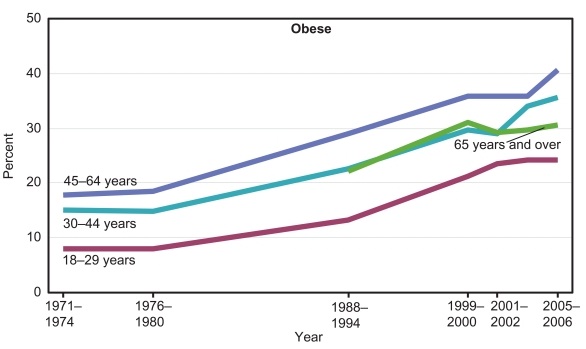
Obesity rates for people over age 65 are lower than for people aged 30-64.

Here are diabetes rates by age group [4]:

Despite their lower obesity rates, the elderly have higher diabetes incidence.

This difference alone is sufficient to answer the question in our title: Yes, the elderly do need a Paleo (ie healthy) diet more than the young. Diabetes is much more dangerous than adipose tissue accumulation, so the elderly will suffer greater health impairment from an obesogenic (and diabetes-genic) diet than the young.

Is There Data Specifically Testing Rose’s Idea?

Rose’s idea that an evolved tolerance for toxin-rich diets will be specific to reproductively-aged persons with agriculturalist ancestors, is, so far as I know, not easily tested by available empirical evidence.

Studies in western populations alone will not be able to test Rose’s idea, because greater intolerance of toxic diets with higher age could simply be a result of an aging process that is universal in all populations. In order to find a process that recently evolved in agriculturalists, we would have to look at rates of aging or morbidity in different populations, both western and aboriginal, and see how aging rates or disease incidence depend on dietary toxicity:

  • Are Pacific Islanders more likely than westerners on similar diets to develop diabetes at reproductive ages, but equally likely at late ages? Are they more likely to become obese at younger ages than old?
  • Is aging more rapid in traditional peoples than in westerners during reproductive years, but similarly fast during elderly years, if they eat similar diets?

I am not aware of any such studies. Let me know if you are!

References

[1] Cassels S. Overweight in the Pacific: links between foreign dependence, global food trade, and obesity in the Federated States of Micronesia. Global Health. 2006 Jul 11;2:10. http://pmid.us/16834782.

[2] Unger RH, Scherer PE. Gluttony, sloth and the metabolic syndrome: a roadmap to lipotoxicity. Trends Endocrinol Metab. 2010 Jun;21(6):345-52. http://pmid.us/20223680. Sun K et al. Adipose tissue remodeling and obesity. J Clin Invest. 2011 Jun;121(6):2094-101. http://pmid.us/21633177.

[3] Health, United States, 2008: With Special Feature on the Health of Young Adults. National Center for Health Statistics (US). http://www.ncbi.nlm.nih.gov/books/NBK19623/.

[4] 2011 National Diabetes Fact Sheet, http://www.cdc.gov/diabetes/pubs/estimates11.htm.

Around the Web: Back to School Edition

Greetings, everyone! It’s hard to believe our last Around the Web was all the way back on April 21. And that we’ve only managed a few days off for swimming and hiking in that time.

We’re very excited about the new Scribner edition: Perfect Health Diet: Regain Health and Lose Weight by Eating the Way You Were Meant to Eat. Can’t wait for it to come out! This version is really solid scientifically, we believe it will bring many people to better health, and we’re very excited to have the opportunity to bring PHD to a popular audience.

We want to extend our thanks once again to all the readers who have left their stories on the Reader Results page, and who gave permission for their stories to be used. Thank you! We were recently in New York to meet with the Scribner editorial staff and they said the reader stories were the best part of the book. I don’t think that was only in comparison to the parts we wrote.

[1] Prayers needed: Frequent commenter erp’s daughter and son-in-law have suffered severe burns in a small plane crash and are in critical condition. Please pray for their recovery.

[2] Podcasts: Let me recommend once again my podcast with Abel James, the Fat Burning Man: Paul Jaminet: The Perfect Health Diet, Safe Starches, and Intermittent Fasting. Abel was very well prepared, indeed he read the whole manuscript of the Scribner edition before our chat, and we covered a lot of material from the book. (By the way, Abel has a $0.99 Intro to the Paleo Diet. Can’t beat the price!)

I’ll be appearing on Cary Nosler’s Wide World of Health on Sunday September 9 at 4 pm EDT/1 pm PDT, unless baseball playoffs interfere in which case it will be at 3 pm EDT/noon PDT.

Finally, I’ve recorded an interview with Jordan Reasoner and Steve Wright of SCDLifestyle.com, scheduled to go live on Sept 27. Topics included the role of infections in inflammatory bowel disease, and how diet can help. Jordan and Steve have a great site for bowel disease patients. Both have been friends of the blog for quite some time; Jordan was one of our first readers and wrote one of the first Amazon reviews of our book.

[3] Music to read by:

[4] Reader Results:

Kevin Lyons started our diet two weeks ago and is live-blogging his experience at “Perfect Health Diet in Practice.” So far, so good: he’s lost 5 pounds, lowered his blood pressure, hasn’t been hungry, and “my energy and mood was great.”

Francesca has some good news about her husband:

He is 68, has a severely degenerated mitral valve and the surgeon’s opinion nine months ago was that immediate surgery was necessary. After just over a year on PHD he feels great and has no symptoms other than atrial fibrillation. He refuses to have the operation while he feels so well, has plenty of energy and is never breathless, not even when walking fast up steep hills or doing hard physical work.

He has refused all blood thinners, even baby aspirin, which infuriates his doctors…. [His] severe fatigue … has miraculously almost disappeared since going on PHD.

JonMarc Grodi has lost 50 pounds, and his wife Teresa 45 pounds.

Her complexion, body composition, energy levels, cravings/hunger, digestion, and other aspects of health have all improved. I have cut my exercise down to a fraction of what I am used to and at the same time put on a ton of muscle.

Pam has improved her cholesterol numbers and increased bone density. Ryan has improved his skin and appetite control.

A friend of Rich’s lost 35 pounds and

more importantly I feel fantastic…. Food no longer has a hold of me…. After 7 months of being on the Perfect Health Diet, my blood pressure was good. (I have always been borderline high). My bad cholesterol was good and my good cholesterol was outstanding. My triglycerides were ridiculously low.

I am now a huge advocate for this way of eating. It has changed my life, and I am excited about it.

MH has “been following PHD for 8-9 months, with wonderful results across the board.”

Marc got rid of his rosacea and stubborn body fat.

Catherine fixed her blood glucose and her headache vanished.

MsBB says “since following this diet-I have boundless energy. My yoyo hypoglycemic events have ended. Sleep like a rock.”

Daniel Han has lost over 90 pounds.

Lauren had chronic migraines for 16 years. No more!

Dr. Helen Riley has dropped a dress size and has more energy.

Steve Reichard has normalized his previously high blood pressure.

Ana Cheeseman says, “My health and energy levels have significantly improved with the PHD!!!! Thank you for sharing all this!!”

Justin: “I was diagnosed with fibromyalgia in 2009, improved on Savella, then plateaued, and now on the PHD for a few months, am improving almost back to where I was in my early 20?s.”

[5] Elsewhere on the Web:

There’s been some fractiousness in the Paleosphere while we were away. Melissa McEwen started a blog to document it: PaleoDrama. Richard Nikoley then declared war, producing but one casualty: his own sleep. Perhaps the blog should have been titled “PaleoComedy.”

Paleo is mainstream. Other evidence: the Roadkill Café is going upscale: get ready for “New Gather Cuisine.”

It’s not just Paleo: carbohydrate restriction has triumphed.

Dan’s Plan has a great infographic: Optimize Your Health.

Chris Kresser sticks to his guns: It’s OK to eat high-on-the-food-chain ocean fish despite mercury risks. ProfDrAndro of Suppversity reports on a conflicting study; Chris’s earlier article.

Nutrisclerosis by Whitney Ross Gray gives the Paleo community another MS recovery story, similar to that of Terry Wahls.

Catch-22: If you make public your cure for cancer, it’s impossible for anyone to bring it to market.

Sometimes journals are reluctant to publish negative results, which is unfortunate, as it would have deprived us of this interesting case study. (Via Greg Mankiw.)

It’s not just black cats whose paths you shouldn’t cross.

Dr Davis says “we’re seeing hundreds of thousands of people losing 30, 80, 150 pounds” by giving up wheat. Great news if true! Oddly, he doesn’t seem aware that gliadins are a component of gluten. Perhaps the journalist garbled the quote.

A good question is: If avoiding grains is so good for health, why didn’t traditional peoples discover it? Maybe they did. Via Martin Inderhaug, the ancient Chinese practice of Bigu.

Pal Jabekk advises: Jump!

Easy as Pi likes our diet.

Against my claim that starch is better than sugar, the Ray Peat Forum is soliciting rebuttals.  Andrew Kim stepped forward with “Fructose is > Glucose” and “Fructose is > Glucose Part II.”

Questions I hope I don’t get asked: Why does this woman need to be upside down? Why is this girl blue?

Caroline Lunger is a prolific young blogger. She made a common mistake – going too low carb on GAPS.

Horses do better on high-fat than high-grain diets.

Emily Willingham replies to the New York Times autism and inflammation article.

Besse Cooper has turned 116. She still doesn’t eat junk food.

Russ Crandall, The Domestic Man, has tips for easing into a Paleo diet.

The Power of Poo” is a resource for those considering fecal transplants.

Great line from Dallas and Melissa:

A Paleo way of life is about choosing to partake in a “nutrient-dense life”, complete with deeply nourishing food, emotionally satisfying social relationships, and genuine interaction with the natural (i.e. outside) world.

In a major upset, a seven year-old won the national ram-groping tournament.

The responsibilities of an academic are teaching, research and service fundraising.” Much research cannot be trusted because many academics exchange scholarly integrity for career success.

“Putting a mango directly into my mouth was stupid. I admit that.”

[6] Cute animal: NO!!!! Don’t do it doggie! It’s not Paleo!

More cute animals here. Via Craig Newmark.

[7] Not the weekly video: Cuter animals:

[8] Photo art:

[9] Weekly video: How to get the Spirit Mars Exploration Rover to Mars. Having worked on projects like this, I can tell you that many of the people in that room will have worked on this project for 20 years. A lot of one’s life hinges on that few seconds when you find out if the landing was successful!

Abel James and the Fat Burning Man Show

I’ve recorded a podcast with Abel James, the Fat Burning Man, which is now available: Paul Jaminet: The Perfect Health Diet, Safe Starches, and Intermittent Fasting.

Abel read the new Scribner manuscript before the interview, and we talked a lot about the new material. The interview can almost serve as a preview. It was a fun interview and I highly recommend listening!

AHS 2012: The Safe Starches Panel

Note: The book has come back to me for copy-editing, that’s why blogging is slow.

The “safe starches” panel turned out to be not about starches, but about carbs. Nobody wanted to contest my assertion that some starchy plants are free of toxins after cooking, so the criticism of starchy foods was solely based on perceived risks from their carb content.

The expectation going in was that Drs. Ron Rosedale and Cate Shanahan would be taking anti-starch/anti-carb positions and that Chris Kresser and myself would take pro-starch/pro-carb positions. But as it turned out, we arrayed ourselves on a spectrum. Ron was resolutely anti-carb, repeating his assertion that we’re all diabetics and intolerant of carbs (see Ron’s summary of the panel here); Cate was more moderate. I supported eating ~30% of calories as carbs, with lower-carb ketogenic dieting as a therapy for certain conditions. Chris took the position that there is little evidence favoring any carb intake over another, and that some cultures have been healthy on carb intakes as high as 85% or more. (See Chris’s summary of his remarks.)

A fair part of the discussion was about longevity and aging, and whether carbs contribute to it. This is a topic that has not been explored much in the Paleo blogosphere, and was the most interesting part of the panel for me.

[Photo from Diana Carr on Facebook.]

My Position: About 30% Carbs is Best

I took an evolutionary perspective. Evolution selected for a carb intake around 30% to 35% of calories. At lower carb intakes, protein is converted to glucose by gluconeogenesis; at higher carb intakes, significant amounts of the excess carbohydrate are converted to fat (not in the liver, but in skeletal muscle and adipose tissue; this is why studies examining lipids exported from the liver show minimal glucose to fat conversion).

If it were equally healthy for the body to have some other glucose supply than the one provided by a carb intake of ~30% of calories, then evolution would not have selected for mechanisms to restore this favored glucose supply by gluconeogenesis or lipogenesis. The body would have accommodated other levels of glucose utilization without trying to alter its glucose supply.

Further, we know that when carb intake is below this natural level, gluconeogenesis does not fully make up the glucose deficit; and when carb intake is above this natural level, lipogenesis does not fully eliminate the glucose surplus. As a result:

  • On high-carb diets, cells/tissues utilize more glucose than in the evolutionarily favored state.
  • On low-carb diets, cells/tissues utilize less glucose than in the evolutionarily favored state.

My thesis is that there are undoubtedly negative effects from over- or under-utilization of glucose by tissues; else evolution wouldn’t be trying to mitigate the over- or under-supply by lipogenesis and gluconeogenesis. And we know at the extremes that negative effects do occur:

  • On very high-carb diets, eg macrobiotic diets, lipid deficiencies appear, reflected in reduced serum cholesterol, impaired immunity, and often mood disorders. We’ve blogged about the effects of lipid-deficient diets in infants.
  • On very low-carb diets, we often see deficient production of mucus and tears due to downregulation of mucin production. We’ve blogged about this.

On less extreme divergences of carb intake from the evolutionary norm, there are no obvious acute effects, but the possibility exists of long-term negative effects.

Ron’s Misunderstanding of My View

Ron Rosedale seems to have misunderstood my argument. In his “A Conclusion to the Safe Starch Debate,” Ron asserts that I am concerned only with blood glucose levels. No, not at all: I am concerned specifically NOT with blood glucose levels but with tissue glucose utilization.

Perhaps a metaphor may help. Imagine an oil well facility connected by pipeline to an oil-burning power-plant. Suppose that it is essential to always maintain a certain pressure of oil in the pipeline, or the pipeline will suffer damage. When the oil wells produce more oil – say, because a new well has become a gusher – the power-plant burns more oil in order to maintain the proper pipeline pressure. When the oil wells produce less oil – say, they’re down for maintenance – the power-plant uses less oil. Always the pipeline has the same amount of oil.

Even though the pipeline always has the same amount of oil and the same oil pressure, that doesn’t mean that it doesn’t matter how much oil is entering the pipeline. The whole complex of wells-pipeline-powerplant may work best and be most robust to trouble if a normal amount of oil is being produced at the well end and a normal amount is being consumed at the powerplant end. Extreme levels of oil production may strain the powerplant’s ability to operate – insufficient oil may shut it down, and excess oil may burn it up or strain its facilities.

In the same way, eating too few or too many carbs will not affect the levels of glucose in the blood – these must be maintained above 60 mg/dl if glucose is to enter the brain which is essential for life even under ketosis – but may strain or stress our tissues which must downregulate or upregulate their utilization of glucose to match the flux of carbs into the body.

Cate Shanahan’s Experience

Cate Shanahan mostly discussed her experiences recommending a low-carb diet to her patients. She says that none of her patients have reported glucose deficiency symptoms, such as dry eyes. For me this mystery was cleared up when she said that she recommends her patients get 70 g of carbs daily. I and others have found that 50 g of starch is a sort of magic level that usually eliminates acute symptoms like dry eyes.  So Cate appears to be recommending a level of carb intake that minimizes the risk of acute symptoms.

It wouldn’t surprise me if most of her patients are eating much more than 70 g. We know the food reward system strongly rewards carb consumption, so that nearly every culture on earth eats at least 45% carbs by calories. Quite possibly most of her patients are eating PHD levels, 100 g to 200 g.

Is there a counter-argument to my evolution based view?

To date, I’ve seen two counter-arguments:

(1)   From the low-carb side, chiefly Ron Rosedale: Evolution didn’t optimize for longevity but for fertility, and we want longevity, therefore we should resist adopting the evolutionarily favored diet.

(2)   From the high-carb side, voiced to some degree by Chris Kresser in the panel: Why isn’t a negative effect of high or low carb intakes apparent in epidemiological data? There seem to be healthy long-lived societies with high carb intakes.

These seem to me to be the interesting issues coming out of the safe starch debate. I will only give brief answers here.

Contra Ron: Very low-carb for longevity

I have two replies to Ron’s argument that very low-carb diets will maximize longevity.

First, evolution DID select for human longevity. The maximum human lifespan is double that of chimps and gorillas. Humans have mitochondrial membranes selected for extreme longevity. Both of these points are discussed in our new Scribner edition. This should give us confidence that the 30% carb intake selected for by evolution may well be the carb intake that maximizes longevity. I believe it is.

Second, Ron’s arguments are based on Cynthia Kenyon’s experiments in the nematode worm C elegans, in which she found that mutations to Daf-2, which is an insulin-like receptor in C elegans, extended maximum lifespan. Cynthia Kenyon famously switched to a low-carb diet after these experiments. However:

  • Humans have multiple genes which are analogs to Daf-2, including insulin-like growth factor 1 as well as insulin, and IGF-1 appears to be more strongly related to longevity than insulin in humans. More significantly, insulin actually antagonizes Daf-2 in worms, inhibiting its signaling; calling into question whether Daf-2 biology can tell us anything about the effects of insulin signaling in humans.
  • More importantly, the mutations to Daf-2 extend maximum lifespan in the laboratory, but they shorten expected lifespan under natural environmental conditions. When Daf-2 mutant worms are placed in the soil, they live shorter lives.

I made the second point during the panel. Here is the reference:

C. elegans mutants that live twice as long as wild-type worms in laboratory conditions typically die sooner than wild-type worms in a natural soil. These results indicate that conclusions regarding extended longevity drawn from standard laboratory assays may not extend to animals in their native environment. [1]

Even if Daf-2 mutant worms were an adequate model of human longevity, we would have to confront the issue of the robustness of health and longevity to stressors such as infections.

The death of Roy Walford, calorie restriction practioner and longevity guru, at age 79 from ALS – a disease that is promoted by fasting and calorie restriction – should warn us about the risks of extreme diets. There are pathogens that can exploit every human environment. “Feed a cold, starve a fever”; for different germs you may need different diets.

Evolution selected for a moderate carb intake because it makes us robust against a wide range of threats. Carb restriction, like calorie restriction, might protect us from some threats but expose us to others. In our natural, free-living situation, we’ll come up against every threat sooner or later. Just because an extreme diet may have the potential to extend our lifespan does not mean that it will. It may reduce our expected lifespan by making us vulnerable to new threats. The safest course, I think, is to follow evolution’s guiding hand.

What Does Experience on High-Carb Diets Tell Us?

Chris Kresser cited a number of healthy high-carb cultures, and noted that Okinawans became the world’s longest-lived culture after being forced to an 85% carb diet during World War II and its aftermath. Stephan Guyenet cites this as a telling point of the debate:

One of the most surreal moments happened right after Kresser brought up the Okinawans, the longest-lived culture and one of the healthiest in the world, and cited a paper showing that their traditional diet was ~85 percent carbohydrate, mostly from sweet potatoes.  Shanahan and Rosedale decided, based on thin air, that the Okinawans actually didn’t eat much carbohydrate, and Shanahan even went so far as to say “I don’t believe you”, even though Kresser was staring right at the citation on his laptop!  This is the kind of head-in-the-sand approach to science that we need to move beyond in the ancestral community.

The source for an Okinawan diet of 85% carbs was published in 1949, and the data was gathered during the post-World War II US occupation. This was a time of desperate poverty, and indeed followed years of poverty and famine during the Great Depression and World War II. Let’s not forget that the Chinese civil war was taking place during this period, and the Korean War was about to begin. Shou-Ching’s parents lived through this period, in China and Korea, and it was a time of starvation for them and for many others in east Asia.

All deeply impoverished people around the world eat high-carb diets, because carb-rich plants are the most readily available “fallback foods” in the natural environment and the cheapest calories available on the market. As soon as animal foods become available, cultures around the world migrate to 50% carb diets.

We have testimony from Okinawans who lived at that time telling us how difficult it was to obtain food. Their diet was severely calorie-restricted. I recall one Okinawan centenarian on television stating that they ate many kilograms of vegetables each day, simply because there was nothing else. (It rather resembled the Terry Wahls diet – very micronutrient rich.)

Then, decades later, the Okinawans become noted for their longevity. What produced the longevity – the carbs or the calorie restriction? Most likely the calorie restriction and high levels of nutrition were more important than the carb-to-fat ratio.

Food quality is also a factor. As readers of our book know, we think traditional Pacific islander diets are the healthiest in the world – composed of safe starches, coconut, and fish, very low in sugar and omega-6 fats. Whatever the carb fraction, such diets are healthier than the American diet. If there is a place in the world to survive a starvation diet of foraged and locally grown foods, it is a Pacific island.

My view: It was silly of the anti-carb panelists to refuse to credit the Okinawan data, but it is also misleading to say that the “traditional diet” of Okinawans is 85% carb based on data from a period of starvation and food scarcity.

As I noted in the panel, when people are able to eat as many calories as they wish, carb intake is generally anti-correlated with longevity at a population level: higher carb intake is associated with shorter expected lifespan. This is mainly due to the correlation of higher carb intake with poverty, but it occurs even within smaller samples of countries at similar income levels. For instance, among the European countries, higher carb intake is associated with shorter lifespan.

As I stated in the panel, this is extremely weak evidence for an effect of carbs; there are many confounding factors and population-level data cannot sort these out (the “ecological fallacy”).

Personally, I give more credence to data on centenarian diets. Few supercentenarians eat high-carb diets, so carbs may indeed reduce maximum lifespan, though eating a high-carb diet certainly doesn’t prevent people from becoming centenarians. (Supercentenarians live to 110.)

How carbs affect appetite may be more important than specific biological effects of glucose (or insulin). As the Simpson & Raubenheimer “protein leverage hypothesis” data show, in rodents higher carb diets are associated with higher calorie intake. Perhaps something similar occurs in humans. We know that energy excess and calorie restriction are major factors in longevity.

In short: I personally think that the relationship of carbs to longevity is U-shaped, with longest expected lifespans at a 30% carb intake; and I think available data is consistent with this. But I think the influence of carbs on longevity is small compared to other factors.

Conclusion

I was concerned going in that the panel would merely re-hash old arguments. I think the anti-carb arguments were, for the most part, familiar and weak; but I think the discussion took us to interesting places. I think the issue of the healthfulness of very high-carb diets, and the data from cultures like Okinawans, is a very interesting topic; and I think the issues of aging and longevity are quite interesting. I enjoyed the panel.

There are some health conditions which benefit from low-carb eating. I am grateful to our moderator, Jimmy Moore, for allowing me to enumerate some of the health conditions that have benefited from the ketogenic version of the Perfect Health Diet.

All in all, I think it was a good discussion but if it is to continue either the very low carb advocates will need to come up with better arguments and better evidence, or the topic will have to shift to exploring the merits of high-carb diets – a topic which the ancestral community hasn’t spent much time discussing.

Reference

[1] Van Voorhies WA, Fuchs J, Thomas S. The longevity of Caenorhabditis elegans in soil. Biol Lett. 2005 Jun 22;1(2):247-9. http://pmid.us/17148178.