



AHS 2012 is in the books. It was very enjoyable. It’s so valuable to bring community members together once a year so that we can share ideas and maybe a few drinks.
I was going to resume blogging with an update of our supplement recommendations, but since AHS is so fresh in my mind, I’ll review the symposium over a few posts, starting with a panel I moderated: “New Technologies and New Opportunities.”
New Technologies
New technologies, especially wifi-enabled Quantified Self tools, have appeared that make it easy to track personal health data. For instance, Fitbit tracks the number of steps you take daily and the length of your sleep; Withings tracks your weight.
These devices automatically upload data to the Internet, allowing you to track data over time and share it electronically.
There’s also movement toward making medical data available over the Internet. Chris Keller, who served on our panel, is working to create a company that will allow us to share and view medical data online. Chris noted that AgaMatrix makes wifi and USB enabled blood glucose sensors, and the data can be tracked on iPhones. Perhaps before long these home blood testing kits will become capable of testing many biomarkers at will and, like Quantified Self tools, upload their data to sites of our choosing.
Another new source of personal health data is personal genomic profiling, such as that provided by 23andme.
The upshot: each of us could soon have extensive series of personal health data at our electronic fingertips. What can we do with it?
Dan’s Plan
Dan’s Plan is an interesting company started by Dan Pardi. Dan is a PhD candidate in cognitive neuroscience, but his interest turned to helping people implement a healthy lifestyle after his father John died prematurely at age 59.
Dan’s Plan aims to make it easy to implement a healthy ancestral lifestyle. It has three content areas: diet, movement, and sleep. We’ll contribute a Perfect Health Diet module to the diet section, and maybe a circadian rhythm enhancement module to the sleep section. But Dan’s Plan is a curated content platform – it will include multiple diet, fitness, and lifestyle modules. So anyone who produces ancestral content should consider contributing a module to Dan’s Plan.
Here’s what a Dan’s Plan page looks like:
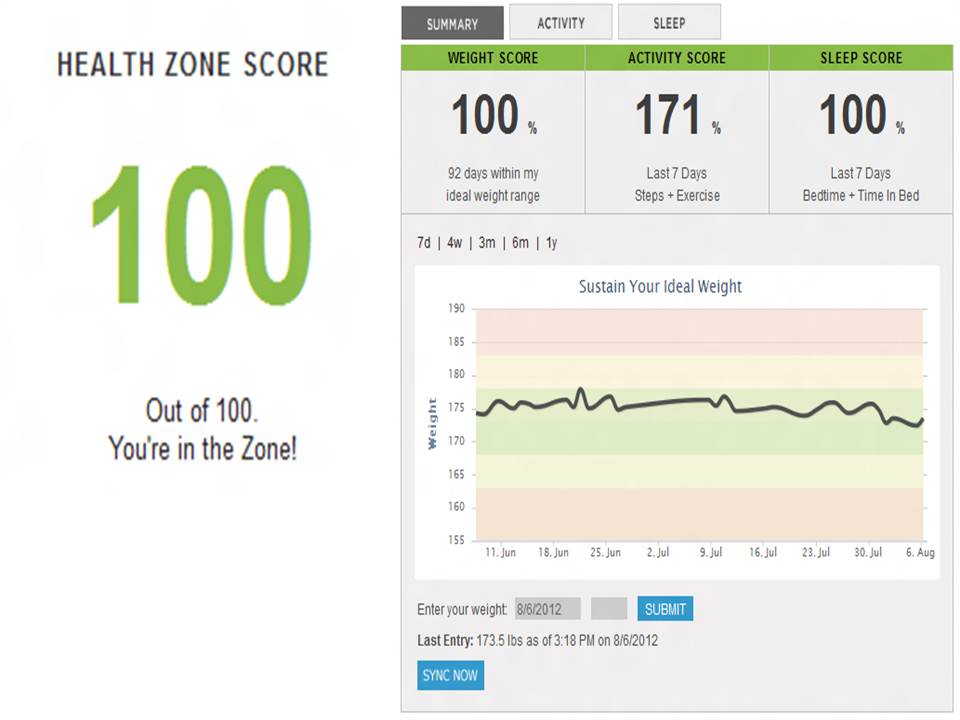
Dan’s Plan integrates to Quantified Self tools like Withings and Fitbit, so it knows your weight, activity, and sleep. Its “scores” provide feedback on how you are doing at the three major areas of ancestral living.
Opportunity: Clinically Guided and Communal Experimentation
What intrigues me about these technologies is the opportunities they open up for improving our knowledge of what works for whom.
Chris Kresser was on the panel to provide a clinical perspective, and he emphasized the value of being able to track patients’ progress by calling up real-time charts. Suppose, for instance, that Dan’s Plan tracks members’ weight, activity, sleep, and other biomarkers, and that Dan’s Plan members can share data with their clinicians. Chris could put his patients on Dan’s Plan and be able to see how they’re doing at all times, and get an idea whether their latest program is working for them.
If users make (anonymized) data available for communal analysis, we could use software like Dan’s Plan to track results on each module. Suppose, for instance, users recorded medical diagnoses and goals: “I’m obese and my goal is to lose weight,” “I’m diabetic and my goal is to control blood sugar.” They could also record which content modules for diet, fitness, and sleep they were following. Then the system could track results to see what outcomes were on each program.
Suppose, for instance, that there were Perfect Health Diet and Rosedale Diet modules on Dan’s Plan, and the safe starches panel at AHS had been able to draw upon actual outcomes data for parameters like weight, blood sugar, and blood lipids. Because the data would be gathered automatically by Quantified Self tools, it would be unbiased and include negative as well as positive outcomes. This certainly would have given us something interesting to discuss.
For clinicians and those looking to improve their health, statistics on outcomes would be enlightening. I find it remarkable that we spend 16% of GDP on health care, yet we have very little data on what works. In comparison, chess is less than 0.001% of GDP, yet we have excellent data on chess outcomes. From the online chess openings explorer at 365chess.com, here is the data on outcomes for alternative moves three moves into the Sicilian Defense:
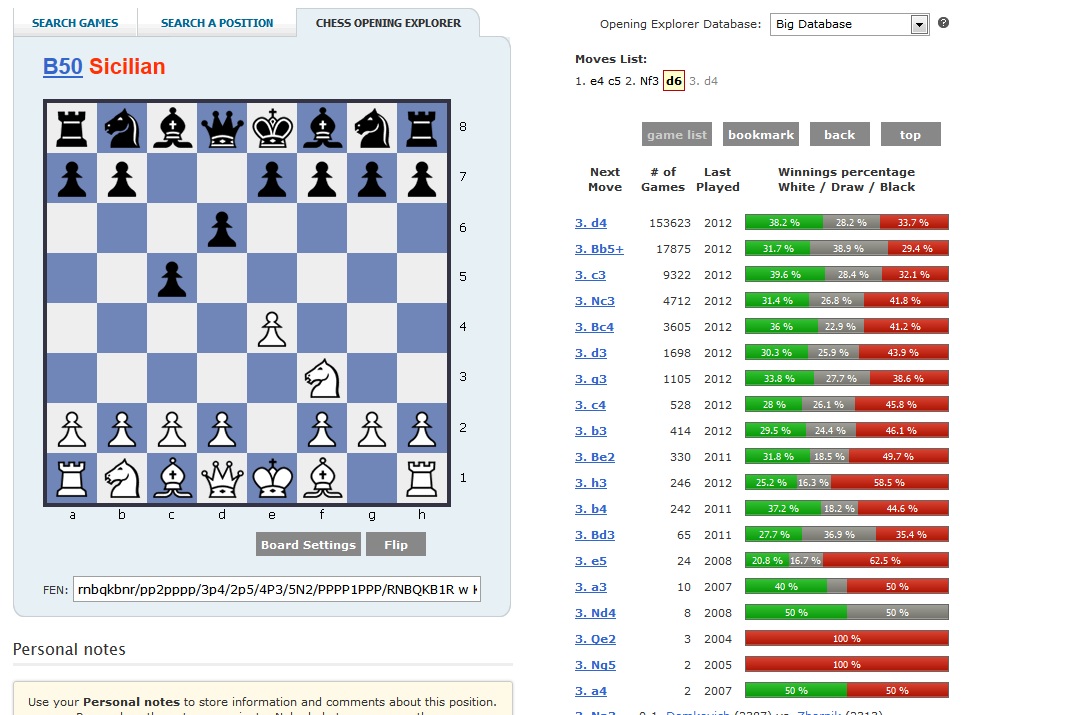
Imagine if a clinician had similar outcomes data for obesity, diabetes, hypothyroidism, whatever: “If you prescribe this treatment, the patient will improve x% of the time, remain unchanged y% of the time, and get worse z% of the time.” It would revolutionize health care.
The data that would make such a healthcare database possible has been hard to collect. But with QS tools and systems like Dan’s Plan, it becomes much easier. Look at how an outcomes database would support routine clinical practice. When considering a prescription such as, “Follow the Perfect Health Diet module on Dan’s Plan,” both patient and clinician could immediately see what the odds of success are.
Enabling Better Analysis
Ned Kock of the Health Correlator blog was also on our panel, and he discussed the benefits of being able to perform nonlinear analysis on health data. Most health outcomes show a U-shaped profile, but most analysis in biomedical journals assumes a linear dependence of outcomes on dependent variables. Fitting a line to a U may give very misleading results!
The downside of using nonlinear analytical methods is that more data is required to constrain them. One of the great benefits of QS tools and online systems which aggregate data, such as Dan’s Plan, is that sufficient data to support more accurate analytical methods may become available.
Bringing Ancestral Health into the Mainstream
Most of us in this movement have confidence that ancestral diets and ancestral lifeways can tremendously improve health. Yet how do we prove that to skeptics?
The ancestral health movement is now in a position often experienced by entrepreneurial companies. A standard model of entrepreneurship states that innovators find their first audience among enthusiasts and visionaries inspired by where the company plans to go. They see the vision, and want to help bring it to fruition.
But at some point, a company can no longer rely on the support of visionaries. It has to be able to persuade skeptics that it has actually delivered the vision. This transition, from relying upon sympathetic visionaries to persuading skeptical pragmatists with convincing evidence, was dubbed “crossing the chasm” by Geoffrey Moore:
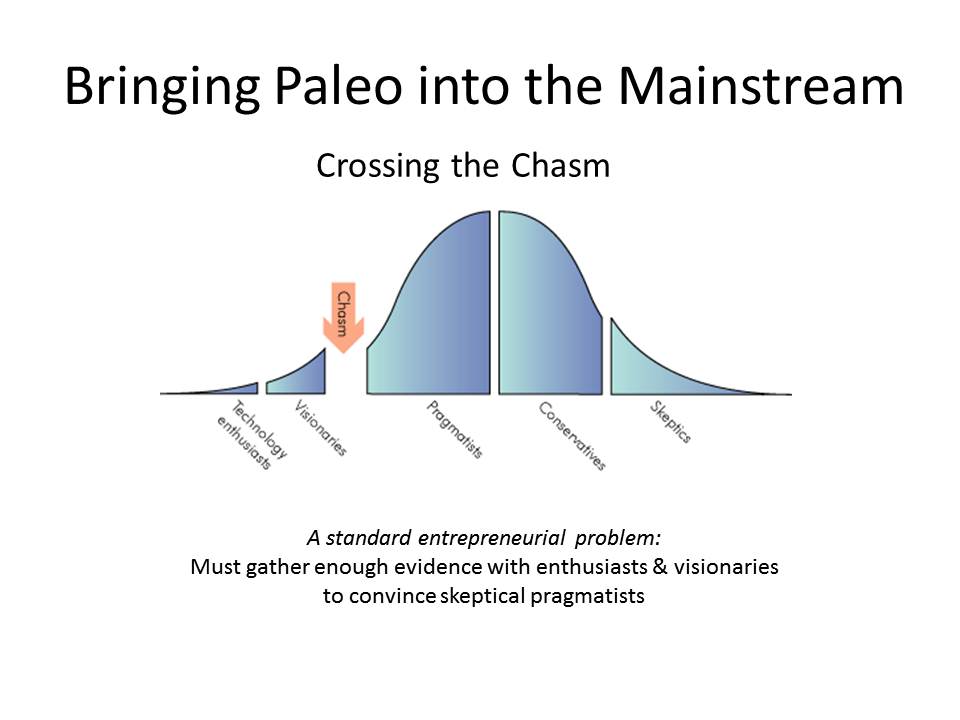
Ancestral health is like that. It has been embraced by enthusiasts and visionaries who believe in the ancestral health story. We see their enthusiasm in blog comments and at events like the Ancestral Health Symposium, which relies so heavily on the dedicated work of volunteers.
But ancestral health has not yet won over skeptical pragmatists – people who want proof before they’ll buy.
Reader success stories on blogs do not convince skeptics. Every diet, including extreme vegan and macrobiotic diets, has success stories. Skeptics want to see unbiased data, including negative as well as positive outcomes.
This is what I think the new technologies give us the opportunity to do. Here is what I see as the formula for bringing ancestral health into the mainstream:
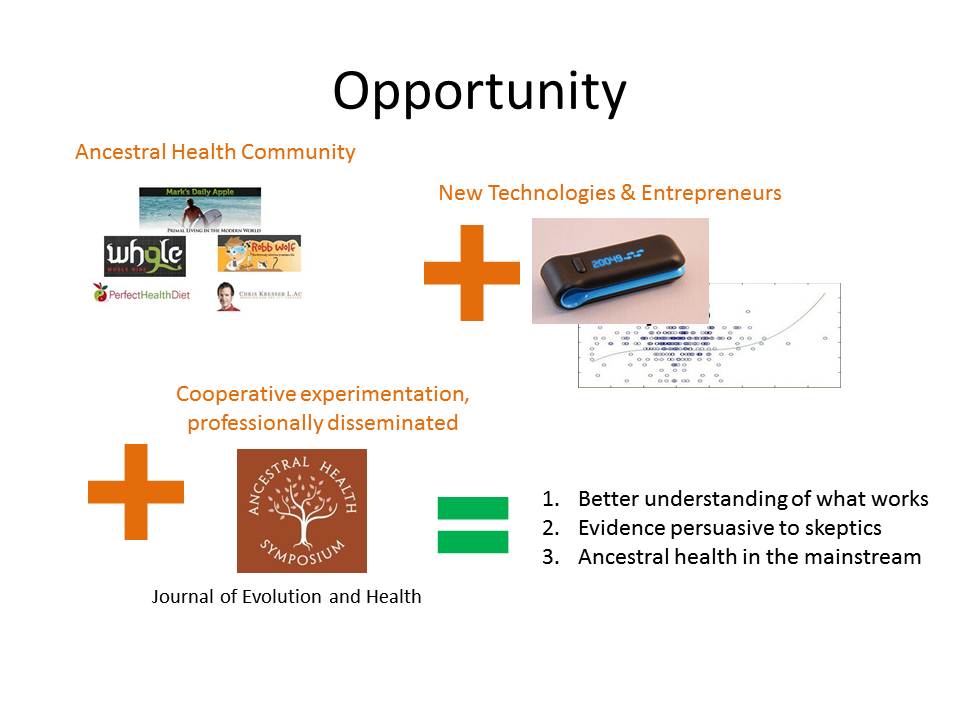
We have a large community – over a million unique monthly visitors to leading blogs. We have new technologies and innovative startups making possible the gathering of unbiased data. We are building institutions, like the Ancestral Health Symposium and the Ancestral Health Society’s planned journal, the Journal of Evolution and Health, that can disseminate evidence and arguments supportive of ancestral living.
We can leverage these assets into improved knowledge of what works. We can generate evidence persuasive to skeptics. And it is by this path, I believe, that ancestral health will enter the mainstream and prove itself the best way to heal disease and optimize health.
We’re in a very exciting time. Ancestral health is on the verge of crossing the chasm. When it does, the enthusiasts and visionaries who made it happen will have much to be proud of. Thank you for being part of the ancestral health movement!
 . Check out the picture of the cover!



 via this link:

Recent Comments