



Sarah Atshan’s Lovely Food

On Facebook, Sarah Atshan has put up photos of meals that helped her lose 120 lbs.

Her food is Perfect Health Diet compatible and awesomely healthy!

I was going to link to her photos yesterday, but Sarah deserves a post to herself. All photos are © Sarah Atshan 2011.

Keftah (middle Eastern meatballs) with raw onion in hummus and veggies.

Beef and broccoli over rice, with some kimchi.

“So simple yet so yummy”: Hainanese chicken rice. Poached stewing hen from Polyface farm (stuffed and cooked with aromatics), plus rice cooked in chicken fat and chicken broth from the poaching, plus caramelized onion and chicken skin. Mix and serve with a chili, garlic, ginger, and lime sauce.

Korean bibimbap is a great way to dispose of leftovers. This began with leftover vegetables: Daikon radish, broccoli, carrot, button mushrooms, shiitake mushrooms, green onion, and cilantro. Standard ingredients: onion, garlic, ginger, and Serrano peppers added to beef, rice, and a raw egg yolk.

Korean seafood stew: Fish and shrimp cooked in homemade seafood broth, with rice, green onion, garlic, jalapeno, cilantro, onion, carrot, bok choy, shiitake mushroom, ginger and Chinese broccoli (gai lan).

Korean style Shepherd’s Pie:

Mash made with Japanese sweet potatoes, Yukon gold potatoes, and egg yolks.

Mince made with grass fed beef, mushrooms, onions, garlic, ginger, kimchi, and Korean seasonings.

Vegetables: wilted pea shoot, carrot, and daikon radish salad.

“Mex-a-bap”: Korean bibimbap with Mexican ingredients. Grassfed Mexican seasoned beef with onions and mushrooms, rice, garlicky guacamole, and green mango salsa (tomato was not in season yet).

Steamed shellfish with grass fed butter, lemon, crystal hot sauce, old bay seasoning, homemade cocktail sauce (tomato paste, fish sauce, and horseradish), served with oven roasted potatoes.

Middle Eastern cabbage stuffed with grass fed beef and beef heart, garlic, green pepper, onion, rice, and spices. Cooked in chicken stock.

Salad: tomato, bell pepper, and dandelion greens with lemon juice.

Yogurt sauce: raw milk yogurt, hot pepper, lemon and garlic.

Beef with lots of garlic, onion, Serrano pepper, mushrooms, green onion, and Sarah’s special sauce, served with carrot and kale, and rice cooked in homemade chicken stock.

Thai coconut milk soup with fish, veggies, and eggs. Serve with rice.

Thai green coconut milk curry with beef. Potato, kale, yellow squash, carrot, green onion, basil, Thai basil, cilantro, and garlic scapes; grass-fed beef, and homemade stock.

The green curry paste was home made: jalapeno, poblano chili, Serrano chili, New Mexico green chili, Thai green chili, lemongrass, galangal, lime leaves, cilantro root, basil, red onion, garlic, ginger, fermented shrimp paste, white pepper, coriander, cardamom, and cumin.

Thai green papaya salad.

Salmon cakes made with basil, mint, carrot, cucumber, onion, lime, garlic, lettuce, ginger, jalapeno, pepper, and tomato. Salad is dressed in a homemade spicy coconut lime dressing and topped with nuts.

Beef pho with beef tendon and rice noodles, garnished after cooking with Thai basil, carrots, cilantro, Thai chilies, lime, daikon radish, and vinegar-ed onions.


Vietnamese garlic and ginger beef stew with beef tendon, daikon radish and carrot salad, rice, and homemade turnip kimchi, topped with raw yolk. Mix and eat.

Vietnamese steak salad made with grass fed sirloin, baby chard, romaine lettuce, carrots, daikon radish, vinegared red onions, cilantro, and pickled jalapenos. With coconut milk rice and a hard-boiled duck egg.

Conclusion

Sarah’s food is super-healthy, super-appetizing – and perfect for those who want to lose weight.

Sarah, it’s great being Facebook friends and all, but how do we wrangle an invitation to dinner?

Around the Web; 9/11 Remembrance and Brain Injury Recovery Edition

As we approach the 10th anniversary of the September 11 terrorist attacks, it may be worth remembering that of the 2,998 killed in New York City, 403 were first responders, including 343 firefighters and 60 police. One was a priest. It is in the nature of life that those who risk themselves for others, who give and love the most, often suffer the most. Let us honor their generosity and their spirit.

[1] Interesting posts this week: Mark Sisson has an interesting discussion of GERD / acid reflux. We’ll have a few posts coming up on acid reflux as well – at least one by me, and several by a guest blogger who some of you know as “Valtsu.”

Alcohol was part of the Paleolithic diet: Drunk Swedish elk found in apple tree near Gothenburg.

Apropos recent discussions of the influence of food reward on addictive eating, Paul Whiteley points to research suggesting that drugs of abuse exploit the same pathways as our natural hunger for salt.

Newell Wright explains why Gary Taubes has much to be proud of.

Beth Mazur explains why she eats moderate carbs for weight loss; and proclaims herself 95% compliant with the Perfect Health Diet.

Beth’s not the only one: Chowstalker is evolving toward the PHD. Patty writes, “since loosening up a bit with the “safe starches”, my energy level has been higher and my weight is inching down a bit.”

I liked Cate Shanahan’s Deep Nutrition a lot, but its argument that pre-natal maternal nutrition has a big impact on children’s looks is controversial. For some, Deep Nutrition is a horror book:

ok, so deep nut is now giving me nightmares. i woke up from one this morning in which my second born was super ugly and i was ashamed to take him in public. every time i did, all these ugly grown ups with patchy hair and skin infections and missing limbs would coo over him in grguly voices and tell me that he reminded them of themselves when they were babies.

Melissa McEwen observes that Paleolithic moms were often well nourished, and yet “Paleolithic people have traits … many of us no longer consider beautiful … such as brow ridges.” Hey – are you calling my Neanderthal ancestors ugly?

Elsewhere, Melissa reports that postpartum depression was “quite rare” in traditional societies. Alas, depression is quite common in New York City, and Melissa is leaving. She has our best wishes; may this move be a step forward, in all respects.

Bix at Fanatic Cook explains why ibuprofen can cause osteoporosis.

John Durant says that bears can teach us which foods are healthy: they eat the fat and abandon the nitrogen rich testicles. Bad news for Aaron Blaisdell?

I didn’t listen to all of Richard Nikoley’s b____t videos, but according to the transcript, he predicted that dogs fed a vegan diet would eat their owner. Life mimics art.

When I saw Emily Deans writing about “the MTHFR enzyme,” I wondered if she had freed her animal. But no, it turns out she’s only explaining how homocysteine promotes anger. Earlier, Emily averred – rightly – that “all that is psychologic is biologic,” and explored links between depression and serum cholesterol.

Lucas Tafur notes that a fruitarian was able to develop extreme nutrient deficiencies after only a 1 week fast.

Barry Sears calls meditation “push-ups for the brain.”

A possible key to fat loss: Be in a socially engaging environment. If you can’t manage that, include running wheels in your cage.

Cracked.com has a cartoon showing “How Stress is Killing You.”

Finally, be sure to correct your chocolate deficiency: “The highest levels of chocolate consumption were associated with a 37% reduction in cardiovascular disease and a 29% reduction in stroke.”

[2] Music to read by: The Copenhagen Philharmonic flash mobs Copenhagen Central Station to play Ravel’s Bolero.

[3] Cute animal photo:

[4] The vagaries of academic research: Most people think medical research should focus on understanding disease causes and finding cures. However, this is slow and difficult – an inefficient way to obtain money or advance a scientific career. Actual research often proceeds along different lines.

It is easier to induce pathologies than to cure them, so an effective strategy for developing a “therapy” that provides symptomatic relief is to induce a new pathology whose symptoms are the opposite of the symptoms of the old pathology. The new-pathology symptoms are dubbed “side effects,” which are an accepted feature of modern medicine. Xkcd mocks this kind of approach:

Other times, research proceeds busily in a hopeless direction. For instance, genes are densely networked, and so no one gene has a big effect; observed effects may be mostly noise. Seth Roberts argues that reported gene-environment interactions may all be invalid.

Even when research is potentially productive, there is a temptation to do shoddy work – to publish an interesting result, without double-checking or triple-checking it to see if it will disappear; or even to do careless work, so that interesting results will be more likely to appear by chance. Researchers who work this way often produce unreproducible data. Via Marginal Revolution, solid evidence that over half of biomedical research studies are irreproducible:

Bayer halts nearly two-thirds of its target-validation projects because in-house experimental findings fail to match up with published literature claims, finds a first-of-a-kind analysis on data irreproducibility.

An unspoken industry rule alleges that at least 50% of published studies from academic laboratories cannot be repeated in an industrial setting, wrote venture capitalist Bruce Booth in a recent blog post. A first-of-a-kind analysis of Bayer’s internal efforts to validate ‘new drug target’ claims now not only supports this view but suggests that 50% may be an underestimate; the company’s in-house experimental data do not match literature claims in 65% of target-validation projects, leading to project discontinuation.

[5] I demand clinical trials!: Dr. Kurt Harris says there are “cases where even Paul Jaminet could customize your diet down to the molecule and you would still get fat”.  Maybe so, but I suspect a well-fed human body is very resilient.

[6] Taubes v Guyenet … Kozinski v Chin?: Two prominent federal judges have taken opposing stands on how to lose weight. Alex Kozinski, Chief Justice of the Ninth Circuit Court of Appeals, advises: “Few carbs, less sugar.” Second Circuit Court of Appeals Judge Denny Chin once advised “Run more, eat less.”

Judging by their pictures, Kozinski is the better judge – of weight loss methods!

[7] Good cause of the week: Deacon Patrick of Mind Your Head Co-op is recovering from brain injury, and has been having good results on our version of the ketogenic diet:

The results are amazing. The more ketogenic my diet, the better my brain capacity, cognitive energy, energy stability, longevity, and the better I feel.

In an email to me he wrote with an expression of thanks and a request for help:

Thank you for the gift of better brain function you have given me! A few months ago I switched to ketogenic diet, and now a completely Paleo diet based in large part on your Perfect Health Diet — the differences I’ve experienced are amazing.

I am currently section running the Colorado Trail to raise awareness for brain injury (which I have) and to help spread the word of the iPad/iPhone donation program of Mind Your Head Co-op which I founded and run — which donates used iPads and iPhones to soldiers and civilians with brain injury.

Would you please help spread the word about the iPad/iPhone donation as well as my run? Here are a few links:

iPad/iPhone donation.

My most recent adventure.

All Colorado Trail Posts.

The Press Release and Pack.

With Abandon,

Patrick

Please consider donating your used iPad or iPhone to Patrick’s effort to help the brain injured. If you don’t have a used iPad or iPhone, donations of money would also be appreciated.

[8] Not the weekly video: Todd Hargrove introduces us to a film introducing the Feldenkrais method from practitioner Irene Gutteridge. Meet Baby Liv, Feldenkrais instructor:

[9] Shou-Ching’s Photo-Art:

[10] Weekly video:  Via Joshua Newman comes a great story about a brain-damaged man who hoped to be a mechanic, but settled for becoming a writer. His cherished hope is to see his stories made into movies. He succeeded in persuading one enterprising film maker to do a short film – about him. Enjoy:

Jeffery and the Dinosaurs from Yasmeen Ismail on Vimeo.

Odds and Ends: Q&A Page, Food Plate, Etc.

I am having to devote some time to other work so I will skip the usual science blogging this week in favor of a few administrative matters.

[1] Q&A Page: I’ve put up a page where readers can leave personal health questions. I will try to answer questions on this page, even though the answer will often have to be, “I don’t know.”

There are several advantages to collecting questions and answers on a single page:

  • It makes it easier for readers to find questions that may be similar to their own, and to search past answers.
  • It makes it easier for knowledgeable readers to contribute and improve upon my answers. We have doctors, scientists, and experienced patients among our readership, and their collective wisdom far exceeds my own.
  • It establishes a permanent record of information, so that knowledge we generate in this community is not lost or forgotten.

With the creation of this page, I will no longer answer emails with personal health questions. I think it is more valuable to ask and answer questions publicly.

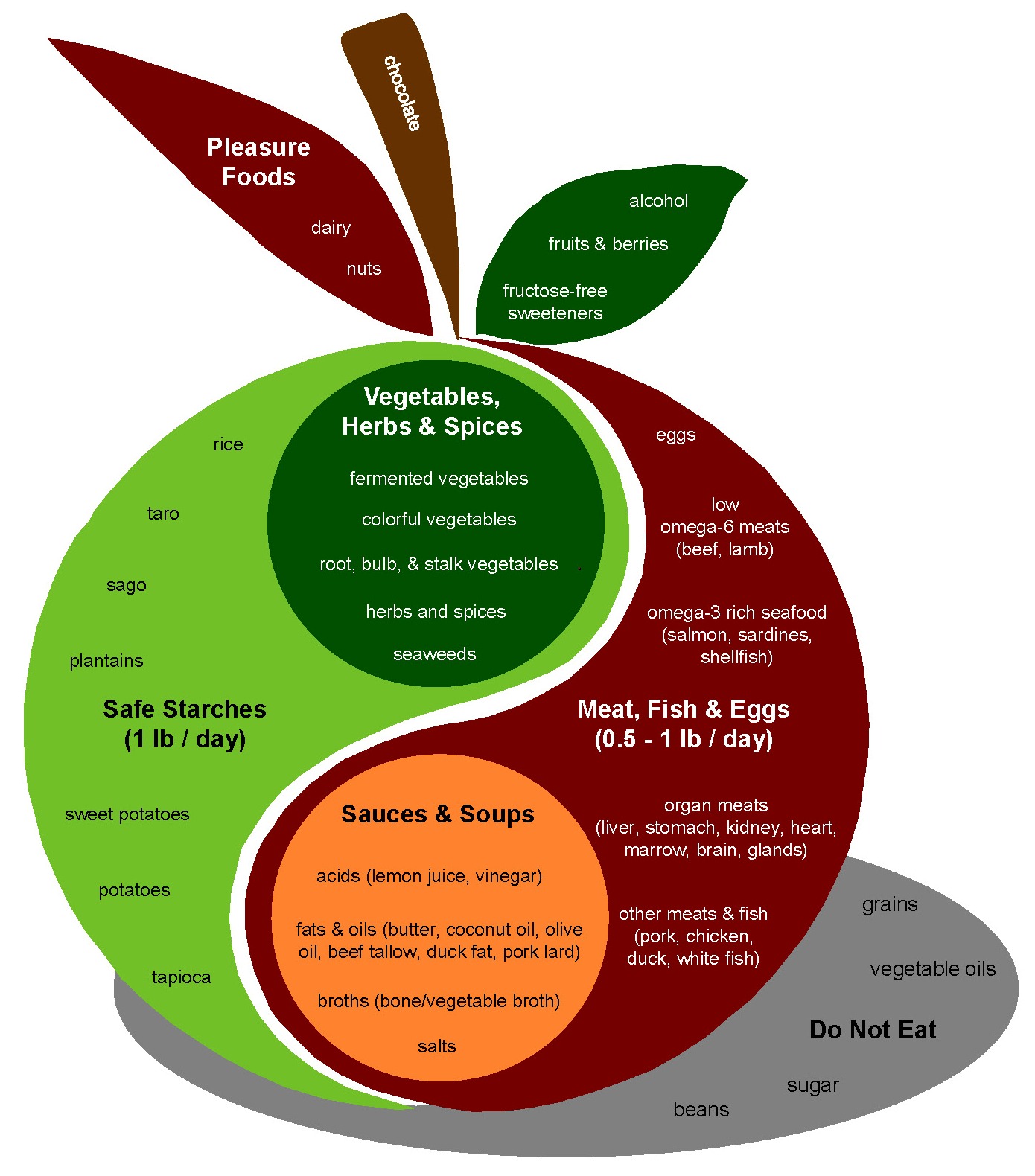
[2] Second Draft of the PHD Food Plate: On the “The Diet” page, you can see our new draft of the Perfect Health Diet food plate. We are grateful to all readers who gave us so many excellent comments on the first draft. The current version is much improved, thanks to all of you.

[3] Allan Balliett has Grass-Fed Beef: PHD reader and commenter Allan Balliett is a farmer and producer of grass-finished beef in Shepardstown, West Virginia. He distributes his beef in the Washington DC area, and would like to reach out to PHD readers. (In fact, he is delivering beef in the DC area this Saturday, and has 80 pounds still available.) If you’re in DC and would like to buy some locally produced grass-finished beef, consider giving Allan a try.

[4] Our Talk in York, Maine: Shou-Ching and I will speak to the Locavore Dinner, hosted by Denny and Aimee Perrin at the Wrap-Around Cottage, 254 Cider Hill Road, York, Maine, on Saturday September 17. Contact information may be found here. A pot-luck dinner starts at 5 pm; bring “a dish to share consisting of locally-sourced ingredients of animal and/or vegetable origins.” After dinner, I’ll give a talk describing our diet and the logic behind it.

Hamburgers

Our round-up of classic American foods continues with a Labor Day classic: the hamburger.

Although it’s possible to buy Perfect Health Diet compatible buns, we’ve gotten out of the habit of eating hamburgers on the bun. Often, we eat dinners buffet style, in which everyone assembles a plate from a choice of ingredients. Hamburgers are a great buffet option.

The classic low-carb Paleo hamburger uses lettuce in place of the bun. This style seems to be making inroads. When we were in California for the Ancestral Health Symposium, we found that the fast food chains there will serve burgers wrapped in lettuce if you ask for it (this is “protein” style at In’n’Out Burger).

Ingredients

Essential patty ingredients include ground beef (1 lb), egg (1, not shown), onion (1 medium), potato starch (1/4 cup, not shown), salt and pepper; we also included shrimp (1 cup), shiitake mushrooms (1 cup), and herbs to taste. A sampling of ingredients:

We made about 8 patties of this size:

Cooking

We fried them in beef tallow, about 3 minutes per side:

Serving

We ate them two ways. First, like meatloaf:

Second, wrapped in lettuce with onion, tomato, egg, cheese, and cucumber or pickle:

We like putting potato starch in the patty because it helps retain moisture in the patties, so they don’t shrink much during cooking. They tasted great, especially with mustard.